
Best Safety Training Companies in Midland (2026)
Midland sits at the center of the Permian Basin, the most active and the most dangerous oil and gas region in the United States. The employers here are operators, drilling and completion contractors, midstream companies, and the service firms that support them, and the work is defined by hazards that kill: hydrogen sulfide, confined space entry, hot work, and heavy equipment. This guide compares the safety training companies that actually serve Midland and Odessa, what each is best for, and where immersive practice fits for the procedures where getting it wrong is fatal.
QUICK ANSWER
The best safety training companies serving Midland and the Permian Basin in 2026 include WellerPeak, Safety 365, Broadway Oilfield Training, LoneStar Safety, FORE Safety, OccuPros and the National Safety Council. Between them they deliver SafeLand, PEC, H2S Clear, IADC RigPass and BasinUnited, OSHA, forklift and fall protection, on-site and in Spanish. For Midland operators whose crews must actually perform H2S response, confined space entry and hot work under real conditions, not just pass an orientation, immersive VR safety training from The Prime VR is the emerging complement that turns knowledge into measured, hands-on practice.
Why Midland is the hardest safety market in the country
Most cities buy safety training to satisfy general OSHA requirements. Midland buys it to keep people alive on leases where a wrong move can be fatal in seconds. The scale of the problem is not an opinion. An analysis of 2025 OSHA data found that the Midland-Odessa area alone accounted for roughly 55 percent of all severe oil and gas injuries reported in Texas and about 43 percent of all severe oil and gas injuries reported nationwide in the first quarter of 2025. One metro, nearly half of the nation's severe oilfield injuries. That is the environment every Permian safety leader is training for.
The provider landscape reflects that reality. Alongside the national brands, Midland and Odessa support a deep bench of oilfield-specific trainers who teach the orientations operators actually require, run daily classes to keep contractors mobilized, and deliver in Spanish because a large share of the workforce speaks it as a first language. The differentiator between them is not whether they can issue a SafeLand card. It is whether the training actually prepares a worker to survive the moment a monitor alarms.
The providers, and what each is best for
WellerPeak
Best for: Permian safety training and equipment
A Midland and Odessa provider delivering professional safety training across oil and gas, construction, and agriculture, and pairing it with safety equipment supply, a practical fit for operators that want training and gear from one local partner.
Safety 365
Best for: SafeLand, PEC, H2S Clear and OSHA
An Odessa provider offering the full SafeLand and PEC catalog, the four-hour H2S Clear course, IADC BasinUnited orientation, and general OSHA compliance training, covering nearly every card a Permian contractor needs to work a lease.
Broadway Oilfield Training
Best for: IADC RigPass and bilingual orientations
A Midland provider running IADC RigPass in classroom and online, plus daily PEC SafeLand and CLEAR classes, and offering training in Spanish for a workforce where that matters for comprehension and documentation.
LoneStar Safety
Best for: H2S certification and compliance
A Midland provider known for comprehensive H2S certification, a top choice for Permian Basin businesses that need dependable compliance training on the single hazard most likely to kill.
FORE Safety
Best for: OSHA, safety meetings and CPR
An Odessa and Midland provider offering OSHA courses, recurring monthly safety meetings, and CPR, useful for operators that want an ongoing training cadence rather than one-off classes.
OccuPros
Best for: On-site OSHA, forklift and fall protection
Delivers OSHA, forklift, CPR, and fall protection training on-site at your Midland-Odessa location, convenient for crews that cannot leave the yard or the lease during a run.
National Safety Council
Best for: Nationally recognized workplace safety
A leading safety nonprofit offering widely recognized workplace safety, first aid, and defensive-driving training, a fit for Permian employers that want a national brand for their general-industry programs.
What Permian operators actually require
Access to a Permian lease is gated by training. Most operators require a site-specific orientation plus an industry-recognized baseline before a contractor can work. The common credentials are SafeLand Basic, the most recognized safety orientation for the U.S. onshore exploration and production industry, the PEC orientation family including CLEAR, IADC RigPass for rig crews, and IADC BasinUnited. These are not OSHA cards, they are industry programs that operators adopt to standardize who they let on location.
On top of the orientations sits the OSHA-based stack that governs the actual work: confined space entry and rescue under 29 CFR 1910.146, respiratory protection under 29 CFR 1910.134, hot work permitting, fall protection, and HAZWOPER where hazardous substances are involved. H2S is regulated through OSHA's general duty clause and its permissible exposure limits for air contaminants, and in practice operators require H2S awareness or the four-hour H2S Clear course across sour-gas country. Because each operator sets its own access rules, Permian contractors routinely carry a stack of current cards from several providers at once.
H2S: the hazard that defines the Basin
Hydrogen sulfide is the reason safety training in the Permian is a category of its own. Sour gas is colorless, heavier than air so it pools in low spots like sumps and cellars, and at high concentrations it kills within a breath or two. Worse, it deadens the sense of smell almost immediately, so a worker cannot rely on odor to warn them. According to OSHA there were about 60 hydrogen sulfide fatalities in the U.S. oil and gas industry between 2012 and 2022, and the Permian has seen repeated events, including four sour-gas fatalities near Odessa in 2019 that took an oilfield worker and his wife, and a worker killed near Orla in 2022 after inhaling H2S near a sump pit.
Training for H2S is not about memorizing a threshold. It is about whether a worker will read the monitor, hold their breath, move upwind and uphill, and account for their crew in the seconds that matter, without freezing. That reflex is built through practice, and practice is exactly what a four-hour classroom orientation, however necessary, cannot fully provide.
The stakes: why completion is not competency
The Permian has also seen criminal accountability for safety failures. In 2025 a Texas oilfield company and an executive pleaded guilty in connection with hydrogen sulfide deaths, a reminder that the consequences of inadequate training now extend beyond OSHA penalties to personal liability. For a safety leader, the lesson is blunt: a worker can hold a valid SafeLand card and a current H2S orientation and still be unprepared to act correctly when a real release happens on a real location at night in the wind.
Classroom training and online modules transfer knowledge. They do not, on their own, build the reflexes a worker needs to don an escape respirator under stress, run a confined space rescue without becoming a second casualty, or evacuate a crew in the right direction. Practice does that, and practice is the layer most compliance training leaves out.
SPECIAL MENTION: IMMERSIVE TECHNOLOGY
The Prime VR, for VR oilfield safety training in Midland
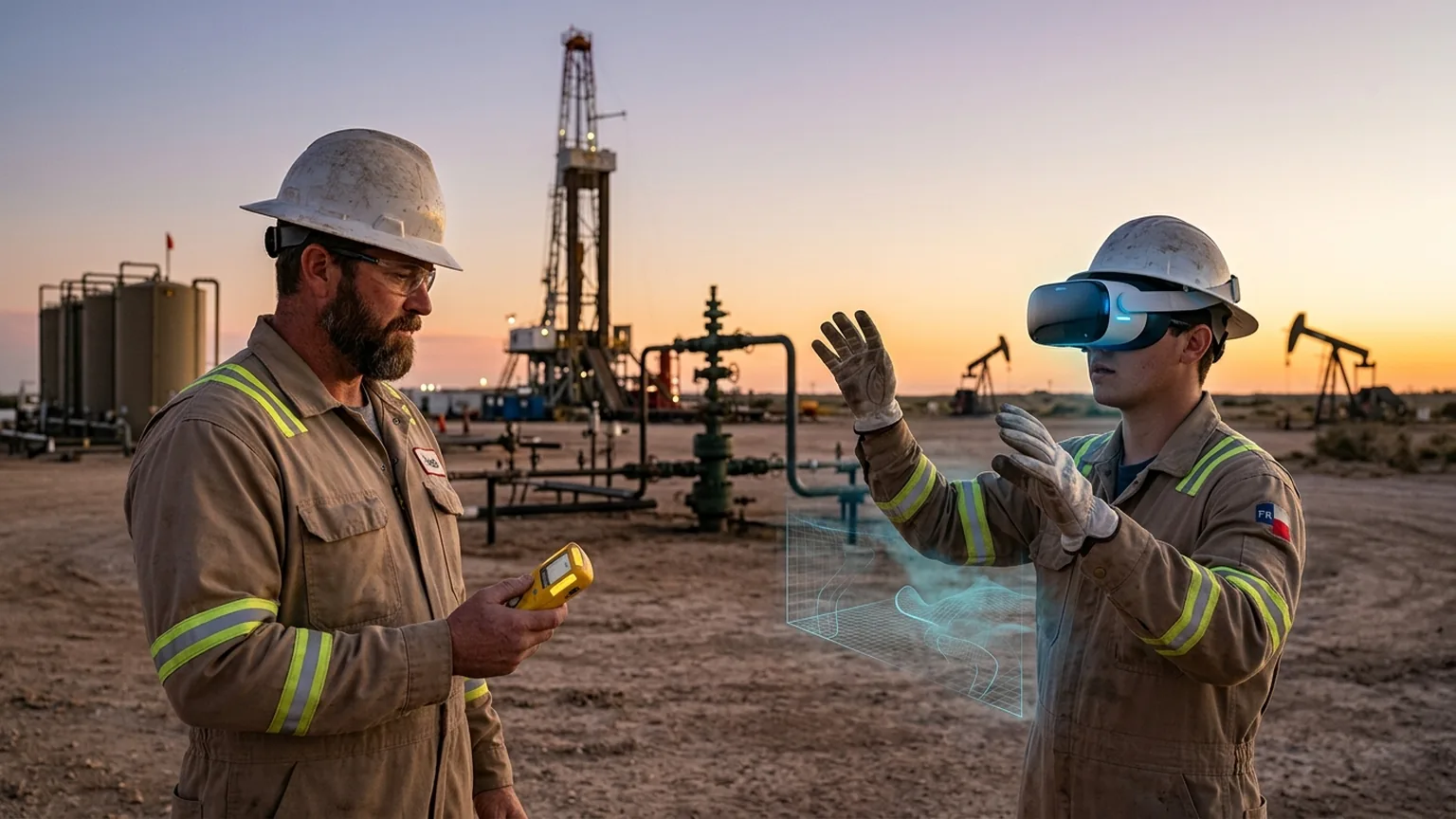
The companies above deliver the orientations, certifications, and compliance tracking every Permian operator needs. The Prime VR represents the layer most of that training is missing: custom virtual reality programs where Midland crews practice H2S detection and response, confined space entry, hot work permitting, and emergency evacuation in realistic simulations of your actual lease or facility, with performance measured step by step.
The value is not novelty. A worker can rehearse an H2S evacuation dozens of times in VR with zero real-world risk, make mistakes safely, and build the muscle memory that transfers to the location. Every decision, hesitation, and error is recorded, so a safety manager can see who is genuinely ready and who needs another rep before they are near sour gas. Because the program is built around your specific hazards and owned outright, there are no per-seat fees, and it can be reused for every new hire and every contractor cycle.
Learn more about VR safety and operations training, how it applies to oil and gas safety, or the specifics of confined space VR training.
The bilingual reality of the Permian workforce
A large share of the Permian workforce speaks Spanish as a first language, and safety training that is only delivered in English carries a hidden risk. A worker can pass a written orientation in a second language and still miss a nuance that matters when a monitor alarms. That is why providers such as Broadway Oilfield Training deliver courses in Spanish, and why serious operators insist on it. Bilingual delivery is a comprehension issue and a documentation issue at once: if an incident is investigated, the employer wants a clear record that the worker was trained in a language they fully understood. Any modern approach, including a custom immersive program, should be authorable in both languages so the experience and the assessment are equivalent for every worker on the crew.
How to choose a Midland safety training partner
Start with the leases you actually work, because the operator requirements on those leases dictate the orientations you need. Confirm the provider is current for SafeLand, PEC, RigPass, or BasinUnited as required, and that they can run daily or on-site classes so a crew is not stranded off the clock waiting to certify. If your workforce is largely Spanish-speaking, confirm bilingual delivery and bilingual documentation. And if your problem is that people complete the orientation but near-misses keep happening, that is the signal you need practice, not another card.
Most Permian operators end up with a blend: local oilfield trainers for the required orientations and refreshers, plus an immersive layer for the handful of high-consequence procedures, above all H2S response, where getting it wrong is not survivable. The orientations keep you compliant and get your people on location. The practice keeps them alive and gives you an objective record to show during an operator prequalification or an incident review.
What a VR pilot looks like for a Permian operator
A custom immersive program does not start with a headset, it starts with your hazards. A typical build runs in four phases. Discovery maps the specific procedures you want workers to practice, drawing on your operator requirements, incident history, and the people who run the location. Design turns those into interactive scenarios with defined success criteria, so the simulation measures the right decisions rather than just presence. Build develops and tests the environment against your real location, whether that is an H2S evacuation from a specific pad, a confined space entry into a tank, or a hot work permit sequence. Deploy handles hardware, integration with your learning management system, and train-the-trainer so your team can run it without depending on an outside vendor.
For a Permian operator, a sensible starting point is a single high-consequence procedure, almost always H2S response, delivered as a pilot before expanding. That keeps the initial investment contained while proving whether measured, repeatable practice moves your leading indicators, from near-miss reports to time-to-competency for new hires. Because the finished program is owned rather than licensed per seat, the economics improve every time you onboard another crew or cycle another contractor group through it.
Beyond H2S: the other Permian killers
Hydrogen sulfide gets the headlines, but it is not the only thing killing Permian workers. Transportation is consistently among the leading causes of oilfield fatalities in the Midland-Odessa region, driven by long distances between locations, heavy truck traffic on rural two-lane roads, and fatigue from long shifts. Struck-by and caught-in incidents around rig floors, tubulars, and rotating equipment add to the toll, and the West Texas heat brings its own risk of heat illness during summer operations. A serious safety program in the Basin therefore reaches past H2S into defensive driving and fatigue management, dropped-object and struck-by awareness, and heat illness prevention.
This is where the choice of training approach matters. Classroom coverage of these hazards is necessary but abstract. A driver cannot rehearse a fatigued night drive in a conference room, and a floorhand cannot practice reacting to a dropped tubular from a slide deck. Immersive simulation can put a worker into those exact moments, safely and repeatably, and measure whether they make the right call. For a Permian operator trying to move leading indicators across the full range of hazards, not just the one that makes the news, that practice layer is what turns a compliant workforce into a genuinely prepared one.
Frequently Asked Questions
Who are the best safety training companies in Midland and the Permian Basin?+
The leading providers serving Midland and Odessa include WellerPeak, Safety 365, Broadway Oilfield Training, LoneStar Safety, FORE Safety, OccuPros and the National Safety Council. Between them they cover SafeLand Basic, PEC orientations, H2S Clear, IADC RigPass and BasinUnited, OSHA 10 and 30, forklift, fall protection and CPR, on-site and in Spanish. The right choice depends on the operator requirements on the leases you work. For crews that must actually perform high-risk procedures such as H2S response and confined space entry under real conditions, immersive VR safety training from The Prime VR is an emerging complement.
How much does oilfield safety training cost in Midland?+
Pricing in Midland follows operator-required and national ranges. SafeLand, PEC and H2S orientations run roughly 50 to 200 dollars per seat, IADC RigPass runs a few hundred dollars, and OSHA and HAZWOPER courses run from low hundreds up. On-site group delivery is priced per class. Custom immersive VR safety training, built around your real Permian worksites and hazards such as H2S, hot work and confined space, and owned rather than licensed per seat, typically runs from 25,000 to 500,000 dollars depending on scope.
What safety training do Permian Basin operators require?+
Most Permian operators require a site-specific orientation plus an industry-recognized baseline before a contractor sets foot on a lease. The most common are SafeLand Basic, the PEC orientation family, IADC RigPass for rig crews, and IADC BasinUnited. On top of that, H2S awareness or H2S Clear is effectively mandatory across sour-gas country, along with OSHA-based confined space entry, hot work, fall protection, and respiratory protection. Contractors often carry several current cards at once because each operator sets its own access requirements.
Why is H2S the defining hazard in the Permian Basin?+
Hydrogen sulfide, known as sour gas, is colorless, heavier than air, and deadly at high concentrations, and it deadens the sense of smell so workers cannot rely on odor as a warning. According to OSHA data there were about 60 hydrogen sulfide fatalities in the U.S. oil and gas industry between 2012 and 2022, and the Permian Basin has seen repeated multi-fatality events, including sour-gas deaths near Odessa in 2019 and a worker killed near Orla in 2022. That is why H2S detection, monitor use, and evacuation are not classroom abstractions in Midland, they are survival skills.
How dangerous is the Permian Basin compared to the rest of the country?+
It is the most dangerous oil and gas region in the United States by a wide margin. An analysis of 2025 OSHA data found that the Midland-Odessa area alone accounted for about 55 percent of all severe oil and gas injuries reported in Texas and about 43 percent of all severe oil and gas injuries reported nationwide in the first quarter of 2025. When one metro drives nearly half the nation's severe oilfield injuries, training that only checks a box is not enough.
What is VR safety training and how does it fit Permian Basin operators?+
Immersive VR safety training puts workers in realistic simulations where they practice real procedures such as H2S detection and response, confined space entry, hot work permitting, and emergency evacuation, and the system measures how they perform step by step. It complements a SafeLand, PEC or OSHA course by turning knowledge into repeatable, measured practice, built around your actual Permian lease or facility and owned rather than licensed per seat.
Do Midland providers offer bilingual training?+
Yes. A large share of the Permian workforce is Spanish-speaking, and providers such as Broadway Oilfield Training deliver courses in Spanish. Bilingual delivery matters for genuine comprehension of life-safety procedures and for defensible documentation if an incident is investigated. Any modern training approach for the Permian, including a custom VR program, should be authorable in both languages so the experience and the assessment are equivalent for every worker.
Can VR training prove competency for operator prequalification?+
Yes. A custom VR program records each worker's decisions, response times, and completion, and can pass that data to your learning management system. For Permian contractors going through operator prequalification, that objective per-worker record helps demonstrate that a crew can actually perform an H2S evacuation or a confined space entry, not just that they hold a card, which is increasingly what safety-conscious operators want to see.
Want Permian crews to practice H2S response before it counts?
We build custom VR training around your real lease and hazards. Tell us your setup and we will scope it.