
Oil and Gas Safety Training: VR for High-Risk Scenarios
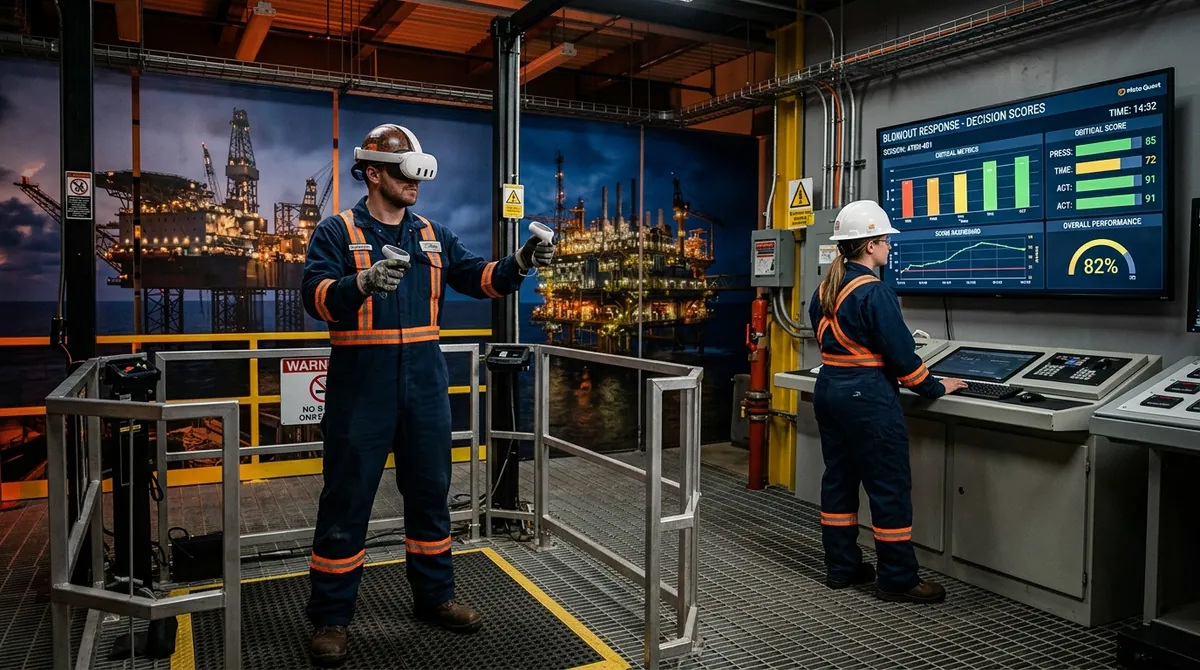
Oil and gas safety training covers scenarios that cannot be staged live: a real blowout, an actual H2S release, or a live confined space emergency. VR simulation builds crew response competency on these high-consequence events without real-world risk.

Hugo Ramirez
Quick Answer
VR oil and gas safety training simulates blowout response, H2S exposure and escape, confined space emergencies, and hot work procedures on virtual replicas of specific site equipment. Scenarios can run individually or as multi-crew drills. Training records export via xAPI to LMS platforms, producing documented competency evidence for OSHA and ISNetworld compliance requirements.
The Core Training Problem in Oil and Gas
Oil and gas safety training has an inherent contradiction: the highest-consequence scenarios are the ones that are most important to practice, and the least safe to practice live. A blowout simulation with real hydrocarbons is not a training tool. An actual H2S release is not a drill.
The result is that most oil and gas safety training relies on classroom instruction, videos, and tabletop exercises. Workers learn what to do. They rarely practice doing it under the sensory pressure of a realistic emergency scenario. VR changes that equation.
$171B
Annual cost of workplace injuries across all U.S. industries (NSC). Energy sector incidents rank among the most costly per event.
4x
Faster completion and higher retention in VR training versus traditional classroom methods (PwC, 2020)
High-Value Scenarios for Oil and Gas VR Training
| Scenario | Training Value | Live Training Feasibility |
|---|---|---|
| Blowout response and well control | Decision sequence under pressure | Not feasible live |
| H2S detection and escape | Recognition, wind direction, evacuation route | Not feasible live |
| Confined space entry and rescue | Permit compliance, atmospheric testing, rescue coordination | Partial only |
| Hot work permit and fire watch | Authorization sequence, hazard identification | Limited, controlled burn only |
| Emergency shutdown procedures | Valve sequence, isolation, muster | Feasible on simulator rigs |
Multi-Crew VR Drills for Coordinated Response
Individual competency is necessary but not sufficient for emergency response. In a blowout scenario, four crew members need to make coordinated decisions simultaneously. Multi-user VR allows an entire crew to occupy the same virtual environment, take their respective roles, and practice the coordination that a single-user scenario cannot test.
Post-drill analytics show each crew member's individual decisions and the cumulative effect on scenario outcome. This makes debrief conversations specific and evidence-based rather than general.
What We See in Energy Sector Programs
- Programs built on equipment-specific 3D models of actual site assets produce faster competency transfer because the virtual environment matches what workers see every day
- Offshore deployments use standalone headsets with offline capability, syncing records to the LMS during crew rotation at port
- ISNetworld and OSHA documentation requirements are met through xAPI records that include per-scenario performance data, not just completion timestamps
- New hire orientation programs that include VR emergency response scenarios before first site assignment show improved hazard recognition in subsequent supervisor observations
Oil and Gas VR Training: Implementation and Procurement Considerations
Building a VR safety training program for oil and gas requires scoping decisions that differ significantly from corporate or retail VR programs. The following factors have the greatest impact on cost, timeline, and program effectiveness.
- Equipment modeling specificity: The most effective oil and gas VR programs are built on 3D models of your actual equipment, not generic industrial assets. Verify whether the vendor will model your specific wellhead configurations, control room layout, and facility geography, or deliver a generic simulation. Specificity is directly correlated with competency transfer speed.
- Offline capability: Offshore platforms and remote sites have limited or no internet connectivity. Confirm the VR platform supports offline operation with local content storage and async LMS syncing. Platforms that require live cloud connection are not viable for these deployment environments.
- Classification and ISNetworld compliance: If contractor safety training is part of the scope, confirm the vendor's experience with ISNetworld documentation requirements. xAPI records must include per-scenario performance data, not just completion timestamps, to satisfy ISNetworld audit standards.
- Multi-user capability: Blowout response and emergency shutdown training requires multi-crew coordination practice, not just individual competency. Confirm whether the platform supports synchronous multi-user scenarios and what the minimum network infrastructure requirement is for offshore deployment.
- Refresh cadence: As regulations update and equipment changes, VR scenarios must be updated to match. Negotiate update terms in the initial contract, including how content changes are scoped, priced, and delivered. Fixed-price build with expensive change orders is the most common budget problem in long-running programs.
KPIs to Track for Oil and Gas VR Safety Programs
The business case for safety VR in energy is strong, but requires consistent measurement to maintain program funding across budget cycles. Track these metrics from program launch.
- Scenario completion rate and repeat attempts: Tracks whether workers are engaging with the content and how many attempts are required to meet the competency threshold. High repeat rates indicate scenarios that need recalibration or workers who need additional support.
- Pre- vs. post-training knowledge assessment delta: Run a 10-question knowledge check before and after VR training for each scenario type. The delta is the baseline evidence that learning occurred, required by most audit frameworks.
- Near-miss incident rate by crew: Compare near-miss rates for crews that have completed VR emergency scenario training versus those who have not. This requires 6 to 12 months of post-deployment data to be statistically meaningful but is the most compelling metric for executive stakeholders.
- Supervisor observation scores: Have site supervisors rate new hire hazard recognition behaviors at 30, 60, and 90 days post-orientation. Compare crews who received VR orientation versus those who did not. Behavioral observation data ties directly to safety culture improvement claims.
Frequently Asked Questions
What oil and gas safety scenarios can be trained in VR? +
VR can simulate blowout response and well control procedures, H2S exposure recognition and escape, confined space entry and emergency extraction, hot work permit procedures, fire and gas detection response, and emergency shutdown sequences. Scenarios can be built to match specific equipment configurations and site layouts.
Does VR oil and gas training satisfy OSHA or IADC requirements? +
VR simulation is a training delivery method, not a certification standard. OSHA standards such as 29 CFR 1910.146 (confined space) specify that workers must be trained and competent, but do not prescribe delivery method. VR training can satisfy the training requirement when it produces documented competency evidence. IADC WellSharp and similar certifications still require recognized classroom or hands-on components.
How does VR training work for crews on offshore platforms or remote sites? +
VR training can be deployed on standalone headsets that do not require internet connectivity during training, making them suitable for offshore platforms and remote sites. The headsets sync competency records to the LMS when connectivity is available. Hardware durability cases rated for industrial environments are available for most enterprise VR platforms.
Can VR simulate multi-crew emergency response for oil and gas? +
Yes. Multi-user VR allows two to eight participants to share a simulated environment simultaneously, practice crew coordination, and assign roles during an emergency scenario. This is particularly valuable for muster station drills, blowout response, and confined space rescue where crew coordination is as important as individual competency.
How long does it take to build a custom VR oil and gas training program? +
A custom oil and gas VR training program typically takes 16 to 28 weeks from discovery to deployment. Timeline depends on the number of scenarios, equipment-specific modeling requirements, multi-user functionality, and LMS integration scope. Programs built on existing energy sector templates move faster than ground-up builds.
Building an oil and gas safety training program?
Schedule a discovery call to discuss your site configurations, scenario requirements, and crew size.