
From Training Problem to Deployed Program: How We Build Custom VR Training
We do not adapt templates. We do not sell off-the-shelf modules. Every program starts with your specific training scenarios, is built around your performance benchmarks, and deploys on your timeline.

WEEKS 1-4
Discovery
Understanding what your team needs to practice.
Before we build anything, we need to understand your training problem. The discovery phase identifies the exact scenarios your employees need to practice, defines what success looks like, and determines how the program fits into your existing systems.
Needs assessment
Scenario identification
Stakeholder interviews
Hardware recommendation
Integration requirements
Timeline and scope definition
WEEKS 3-8
Design
Defining what the training looks and feels like.
With scenarios identified, we design the training experience. This includes how each scenario unfolds, what decisions the trainee faces, what constitutes a correct response, and how performance is scored. You review and approve storyboards before any development begins.
Scenario storyboards
Branching scripts
Performance metric definition
Scoring rubrics
Hardware specification
Client review and approval
WEEKS 5-20
Build
Development, iteration, and review.
Development proceeds in iterative cycles. You review builds at regular checkpoints, provide feedback, and approve before the next milestone. The build phase duration depends on the number of scenarios, level of interactivity, and visual complexity required.
Environment and asset development
Interaction programming
Scenario logic and branching
Analytics integration
Client review cycles
QA testing and refinement
WEEKS 18-28
Deploy
Getting the program into your team's hands.
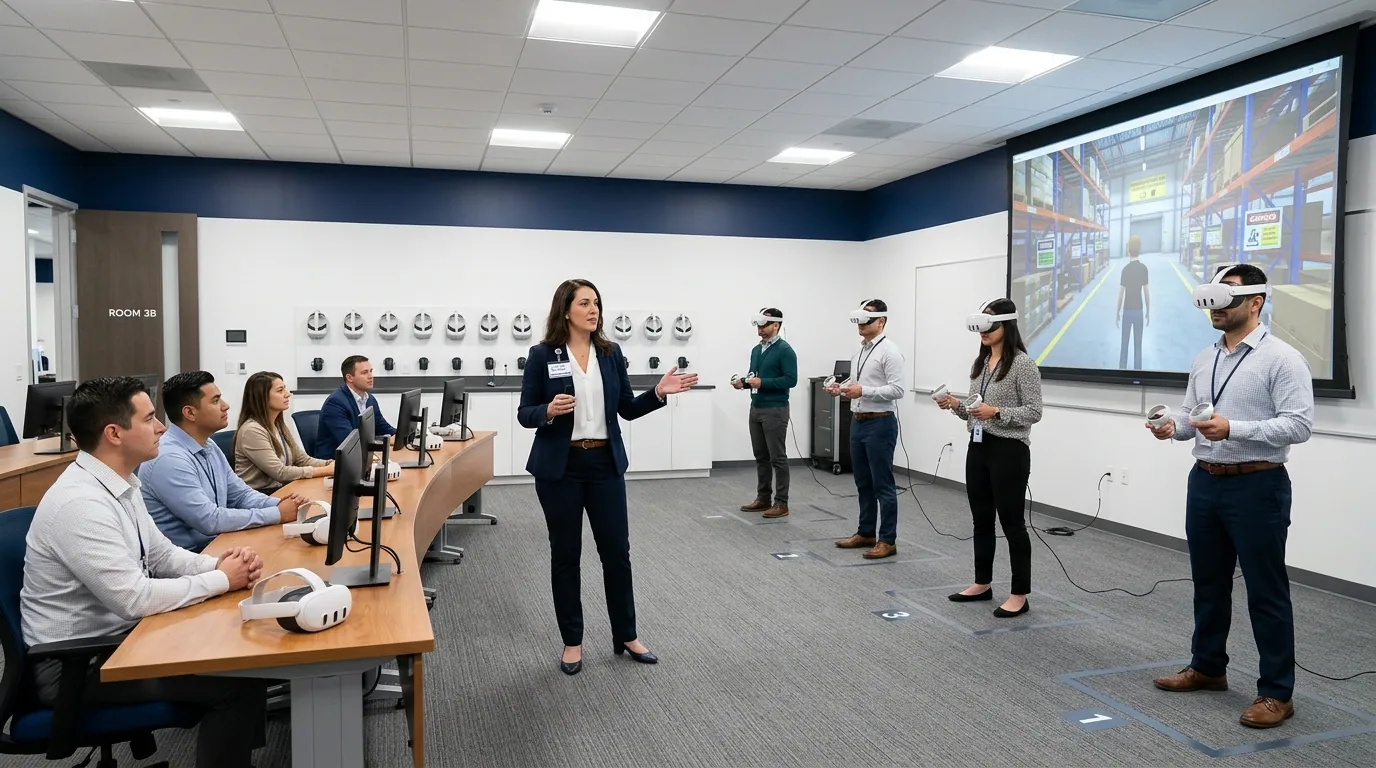
Deployment includes hardware provisioning (if applicable), LMS integration, train-the-trainer sessions for your internal team, and a structured launch plan. We do not hand off a file and disappear. We deploy alongside your team until the program is operational.
Hardware setup and provisioning
LMS/HRIS integration
Train-the-trainer sessions
Pilot launch and validation
Full rollout support
Post-launch monitoring
Total Development Timeline
Programs range from 12 weeks (focused single-module) to 28 weeks (enterprise multi-module deployment). Timeline depends on number of scenarios, interactivity complexity, and integration requirements.
The discovery call establishes scope and provides a realistic timeline estimate before any commitment.
VR Hardware Options
Programs are built for standard enterprise VR headsets. Three provisioning models are available:
- We recommend, you procure through your IT team
- We provision headsets as part of the program scope
- We lease hardware for pilot programs
What Performance Data Looks Like
Every VR training session generates structured performance data. This data can live within the VR platform dashboard, be exported to your existing systems, or both. Common data points include: For the technical side of rollout, device management, LMS integration and IT security review, see the VR training implementation guide.
Employee name and ID
Scenario completed
Completion date and time
Performance score
Number of attempts
Specific errors made
Time to completion
Skill gap identification
Cohort comparisons
What Your Team Provides During a Build
A VR training build goes faster when the client side is prepared. None of this requires a technical team, but it does require people with real knowledge of the work.
A subject-matter expert
Someone who does the job and can explain what good and bad look like. Typically a few hours per week during discovery and design.
Your own materials
SOPs, safety rules, scripts, floor plans, equipment photos and any existing training decks. We build from these, not from generic content.
A decision maker for reviews
One person who can approve storyboards and builds so review cycles do not stall.
Access to the environment
For site-based training, a walkthrough of the real facility so the virtual version matches it.
How This Process Applied to a Real Client
Yates Construction, ranked #29 on the Engineering News-Record Top 400 Contractors list, already had an OSHA 30 safety training program. We rebuilt it in VR using their own hazard scenarios and their own procedures, so crews practice the hazard before they meet it on an active jobsite.
Discovery for a project like this starts with the client hazard list and existing procedures, not with a template. The result reflects the way that contractor already trains and audits.
Common Reasons Training Projects Slip, and How We Handle Them
Scope grows during the build
New scenarios are added late. We fix the scenario list at the end of design and treat additions as a change request with its own estimate.
Procedures are not agreed internally
If two managers describe the task differently, the simulation cannot teach both. We surface the disagreement in discovery so it is settled before building.
Review feedback arrives in pieces
Consolidated feedback from one owner per round keeps the schedule intact.
Headsets arrive late
Hardware is specified in design, so procurement can run in parallel with the build.
Ready to see what the investment looks like?
Programs range from $25,000 for a foundational module to $500,000+ for enterprise-scale deployments.
Process and Development Questions
How long does it take to build a VR training program? +
Total development time ranges from 12 to 28 weeks depending on scope and complexity. A foundational single-module program with defined scenarios can be deployed in 12-16 weeks. Multi-module enterprise programs with custom analytics and LMS integration typically require 20-28 weeks from kickoff to deployment.
What is the development process for a custom VR training program? +
The process follows four phases: Discovery (needs assessment, scenario identification, stakeholder interviews), Design (storyboarding, scripting, performance metric definition), Build (development, iteration, client review cycles), and Deploy (hardware setup, integration, train-the-trainer, launch). Each phase includes client checkpoints and approval gates.
What hardware does VR training require? +
VR training programs are built for standard enterprise VR headsets (Meta Quest Pro, Meta Quest 3, HTC Vive Focus 3, or equivalent). Hardware can be provisioned by us, sourced by your IT team, or leased. The discovery phase includes a hardware recommendation based on your deployment environment and scale.
Can VR training integrate with our existing LMS? +
Yes. VR training programs can export performance data via xAPI (Tin Can), SCORM, or direct API integration. During the Design phase, we define the data architecture and integration points based on your current LMS, HRIS, or learning record store. Common integrations include Cornerstone, SAP SuccessFactors, Workday Learning, and custom platforms.
What happens after the VR training program is deployed? +
Post-deployment, we provide analytics monitoring, scenario updates when procedures change, and expansion support for new modules or locations. A support agreement is defined during the Build phase. Most programs include 90 days of post-launch support with an option for ongoing maintenance.
Who manages the VR training program after launch? +
Day-to-day program administration (scheduling sessions, monitoring completion, pulling reports) is managed by your training team. We provide a train-the-trainer session during deployment. Scenario updates, new module development, and technical maintenance are handled by our team under a support agreement.
What does the client need to provide? +
A subject-matter expert, your existing procedures and materials, one decision maker for reviews, and access to the real environment for site-based training.
Can we start with a small pilot? +
Yes. Many engagements start with a limited scenario set, are used with a small group, and are expanded after the team sees real data.
What if our procedures change mid-project? +
Changes made before the design is approved are absorbed. Changes after that are handled as a scoped change so timeline and cost stay transparent.
Ready to discuss your training challenge?
The discovery call is the starting point. No sales deck. We listen first.