
Your Employees Should Practice the Emergency Before It Happens
An OSHA card proves your workers sat through a class. VR safety training proves they practiced the scenario. Build training that workers actually remember, that simulates real hazards, and that produces auditable performance data for every employee.
Request a Safety Training Quote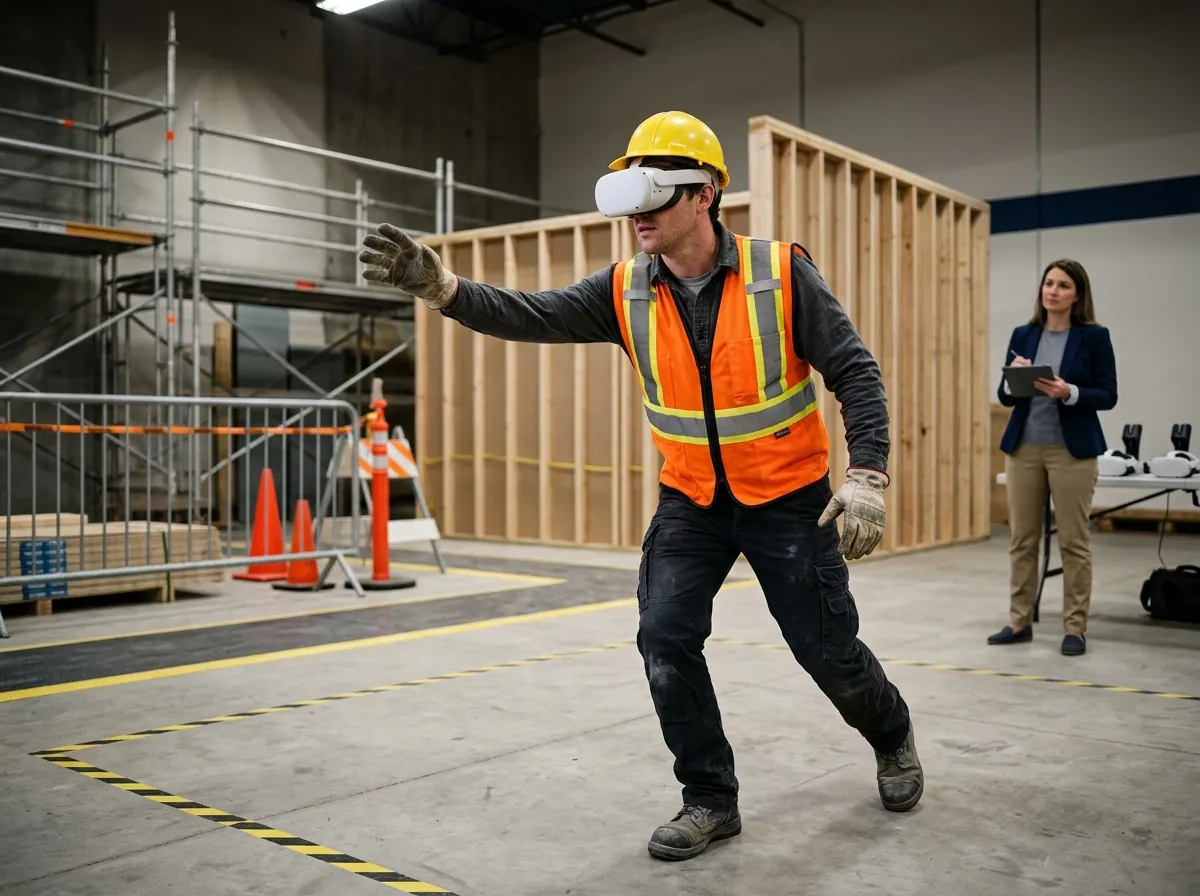
Compliance Documentation Is Not the Same as Competence
Video compliance without behavior change
Workers watch safety videos, sign attendance sheets, and forget the content within a week. When an incident happens, the training records show compliance. The employee's behavior shows they never actually practiced the scenario.
No documentation of actual competence
Current training systems track who attended, not who can perform. There is no data showing whether an employee can actually execute a fall protection procedure, recognize a confined space hazard, or respond to a chemical spill under pressure.
Same refresher training repeated annually
Every year the same video-based refresher is delivered to every employee regardless of whether they demonstrated competence or not. No differentiation between employees who need more practice and those who do not.
Practice, Not Paperwork
Physical practice with hazardous scenarios
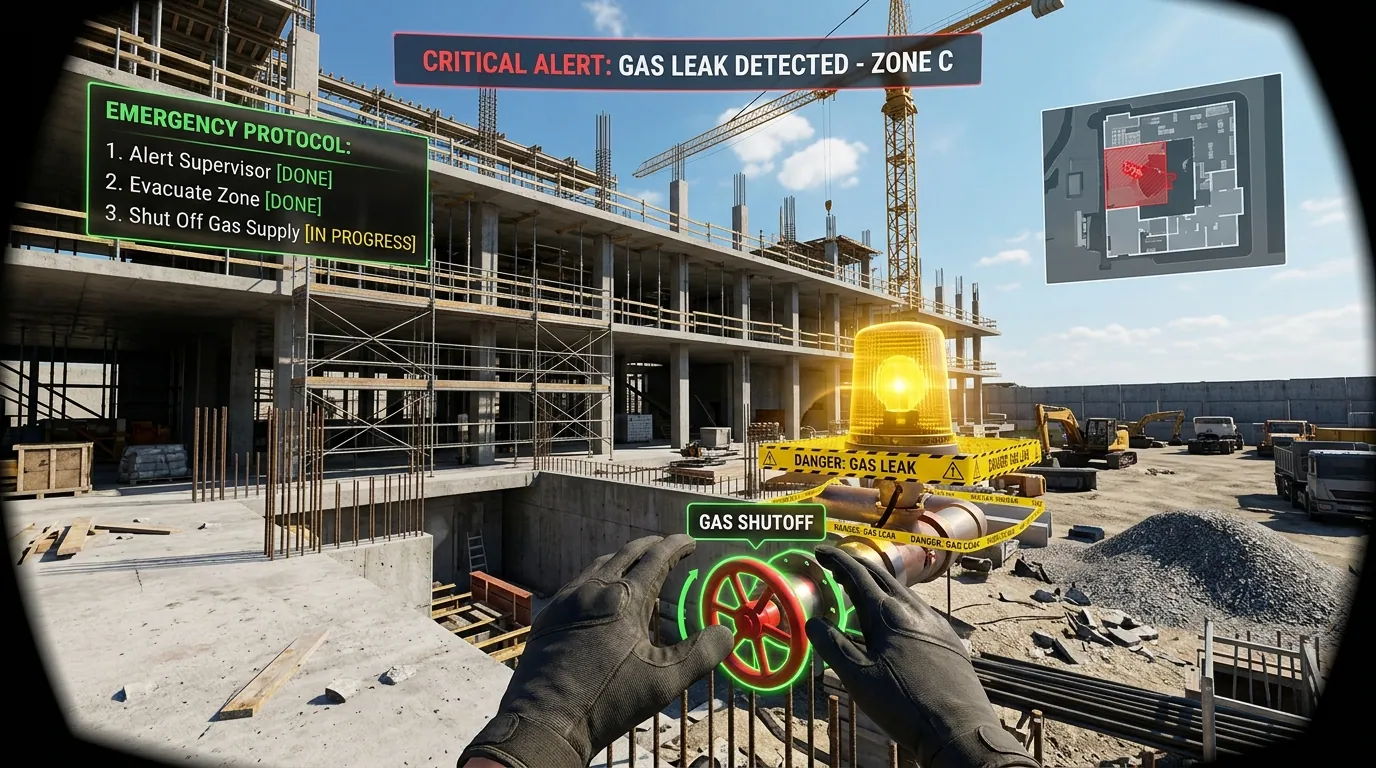
Employees physically practice fall protection, hazard recognition, emergency response, and equipment procedures in a controlled VR environment. No risk. Full repetition. Real muscle memory. On a jobsite specifically, see the scenarios and pilot structure in VR construction safety training.
Documented performance data
Every session generates a performance record: who trained, what scenario, what score, how many attempts, and where they made errors. This data supports safety audits and OSHA compliance documentation.
Custom hazard scenario library
Scenarios are built from your specific worksites, equipment, and hazard conditions. Not generic safety content. The training reflects what your employees actually encounter on the job.
Repeatable and updatable
Training scenarios can be repeated as many times as needed. When procedures change or new hazards are introduced, the VR program is updated without rebuilding from scratch.
Safety Training Built for High-Risk Operations
Manufacturing
Machine guarding, lockout/tagout, chemical handling, assembly line safety
Warehousing & Logistics
Forklift operation, loading dock safety, material handling, rack safety
Oil & Gas
H2S exposure, well control, PPE procedures, emergency evacuation
Utilities & Energy
Electrical safety, line work procedures, confined space, excavation safety
Food Production
Equipment sanitation, chemical handling, slip/trip/fall prevention, PPE compliance
Safety Training Program Investment
Programs range from a single-module hazard scenario to a comprehensive site-wide deployment with multiple scenario types and analytics.
VR Safety Training Questions
What is virtual reality safety training? +
Virtual reality safety training is immersive, headset-based training that lets workers practice recognizing hazards and responding to emergencies inside a simulated replica of their real worksite, before they face the real risk. It goes beyond passive video by turning hazard recognition training into active practice: the worker must spot the hazard, decide, and physically act, while the system scores every decision. The Prime VR builds custom virtual reality safety training and functions as a practical OSHA hazard identification training tool, with timestamped performance records for compliance documentation.
Can VR training meet OSHA compliance requirements? +
VR training produces documented evidence that employees practiced specific hazard scenarios, including completion records, performance scores, and timestamps. This data supports OSHA compliance documentation by proving that employees did not just attend training but actively participated in scenario-based practice. VR training supplements, rather than replaces, required OSHA certifications.
What safety scenarios can be built in VR? +
Any safety scenario that involves recognizing a hazard, making a decision, and taking a physical action can be built in VR. Common scenarios include fall protection, hazard recognition, emergency response, equipment lockout/tagout, forklift operation, confined space entry, chemical spill response, and fire evacuation.
How does VR safety training reduce incident rates? +
VR safety training reduces incident rates by giving employees physical practice with hazardous scenarios before they encounter them on the job. Workers who have practiced a response in VR recognize hazards faster, make better decisions under pressure, and execute procedures more reliably than workers who only watched a video or read a manual.
Which industries is this built for? +
Any environment where the consequences of poor training are physical injury or death. Manufacturing, warehousing and logistics, oil and gas, utilities and energy, and industrial operations are the highest-value applications, because the scenarios involve real physical risk that cannot be safely replicated in a classroom. Construction is covered as its own vertical in VR construction safety training, which goes deeper on jobsite hazards, scenarios and pilot structure.
How is training performance documented for safety audits? +
Every VR training session generates a performance record including the employee name, date, scenario completed, score, number of attempts, and specific errors. This data can be exported for safety audits, integrated with your existing training management system, or stored as standalone documentation.
Can VR safety training replace in-person safety training? +
VR safety training is most effective as a complement to in-person training, not a complete replacement. It excels at scenario practice, hazard recognition, and decision-making under pressure. Hands-on equipment certification and site-specific orientation still benefit from in-person instruction. The combination produces stronger results than either approach alone.
Tell us the safety scenario your team needs to practice.
We will tell you honestly whether VR is the right approach.