
Your Brand Promise Is Only as Strong as Your Weakest Location's Training
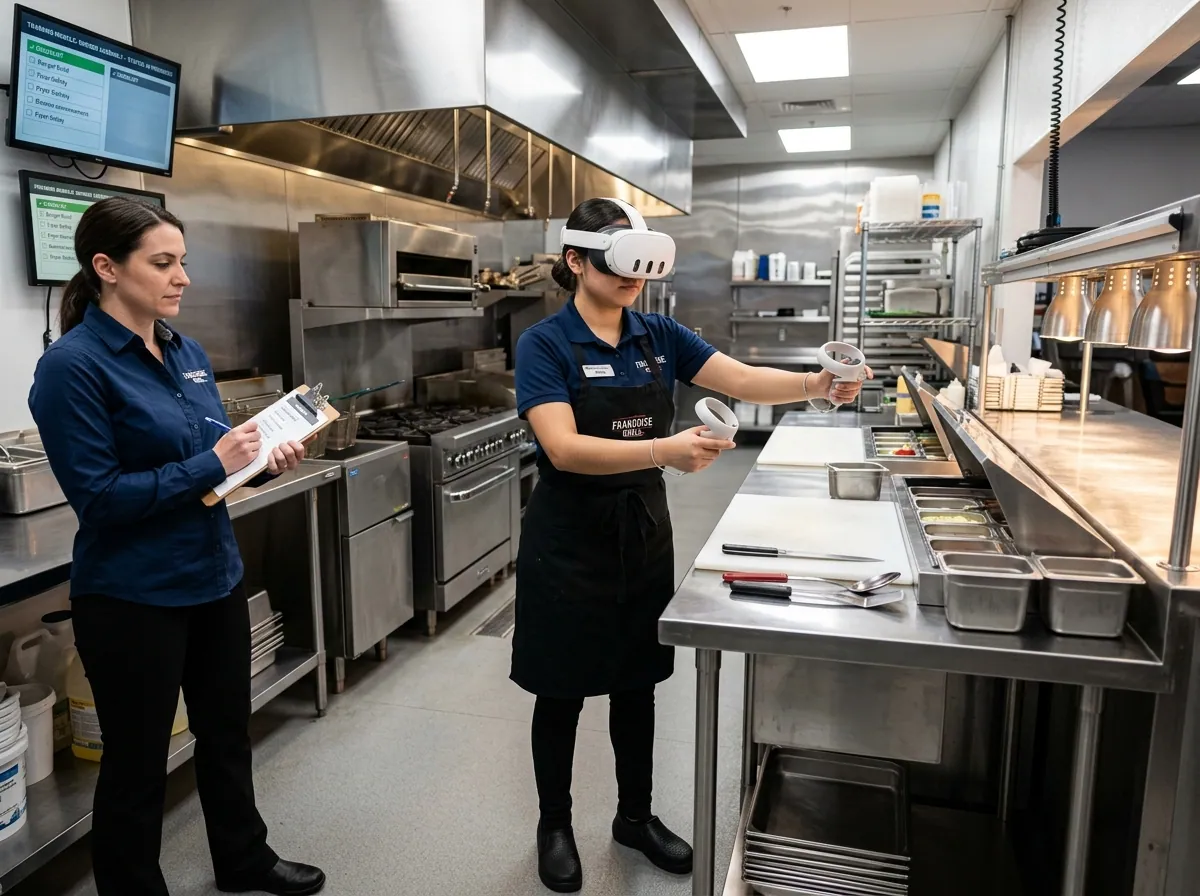
Manager-dependent training creates inconsistent customer experiences. Every location trains differently. VR delivers the same onboarding, product knowledge, and customer interaction training to every franchise location, on every shift.
When Training Depends on Who Is Managing the Floor, Quality Depends on Luck
Manager-dependent interpretation
Each shift manager trains new hires based on their own understanding, their own shortcuts, and their own priorities. The corporate standard exists on paper but is executed differently at every location.
Turnover makes training continuous
High-turnover environments need to train new employees every week. When training requires a person, every departure creates a gap and every hire creates a burden on existing staff who are already at capacity.
Brand experience inconsistency
Customers expect the same experience at every location. When training varies, customer experience varies. Reviews reflect the weakest location's training, not the brand's intent.
Same Training. Every Location. Every Shift. No Trainer Required.
Same training at every location
Every franchise location receives identical training scenarios. The standard is enforced by the program, not by whoever happens to be working that day. No interpretation. No shortcuts. No drift.
No trainer required for Day 1
New hires begin training immediately without waiting for a scheduled trainer or burdening existing staff. The VR program handles scenario practice while managers handle administrative orientation.
Centralized completion data
Franchise owners see which locations have trained staff, which employees completed scenarios, and who needs additional practice. No more relying on shift managers to report training status.
Updatable when procedures change
New menu items, new safety procedures, new brand standards. Updates deploy to every location simultaneously. No cascading communication through regional managers. Every site trains on the current version immediately.
VR Training Built for Multi-Location Operations
Quick-Service Restaurants
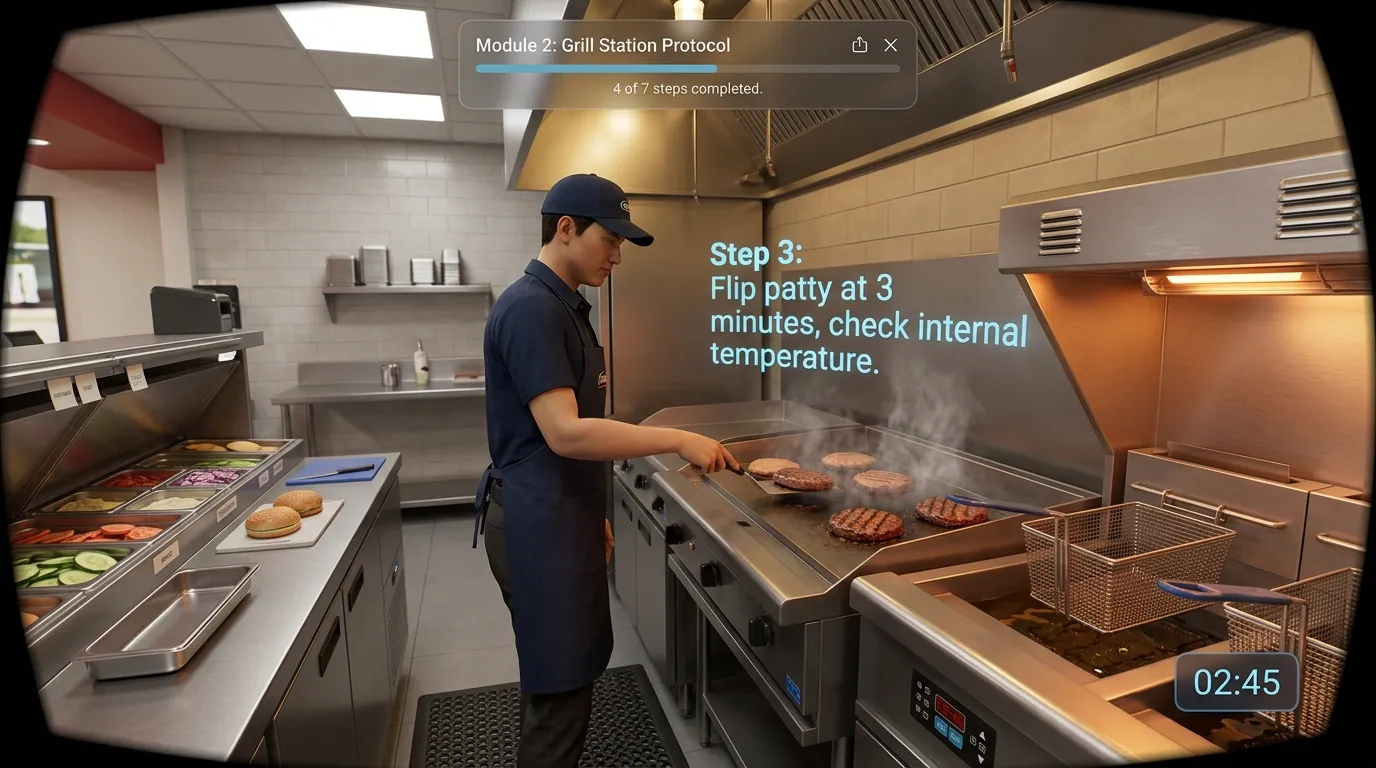
Food prep consistency, customer interaction, order accuracy, health code compliance
Retail Franchise
Brand presentation, customer service standards, inventory procedures, loss prevention
Fitness & Wellness
Equipment orientation, member safety, class instruction, sales process
Automotive Service
Service advisor process, inspection procedures, customer communication, safety protocols
Home Services
Customer interaction, service delivery standards, safety procedures, upsell process
Hotel Chains
Guest experience, check-in procedures, housekeeping standards, emergency response
High Turnover Does Not Have to Mean High Training Cost
In high-turnover environments, the cost of training each new hire with a human trainer compounds quickly. VR training inverts this equation: the program costs the same whether it trains 10 employees or 1,000. The more turnover you have, the more cost-effective VR becomes per new hire.
The hundredth new hire receives the same quality training as the first, without requiring additional trainer time, additional scheduling, or additional location-level investment. Turnover bites hardest in restaurants and hotels, where VR training for hospitality teams covers the scenarios, languages and per-property rollout in detail.
A Growing Houston Franchise Trains Every Location to the Same Standard
A Mexican food franchise expanding across Houston was opening locations faster than it could train crews. We built two VR programs: kitchen station workflow under real time pressure, and the customer service situations that actually happen at the counter.
How a Franchise Rollout Typically Runs
Standard first
We agree the brand standard with corporate: the procedures, guest scenarios and service steps that must be identical everywhere.
Pilot at a few locations
A small group of stores use the training for several weeks so we can compare data and collect manager feedback.
Network rollout
Headsets and training are deployed store by store with a simple checklist for each general manager.
Update centrally
When a menu, procedure or policy changes, the scenario is edited once and pushed to every location.
What Multi-Unit Operators Usually Ask First
Operators tend to ask about cost per new hire, how long it takes a new employee to be productive, and whether the training will actually be used on a busy shift. The answers depend on your network, so we scope them against your turnover, headcount and existing onboarding before proposing a build.
The training is short enough to run before a shift, does not require a trainer, and produces completion data corporate can review by location.
Franchise Training Program Investment
Programs range from a single-scenario onboarding module to a comprehensive multi-scenario platform covering the full employee lifecycle.
Franchise VR Training Questions
How does VR training work for franchise networks? +
VR training programs for franchise networks are deployed on standard VR headsets at each location. New hires and existing staff complete the same training scenarios regardless of which location they work at or who manages the shift. The franchise owner or corporate team can monitor completion and performance data across all locations from a centralized dashboard.
Can VR training replace in-person new hire orientation? +
VR training can replace the scenario-practice portion of orientation: customer interactions, product knowledge, process execution, and brand standard demonstrations. Administrative orientation (paperwork, system logins, facility tours) still happens in person. The combination reduces Day 1 orientation time while ensuring consistent skill practice.
How does VR training handle high employee turnover? +
High turnover means continuous training demand. VR programs are always available, require no scheduled trainer, and deliver the same quality to the hundredth new hire as the first. The per-employee training cost decreases as more employees use the program. This makes VR particularly cost-effective for high-turnover environments.
What franchise industries is VR training best suited for? +
VR franchise training is most effective in industries where customer-facing interactions must be consistent across locations: QSR, retail, fitness, automotive service, home services, and hotel chains. Any franchise where the brand promise depends on employee behavior during customer interactions benefits from standardized practice.
Can the training content be updated when our procedures change? +
Yes. VR training scenarios can be updated when procedures, products, or brand standards change. Updates are deployed to all locations simultaneously, ensuring every site trains on the current version immediately. This eliminates the delay of cascading updates through regional managers.
How does franchise VR training centralize reporting across locations? +
Every training session generates a performance record that is stored centrally. Franchise owners see per-location completion rates, individual performance scores, and aggregate data across the network. This data identifies which locations are undertrained and which employees need additional practice.
How many headsets does each location need? +
Usually one or two per location depending on staff size and shift overlap. We plan this in scoping.
Can franchisees opt out? +
That is a brand-level decision. Training is easiest to enforce when it is part of the onboarding checklist in your franchise agreement or operations manual.
Does it work in multiple languages? +
Scenarios can be built in more than one language when the workforce needs it. This is scoped per project.
Tell us the brand standard your franchise needs to protect.
Tell us about your locations, your turnover, and your brand standards.