
Arc Flash VR Training for Electrical Safety Teams
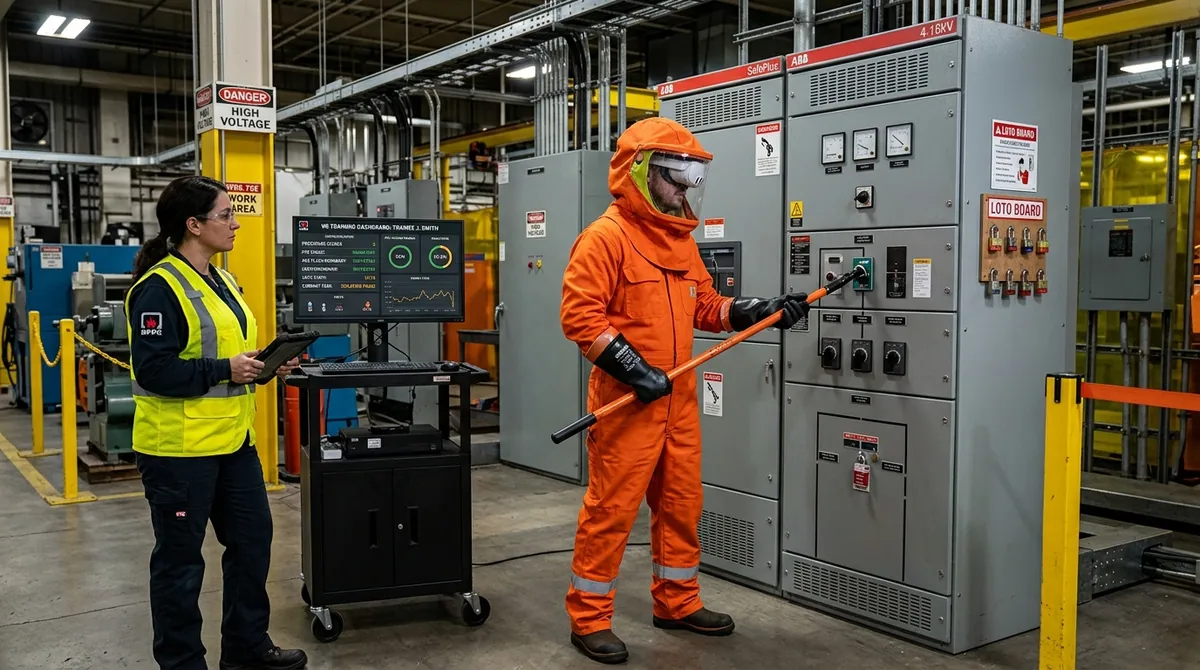
Arc flash electrical safety training must build correct PPE selection, approach distance judgment, and energized work permit behavior before workers are ever near live equipment. VR simulation provides that practice environment with NFPA 70E-aligned scenarios and documented competency records.

Hugo Ramirez
Quick Answer
VR arc flash and electrical safety training builds NFPA 70E-aligned procedural behavior before workers are near live equipment. Scenarios cover incident energy recognition, PPE selection by hazard risk category, approach boundaries, energized work permits, and lockout/tagout for electrical systems. Training records export via xAPI, providing the per-employee competency documentation NFPA 70E Article 110.2 requires.
Why Electrical Safety Training Fails in the Classroom
Arc flash events cause approximately 2,000 hospitalizations and 400 fatalities per year in the United States (IEEE). The workers involved in most of these incidents had completed their required NFPA 70E training. They passed the written test. They could describe the PPE categories and approach boundaries.
The gap is between knowing the rule and applying it in the field. A worker who has read about approach distances behaves differently at a live switchgear panel than one who has rehearsed the distance judgment in a realistic simulated environment. VR closes that gap.
2,000
Annual arc flash hospitalizations in the U.S. Most victims had completed required electrical safety training (IEEE)
96%
Knowledge retention rate for VR-trained learners versus 10% for video-based training (STRIVR research)
Key Scenarios for Electrical Safety VR Training
| Scenario | What the Worker Practices | NFPA 70E Reference |
|---|---|---|
| Arc flash PPE selection | Match PPE to incident energy level and hazard risk category | Article 130.5, Table 130.5(G) |
| Approach boundary assessment | Establish limited, restricted, and prohibited approach distances | Article 130.4 |
| Energized electrical work permit | Complete permit steps, identify justification requirements | Article 130.2 |
| Electrical lockout/tagout | Identify all energy sources, apply locks and tags, verify de-energization | Article 120 |
| Substation safe work practices | Entry procedures, grounding requirements, communication protocols | Article 130.8 |
What We See in Utility and Industrial Electrical Safety Programs
- Programs built on 3D models of actual switchgear configurations and substation layouts produce the strongest transfer to field performance because workers recognize the equipment they train on
- Annual NFPA 70E refresher training delivered via VR scenario completion (versus classroom re-attendance) reduces per-employee training cost while producing higher assessment scores
- Incident investigation teams at facilities using VR training report fewer near-miss events attributed to PPE selection errors after program deployment
- xAPI records that include per-scenario decision data provide stronger audit evidence than sign-off sheets when OSHA citations are contested, because they document what the worker actually demonstrated, not just what they were told
Arc Flash VR Training: Implementation Steps for EHS and Training Teams
Deploying a VR arc flash training program requires alignment between your EHS team, training department, and operations management before content is built. The following steps reflect what successful electrical safety VR deployments have in common.
- Define the qualified worker population: NFPA 70E defines a qualified person as someone trained in and familiar with the construction and operation of equipment and the hazards involved. Map your qualified worker population by facility, equipment type, and annual requalification schedule. This determines how many learners the VR program must serve per year and what equipment configurations must be modeled.
- Audit your current NFPA 70E training gaps: Review your last 3 years of arc flash incident investigation reports, near-miss logs, and OSHA recordable data. Identify which procedure steps workers most commonly skip or execute incorrectly. These become the priority scenarios in the VR program, not a generic coverage of the full standard.
- Specify equipment-specific 3D modeling requirements: Request that the VR vendor model the specific switchgear manufacturers, voltage levels, and panel configurations present at your facilities. Generic switchgear models produce weaker competency transfer. If you have ABB, Square D, or Siemens equipment, provide technical drawings and photos for 3D modeling reference.
- Design the xAPI record schema: Work with your LMS administrator to define what per-scenario data fields you need for NFPA 70E Article 110.2 compliance documentation. At minimum: learner ID, scenario name, completion date, PPE selection decision, approach boundary decision, and pass/fail outcome. More granular data supports OSHA citation defense.
- Establish annual requalification workflow: NFPA 70E requires retraining when there is reason to believe a qualified worker does not understand the hazards. Design the VR requalification scenario as a shorter (8 to 12 minute) annual refresher that tests the same critical decision points as the initial training without requiring a full program repeat.
KPIs for Electrical Safety VR Programs
Tracking the right metrics from program launch ensures you can demonstrate program value at the annual EHS budget review and defend the investment during audits.
- PPE selection accuracy rate: Track the percentage of learners who select the correct PPE for each incident energy level on the first attempt. Benchmark at program launch and measure improvement at 6 and 12 months.
- Approach boundary compliance rate: Measure how frequently workers establish correct approach distances in simulation. This is the decision most commonly skipped in live arc flash incidents and the highest-value behavior to reinforce.
- Arc flash incident rate: Compare recordable arc flash incidents per 200,000 work hours before and after program deployment. This requires 12 to 18 months of post-deployment data but is the metric OSHA and your insurance carrier care about most.
- Energized work permit completion quality: If your facilities use energized electrical work permits, audit a sample of permits completed by VR-trained workers versus classroom-trained workers. VR-trained workers consistently complete permits with fewer omissions and errors in the first year post-training.
Frequently Asked Questions
What electrical safety procedures can be trained in VR? +
VR electrical safety training covers arc flash hazard recognition and incident energy assessment, PPE selection and donning procedures per NFPA 70E hazard risk categories, lockout/tagout for electrical equipment, energized electrical work permits, substation approach distances, and transformer and switchgear inspection procedures. Scenarios can be built to match specific equipment configurations used at your facilities.
Does VR electrical safety training satisfy NFPA 70E training requirements? +
NFPA 70E Article 110.2 requires qualified electrical workers to be trained on the hazards associated with their work. It does not prescribe a delivery method. VR simulation satisfies the training requirement when it produces documented evidence of competency on the specific hazards workers will encounter. Records exported via xAPI provide the per-employee documentation NFPA 70E requires.
How do you simulate arc flash in VR without being misleading about the actual hazard? +
Well-designed VR arc flash scenarios use realistic incident energy visualizations and consequence modeling without creating a desensitization effect. The goal is to build correct procedural behavior before exposure, not to minimize the severity of the hazard. Scenarios that show what happens when workers skip steps, such as selecting inadequate PPE or failing to establish an approach boundary, are more effective than scenarios that only show correct behavior.
What is the cost of an arc flash VR training program? +
A custom arc flash VR training program ranges from $75,000 to $200,000 depending on the number of equipment types modeled, the number of scenarios, facility-specific customization, and LMS integration. Programs built on existing electrical safety content libraries move faster and cost less than ground-up builds requiring original equipment 3D modeling.
How does VR arc flash training compare to traditional classroom training? +
Traditional arc flash training typically consists of a classroom session covering NFPA 70E requirements, PPE categories, and safe work practices. Workers pass a written test but have no opportunity to practice the actual decision sequence before working near energized equipment. VR adds scenario-based practice where workers must apply the knowledge under simulated work conditions, which research consistently shows produces higher retention and better field performance.
Building an electrical safety training program?
Schedule a discovery call to discuss your equipment configurations, NFPA 70E requirements, and workforce size.