
Lockout/Tagout VR Training for Manufacturing Employees
Lockout/tagout is among the most cited OSHA standards and among the most dangerous to get wrong. A sequence of 12 to 18 machine-specific steps, where one missed isolation can be fatal, is exactly the kind of procedure that cannot be learned by watching a video. It has to be practiced, and VR is the only way to practice it safely on the actual machine.
QUICK ANSWER
Lockout/tagout VR training lets manufacturing employees perform the complete energy-isolation sequence on a virtual replica of their specific machine, identifying every energy source, shutting down in order, applying locks and tags, and verifying zero energy state, before touching real equipment. Because LOTO is machine-specific and a single missed step can be fatal, watching a video does not transfer; practicing does. VR supports OSHA 1910.147 with per-worker competency records. Custom programs range from $35,000 to $150,000.
Why LOTO Is the Procedure Video Training Fails Most
A lockout/tagout procedure on a machine with multiple energy sources is a 12 to 18 step sequence that must be executed in the correct order, on the correct sources, with the correct isolation method. Every step matters, and the consequence of error, energizing a machine while a worker is inside it, is among the most severe in manufacturing. Yet the standard training is a video and a signed energy control procedure.
Video and document training cannot build the ability to perform this sequence. They can describe it, but they cannot make the worker do it, and they cannot account for the fact that every machine is different. A LOTO procedure learned generically does not transfer to a specific press, lathe, or processing unit with its own energy sources in their own locations. The worker leaves "trained" with a completion record and no verified ability to actually isolate the machine they will service.
12-18
A typical multi-energy lockout/tagout sequence has 12 to 18 steps that must be performed in the correct order, where one missed isolation can be fatal.
What Workers Practice in LOTO Simulation
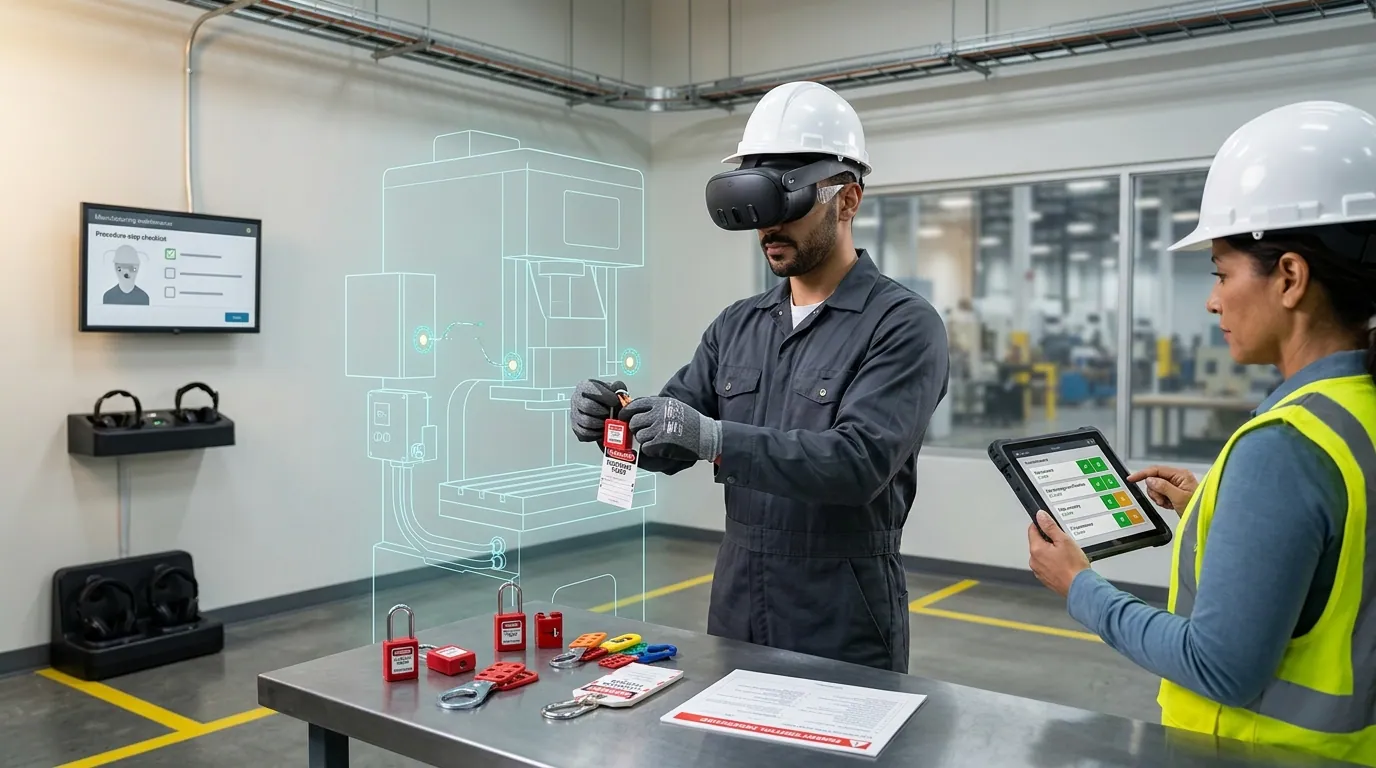
VR lockout/tagout training puts the worker in front of a virtual replica of their actual machine and requires them to perform the complete energy control sequence, repeatedly, until the data shows they can do it correctly. The simulation enforces the correct order and flags errors, building procedural memory with a simulated consequence rather than a real one. The practiced sequence covers:
- Energy source identification: Locate every source, electrical, hydraulic, pneumatic, mechanical, thermal, and chemical, on the specific machine, the step workers most often miss.
- Sequenced shutdown and isolation: Shut down and isolate in the correct order, applying locks and tags at the correct points, with the simulation enforcing sequence.
- Zero-energy verification: Confirm the machine is fully de-energized before any work begins, the verification step that prevents stored-energy incidents.
- Correct restoration: Remove locks and restore service in the proper order, the phase where rushed re-energizing causes its own incidents.
LOTO is a flagship scenario within our manufacturing workforce simulation systems, and it connects directly to broader safety training for manufacturing.
| Method | Machine-Specific | Sequence Practice | 1910.147 Evidence |
|---|---|---|---|
| Video / document | Generic | None | Sign-off |
| Classroom | Generic | Described | Quiz score |
| OJT on live machine | Specific, but real risk | Once | Variable |
| VR Simulation | Exact machine replica | 10-15 reps, safe | Per-step log |
Compliance and Verified Competence
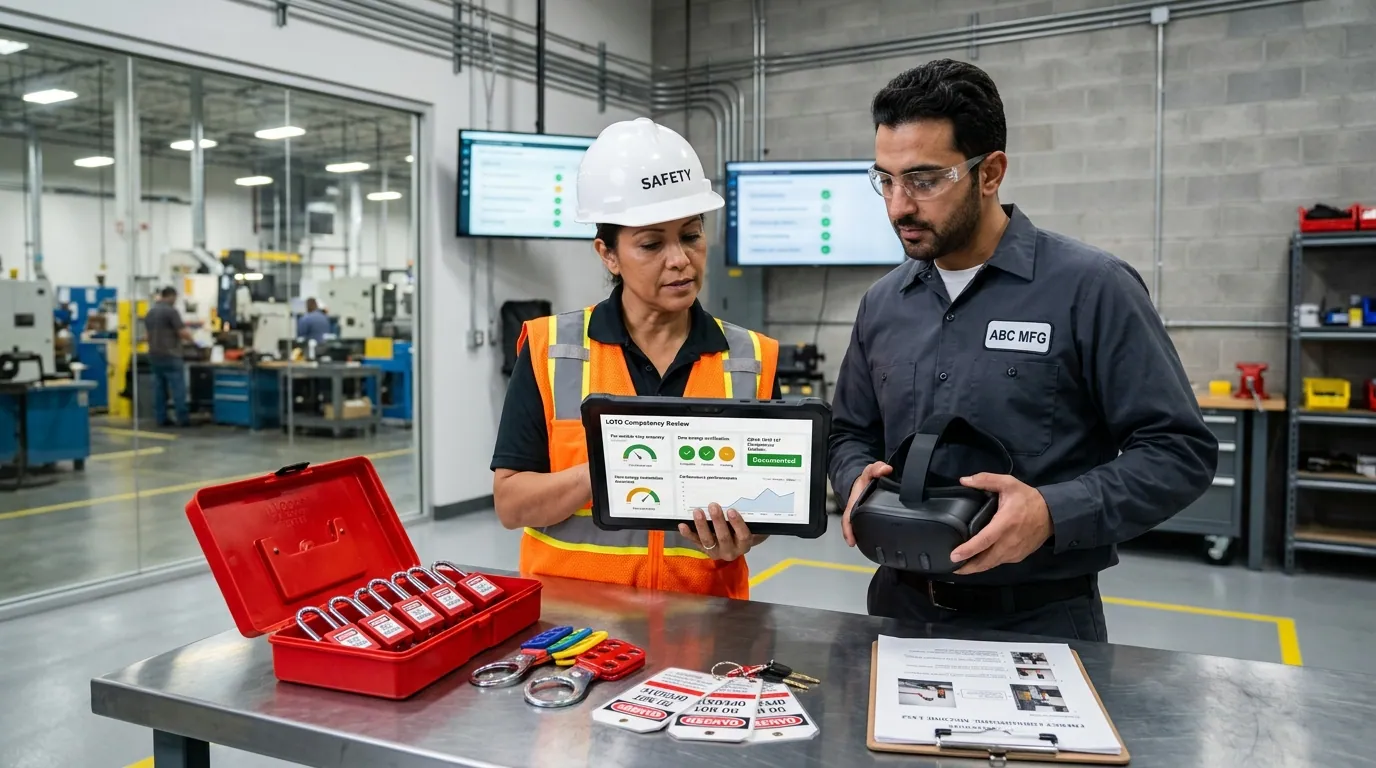
OSHA 1910.147 requires that authorized employees be trained in energy control procedures and that the employer verify their knowledge and ability. A signed roster verifies neither. A VR competency record, showing that the worker identified all energy sources, followed the correct sequence, and verified zero energy, on the specific machine, is exactly the evidence the standard intends, and exactly what protects the company after an incident.
That documentation is also where the ROI compounds. With the average serious manufacturing injury near $58,000 and LOTO incidents among the most severe, preventing even one justifies the program. We walk through the full economics in our breakdown of VR training cost, and the compliance angle in VR training for OSHA compliance.
$58K
Average cost of a serious manufacturing injury, with LOTO incidents among the most severe, so preventing one typically pays back the program (National Safety Council, 2023).
What We See in LOTO VR Deployments
- Missed energy sources are the common failure. First-session data routinely shows certified workers overlooking a secondary energy source, hydraulic, pneumatic, or stored, the exact gap that causes real LOTO incidents.
- Machine-specific replicas are non-negotiable. A scenario built on the actual machine, with its real isolation points, produces transfer that a generic LOTO module never will.
- Highest-risk equipment goes first. Facilities with many machine types start with the equipment carrying the most severe LOTO exposure, then expand the scenario library over time.
- Restoration errors get attention they rarely received. The lock-removal and re-energizing phase, often neglected in traditional training, becomes a measured, practiced step in simulation.
Frequently Asked Questions
Why is lockout/tagout so hard to train with traditional methods? +
Lockout/tagout is a multi-step, machine-specific procedure where a single missed or out-of-order step can be fatal, yet traditional training only describes it. A worker watches a video or reads the energy control procedure, signs an acknowledgment, and is considered trained, without ever performing the isolation sequence on the actual equipment. Because every machine has different energy sources and isolation points, generic training does not transfer. VR closes the gap by letting workers practice the exact sequence on a replica of their specific machine.
What does lockout/tagout VR training let workers practice? +
Workers practice the complete energy control sequence on a virtual replica of their actual machine: identifying all energy sources (electrical, hydraulic, pneumatic, mechanical, thermal, chemical), shutting down in the correct order, applying locks and tags at the correct isolation points, verifying zero energy state, and removing locks correctly to restore service. The simulation enforces correct sequence and flags errors, letting workers build the procedural memory that the high-consequence nature of LOTO demands, with no real risk.
How does VR lockout/tagout training support OSHA 1910.147? +
OSHA 1910.147 requires that authorized employees be trained in energy control procedures and that the employer verify their knowledge and ability. VR directly serves both: workers perform the actual isolation sequence, and the system logs each step, error, and competency score per worker. That timestamped record demonstrates verified ability, not just attendance, which is exactly the evidence 1910.147 calls for and the kind that holds up during an audit or incident investigation.
Does lockout/tagout VR training work for machine-specific procedures? +
Machine-specific accuracy is the core advantage. Because LOTO sequences differ by machine, the most effective training is built on a replica of the specific equipment, with its real energy sources and isolation points in the correct locations. A generic LOTO scenario teaches the concept; a machine-specific scenario builds procedural memory that transfers directly to that machine. For facilities with many machine types, scenarios are built for the highest-risk equipment first.
What does a lockout/tagout VR training program cost? +
Custom lockout/tagout VR programs range from $35,000 for a single high-risk machine procedure to $150,000 or more for multiple machine types across several facilities with multilingual delivery and LMS integration. Because procedure scenarios are reused across every worker and every shift on that equipment, and across facilities with the same machines, per-worker cost falls sharply, and the program is owned rather than licensed per worker each year.
Ready to verify every worker can isolate the machine, not just sign for it?
Tell us your highest-risk equipment. We will build a machine-specific LOTO simulation that documents real competence.