
VR Training for OSHA Compliance: What Companies Should Know
OSHA does not just ask whether you trained your workers. For the standards that matter most, it asks whether you can prove they are competent. That distinction is where traditional sign-off sheets fall short and where VR training changes what compliance documentation can actually demonstrate.
QUICK ANSWER
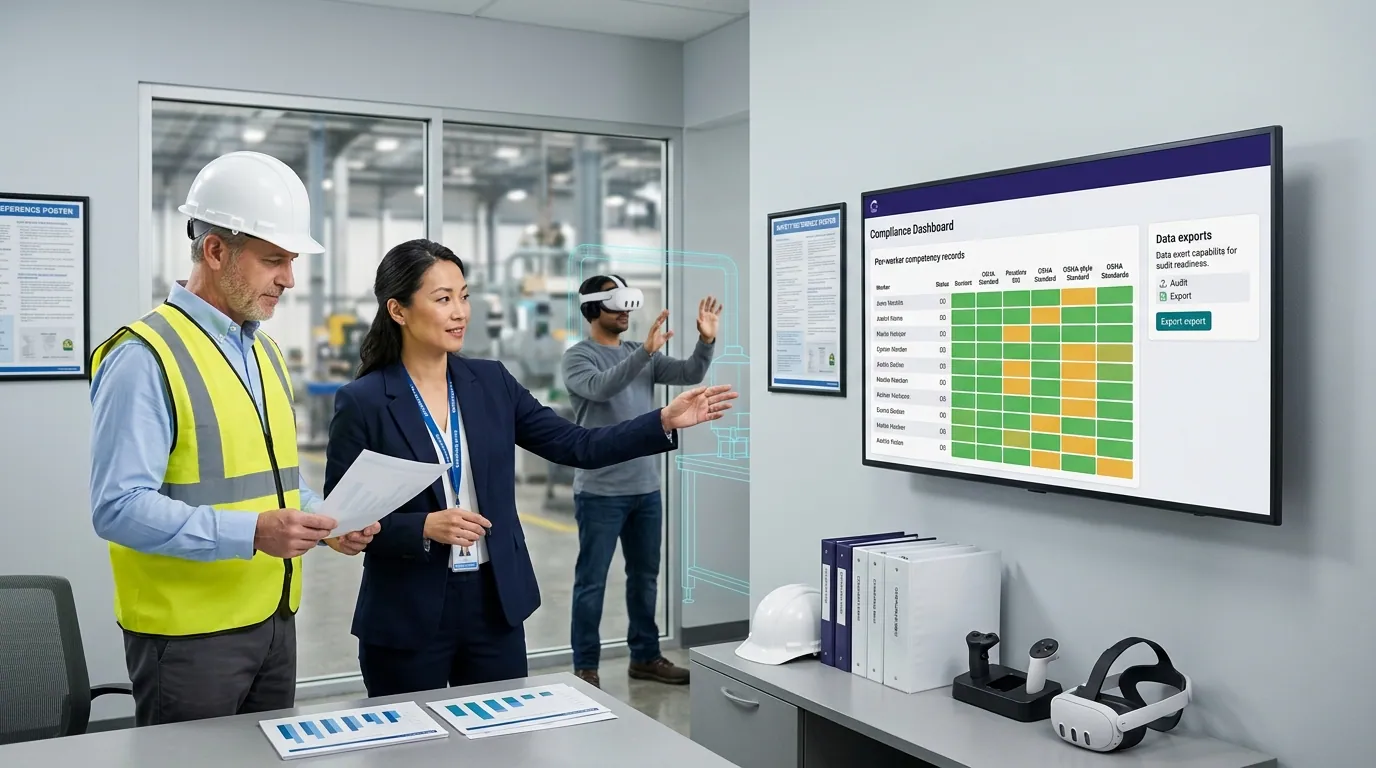
VR training for OSHA compliance produces per-worker competency records that demonstrate workers can actually perform a procedure, going well beyond the attendance sign-offs traditional training generates. It pairs especially well with standards requiring verified competence such as 1910.147 lockout/tagout, 1910.146 confined space, 1910.178 powered industrial trucks, and 1926.501 fall protection. The documentation is more defensible during audits and incident investigations. With serious injuries averaging roughly $58,000 (National Safety Council), prevention has direct value. Custom OSHA VR programs range from $35,000 to $250,000.
What OSHA Actually Requires
Many companies treat OSHA training as a box to check: deliver the content, collect signatures, file the roster. For some awareness-level requirements, that is genuinely sufficient. But for high-consequence standards, OSHA's language goes further, requiring the employer to ensure and, in several cases, verify that the employee can perform the procedure. A signature proving attendance does not prove competence, and competence is what the standard is actually after.
That gap matters most after an incident. When an investigator asks how the company verified that a worker could perform the lockout/tagout procedure they failed to execute, a signed roster is a weak answer. It demonstrates the worker was present, not that they were capable. Companies increasingly find that their documentation satisfies the letter of the requirement while leaving them exposed on the substance.
$58K
Average cost of a serious workplace injury, before counting citations and contested-penalty exposure, making verified competence a financial issue, not just a regulatory one (National Safety Council, 2023).
How VR Documents Competence, Not Just Attendance
VR training generates exactly the kind of evidence high-consequence OSHA standards favor. Because the worker performs the actual procedure in simulation, the system logs each step completed, each error, the number of attempts, and the final competency score, all timestamped per worker and exportable to your LMS via xAPI. The record demonstrates the worker was verified capable, not merely instructed.
This applies across the standards where competence is the real requirement. Lockout/tagout, confined space, fall protection, and powered industrial truck operation all involve procedures OSHA expects workers to perform correctly. VR lets them practice and proves they can, the foundation of our manufacturing workforce simulation systems and fall protection VR training.
| OSHA Standard | Topic | VR Fit |
|---|---|---|
| 1910.147 | Lockout/Tagout | Strong, procedural |
| 1910.146 | Confined Space | Strong, high-risk practice |
| 1910.178 | Powered Industrial Trucks | Strong, spatial |
| 1926.501 / 503 | Fall Protection | Strong, at-height judgment |
What Companies Should Confirm Before Deploying
VR is a powerful compliance tool, but companies should approach it deliberately. First, confirm the specific standard's requirements: most procedural standards welcome hands-on demonstration, but some have format or instructor specifics worth verifying. Second, ensure the VR program models your actual equipment and procedures, since generic scenarios produce generic competence that may not match what an inspector expects to see. Third, plan the LMS integration so the competency data lands in your existing system of record.
Done right, VR does not replace your compliance program, it strengthens it, adding verified-competence evidence on top of your existing policy and documentation backbone. We cover the broader cost and ROI picture in our breakdown of VR training cost.
Per-step
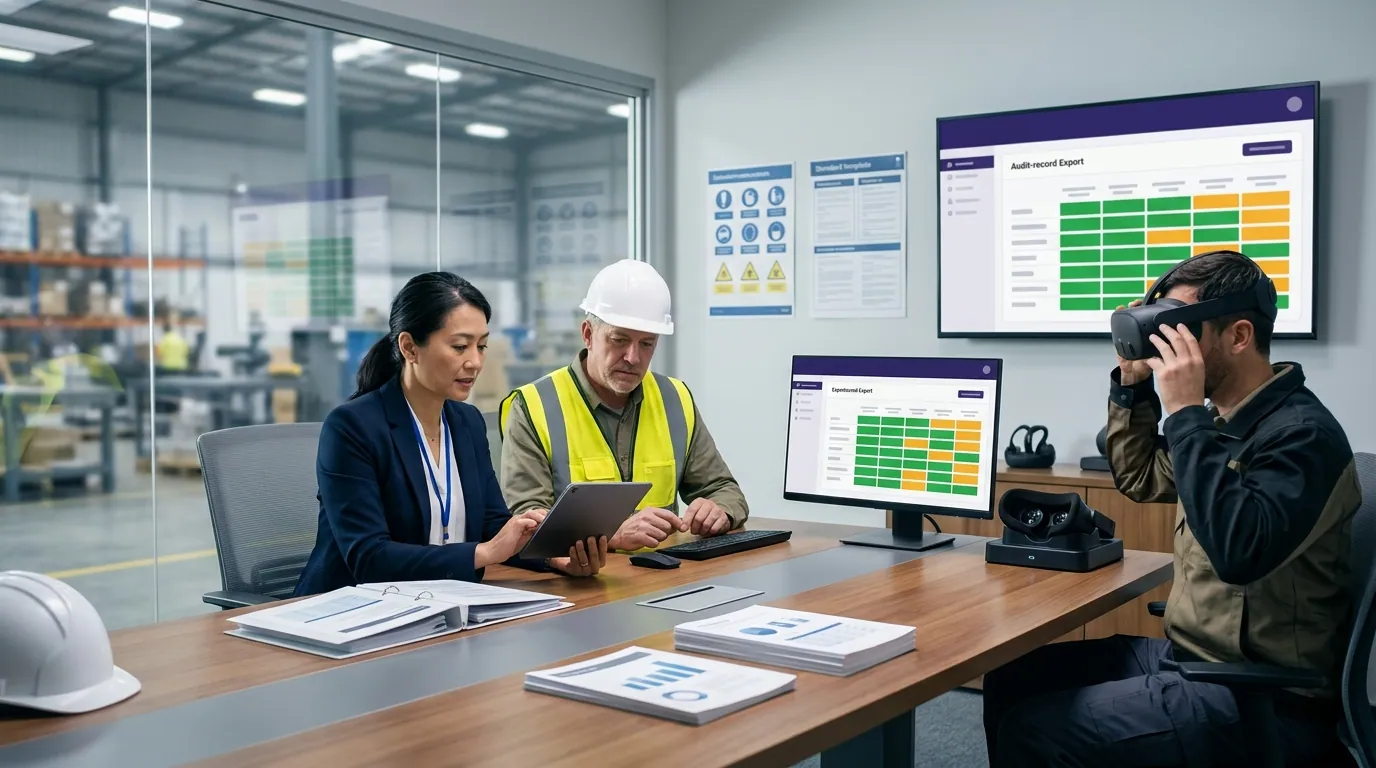
VR logs competence at the individual procedure-step level per worker, the documentation standard that holds up when a signed attendance roster does not.
What We See in OSHA-Focused VR Deployments
- Compliance teams value the audit trail most. The shift from "here is who attended" to "here is who is verified competent, step by step" changes how confidently a company faces an audit.
- The first session is a risk assessment. Baseline competency data routinely reveals which certified workers cannot perform a procedure, exactly the exposure OSHA documentation is meant to address.
- Standard-specific scenarios beat generic ones. A lockout/tagout scenario built on your actual equipment produces documentation that matches what an inspector expects to see on your floor.
- Integration is the make-or-break detail. Programs that route competency data cleanly into the existing LMS get adopted; those that create a separate data silo do not.
Frequently Asked Questions
Does VR training satisfy OSHA training requirements? +
VR training can satisfy and exceed many OSHA training requirements when designed correctly. OSHA standards generally require that employees be trained and, for several standards, that the employer verify and document competence. VR is well suited to both: workers perform the actual procedure, and the system logs each step and score, producing a per-worker competency record. Companies should confirm the specific standard's requirements, since some mandate hands-on demonstration that VR provides and others have format-specific rules.
Which OSHA standards pair well with VR training? +
Standards requiring procedural competence and documentation pair best with VR: 1910.147 (lockout/tagout), 1910.146 (confined space), 1910.119 (process safety management), 1910.178 (powered industrial trucks), and 1926.501/503 (fall protection). These all involve high-consequence procedures where OSHA expects verified competence, not just awareness. VR lets workers practice the procedure and generates the documentation that demonstrates competence during an audit or incident investigation.
How does VR improve OSHA compliance documentation? +
Traditional OSHA documentation is usually a signed roster proving attendance. VR documentation is a timestamped, step-by-step record showing each worker completed the procedure correctly, how many attempts it took, and what score they achieved. During an audit or after an incident, that competency record is far more defensible than a signature, because it demonstrates the employee was verified capable of performing the procedure, not merely present for instruction.
Can VR OSHA training reduce citations and incidents? +
VR OSHA training reduces both by closing the competence gap that drives them. Many citations and incidents trace back to workers who were trained on paper but could not actually perform the procedure correctly. By requiring repeated practice with measured competence before floor work, VR reduces the procedural errors that cause recordables, and the resulting documentation strengthens the company position if a citation is contested. With serious injuries costing roughly $58,000 each, prevention has direct financial value.
What does VR OSHA compliance training cost? +
Custom VR OSHA compliance programs range from $35,000 for a single standard such as lockout/tagout to $250,000 or more for multiple standards across several facilities with multilingual delivery and LMS integration. Because procedure scenarios are reused across workers and sites, per-facility cost falls sharply at scale, and the program is owned rather than licensed per worker each year.
Want OSHA documentation that proves competence, not just attendance?
Tell us which standards you train against. We will design a VR program that produces audit-ready competency records.