
Fall Protection VR Training: Safer Practice Before the Jobsite
Fall protection training has a built-in contradiction: the only fully realistic place to practice is at height, which is exactly where the hazard lives. For decades the answer was to teach the rules in a classroom and hope judgment develops on the structure. VR removes the contradiction by putting workers at simulated height with zero real risk.
QUICK ANSWER
Fall protection VR training lets workers practice harness inspection, anchor selection, 100% tie-off, and at-height judgment at simulated elevation, with zero exposure to a real fall. Falls are the leading cause of construction fatalities, and classroom training cannot replicate the spatial awareness elevation demands. VR provides that practice safely and documents per-worker competence for OSHA 1926.501 and 1926.503. According to PwC, VR learners are up to 275% more confident applying skills. Custom fall protection programs range from $35,000 to $150,000.
The Fall Protection Training Paradox
Falls are consistently the leading cause of death in construction, and fall protection is one of OSHA's most-cited standards year after year. Despite that, fall protection remains stubbornly hard to train well, because effective practice requires the worker to be at height, and being at height is the hazard you are trying to protect them from. The training environment and the danger are the same place.
The traditional workaround is to separate the two: teach harness components, anchor ratings, and tie-off rules in a classroom, then let the worker develop actual at-height judgment on the live structure. But that means the worker who is still learning is the one exposed to the fall hazard, and the spatial awareness that prevents falls, distance perception, edge proximity, movement discipline, is exactly what a classroom cannot teach.
#1
Falls are the leading cause of fatalities in construction and among OSHA's most-cited standards every year, making fall protection the highest-stakes training a contractor delivers.
How VR Resolves the Paradox
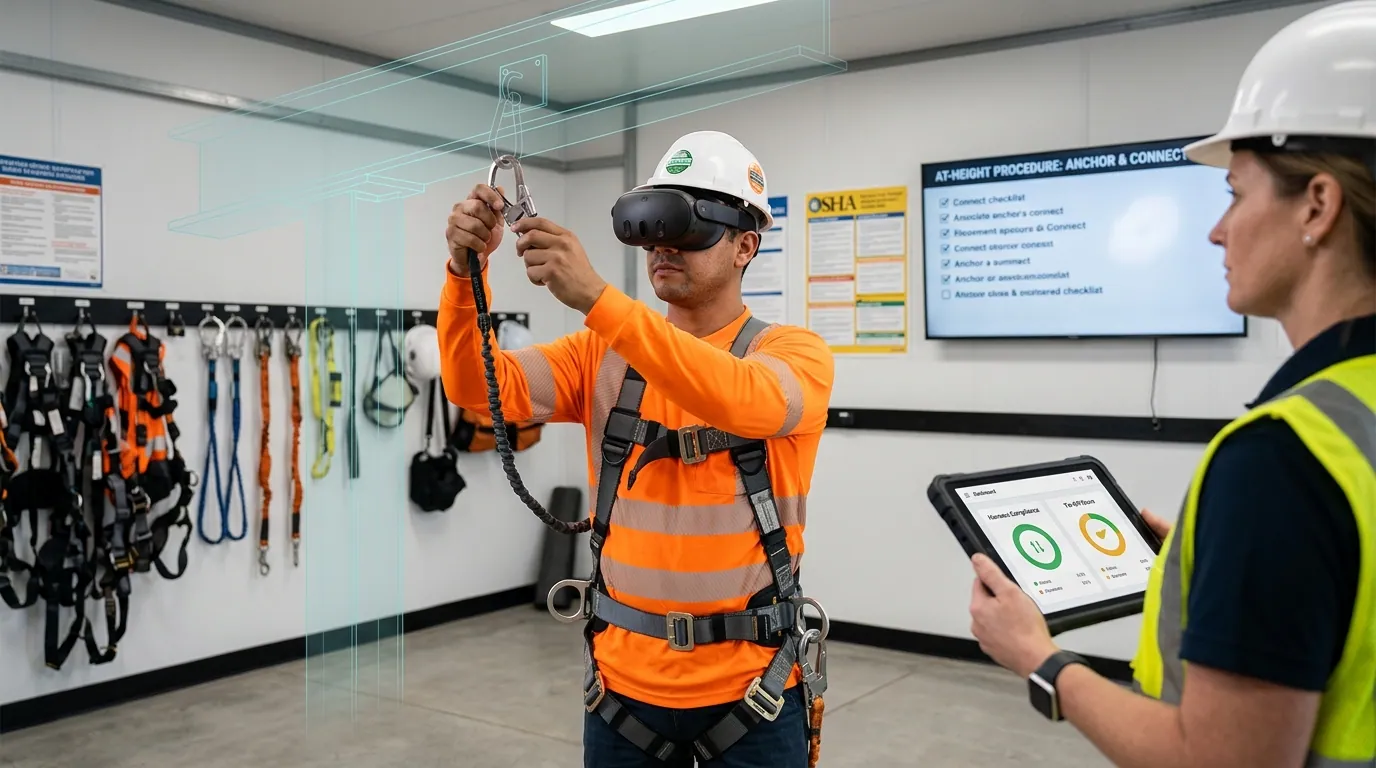
VR lets the worker practice at height without being at height. Inside a simulation of an elevated structure resembling their actual worksite, the worker performs the complete fall protection workflow and experiences the spatial and consequence cues elevation produces, while standing safely on the training room floor. The brain responds to the simulated height, building genuine at-height judgment, but a mistake ends the scenario rather than the worker.
- Harness inspection and donning: Practice the pre-use inspection and correct donning sequence until it is automatic, with the simulation flagging missed checks.
- Anchor selection and connection: Choose appropriate anchor points for the structure and conditions, and connect correctly, the judgment that prevents the most common fall arrest failures.
- 100% tie-off discipline: Maintain continuous connection while moving and transitioning between anchors, the habit that classroom rules describe but only practice builds.
- Hazard recognition and fall arrest response: Identify unsafe conditions and respond correctly to a simulated fall arrest event, including post-fall procedures.
This pairs directly with broader VR construction safety training and the wider category of VR safety and operations training for high-risk environments.
| Method | At-Height Judgment | Worker Risk | Competency Record |
|---|---|---|---|
| Classroom | Rules only | None | Quiz / sign-off |
| Ground-level demo | Limited | Low | Attendance |
| Live structure practice | Real, but learner exposed | High | Variable |
| VR Simulation | Real cues, safe | Zero | Per-step xAPI log |
Documentation That Holds Up
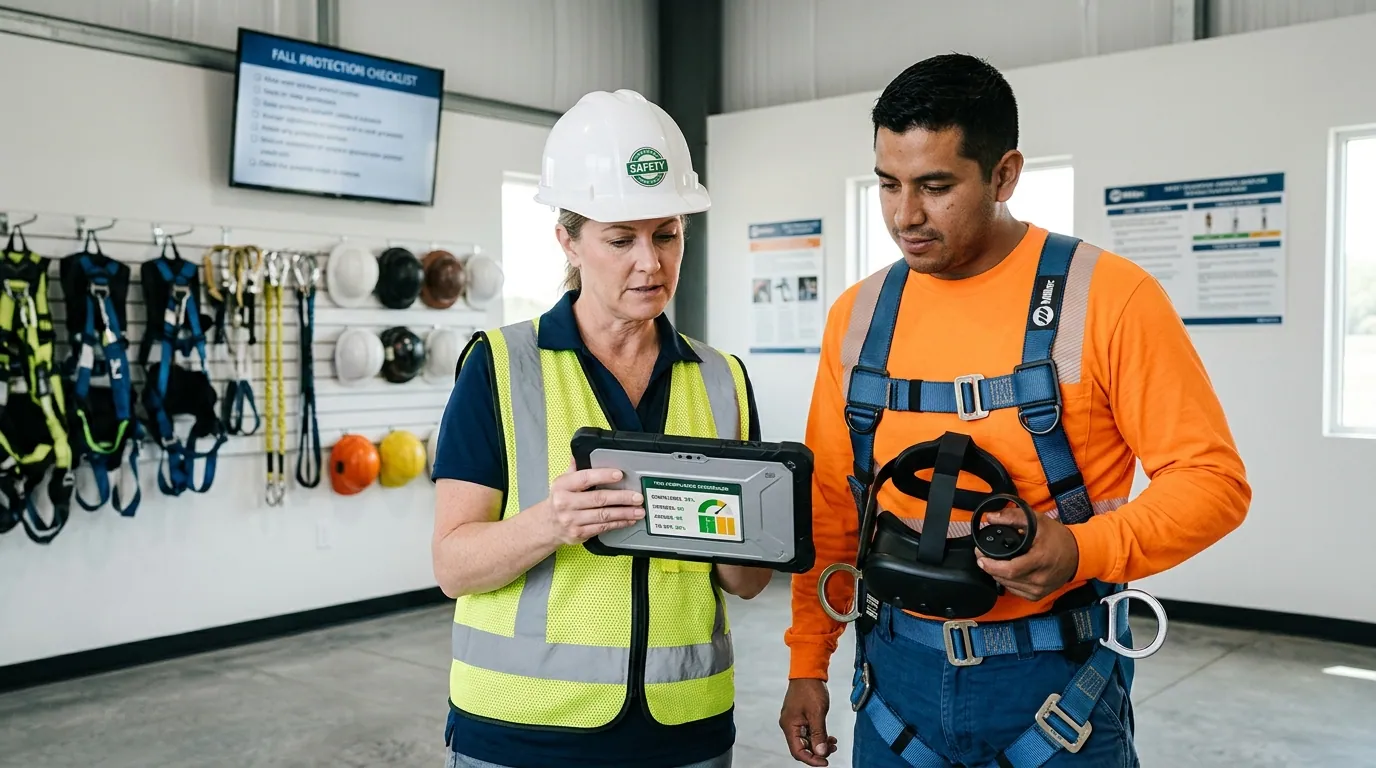
Fall protection carries some of the strictest OSHA training and documentation requirements, and VR produces exactly the evidence those standards favor. Every session logs which inspection steps a worker completed, which anchor they selected, whether they maintained tie-off, and how they responded to a fall event. That per-worker record supports OSHA 1926.501 and 1926.503 with proof of demonstrated procedure, not just attendance.
In a fall incident investigation, the difference between a signed roster and a step-by-step competency record is significant. The simulation log shows the worker was not merely instructed but verified capable, which is the standard regulators and insurers increasingly expect.
275%
VR learners are up to 275% more confident applying what they learned, critical for at-height work where hesitation or error carries fatal consequences (PwC, 2022).
What We See in Fall Protection VR Projects
- The height response is real and useful. Workers experience genuine caution at simulated elevation, which means the judgment they build transfers to the actual structure rather than staying theoretical.
- Tie-off discipline is the common failure. First-session data frequently shows workers breaking 100% tie-off during transitions, the exact behavior that causes real fall arrest failures, now visible and correctable.
- Structure-specific scenarios transfer best. A simulation modeled on the crew's actual project type, steel, roofing, tower, produces sharper judgment than a generic elevated platform.
- Repeatability matters for refreshers. Because the program is owned, annual refresher practice costs nothing extra, keeping at-height judgment sharp between projects.
Frequently Asked Questions
Why is fall protection so hard to train effectively? +
Falls are the leading cause of death in construction, yet fall protection is among the hardest topics to train because the only realistic practice environment, height, is also the most dangerous. Classroom training teaches harness components and rules but cannot replicate the judgment and physical awareness needed at elevation. Practicing on a real structure exposes the very worker who is still learning to the fall hazard. VR resolves the contradiction by letting workers practice at simulated height with zero real risk.
What can workers practice in fall protection VR training? +
Workers can practice the full fall protection workflow: inspecting and donning a harness correctly, selecting and connecting to appropriate anchor points, maintaining 100% tie-off during movement, recognizing unsafe conditions, and responding to a fall arrest event. In VR they perform these at simulated elevation, on virtual structures resembling their actual worksites, experiencing the spatial and consequence cues that classroom training cannot provide, without any exposure to a real fall.
Does fall protection VR training support OSHA compliance? +
Yes. Fall protection VR training logs each session, procedure step, and competency score, producing a timestamped per-worker record that supports OSHA fall protection standards including 1926.501 and 1926.503 training requirements. This documentation demonstrates not just that a worker received fall protection instruction but that they performed harness, anchor, and tie-off procedures correctly, evidence far stronger than a classroom sign-off during an audit or incident review.
Is VR fall protection training only for construction? +
No. While construction has the highest fall fatality rate, fall protection VR training applies to any at-height work: utilities, telecom tower work, wind energy, industrial maintenance, warehousing with elevated work platforms, and facilities management. Any operation where workers use harnesses, anchors, and elevated platforms benefits from letting them build at-height judgment in simulation before doing it for real.
What does a fall protection VR training program cost? +
Custom fall protection VR programs range from $35,000 for a focused harness and tie-off module to $150,000 or more for a full at-height program covering multiple structure types and fall arrest scenarios across several sites with analytics. Because scenarios are reused across crews and locations, per-worker cost falls at scale, and the program is owned rather than licensed per worker each year.
Ready to build at-height judgment before your crew is at height?
Tell us your project types and your fall protection requirements. We will design a simulation around your real structures.