
Safety Training for Manufacturing: Why Simulation Outperforms Classroom Training
Every manufacturing worker who is injured on a machine they were certified to operate represents the same failure: training that taught recognition instead of execution. The classroom can explain a procedure. Only practice builds the ability to perform it correctly under pressure.
QUICK ANSWER
Safety training for manufacturing outperforms classroom and video methods when it requires workers to physically practice procedures rather than watch them. VR simulation lets manufacturing workers rehearse lockout/tagout, confined space entry, and emergency response on virtual replicas of their actual equipment, building procedural memory that transfers to the floor. According to PwC, VR-trained workers complete procedures up to 4x faster and are more confident than classroom peers, while the National Safety Council reports manufacturing accounts for about 15% of U.S. workplace fatalities. Custom manufacturing safety programs range from $35,000 to $250,000.
The Difference Between Knowing and Doing
Classroom safety training is built around comprehension. A trainer explains the hazard, walks through the procedure, and confirms understanding with a quiz. The worker leaves able to describe what should happen. What the classroom never tests is whether that same worker can execute the procedure, in the correct order, on the correct energy source, in the noise and time pressure of a live production floor.
This is the knowing-doing gap, and in manufacturing it is measured in injuries. A worker can pass a written lockout/tagout test and still skip a step or isolate the wrong source on a real machine, because written knowledge and physical execution are different skills that require different training. The classroom builds the first and assumes it produces the second.
Video training has the same limitation with even less engagement. A worker watching a procedure on a screen is a passive observer. Nothing about watching builds the muscle memory or decision speed that performing the procedure under realistic conditions requires.
15%
Manufacturing accounts for roughly 15% of all U.S. workplace fatalities, and most victims held current safety training certificates (National Safety Council).
Why Simulation Changes the Outcome
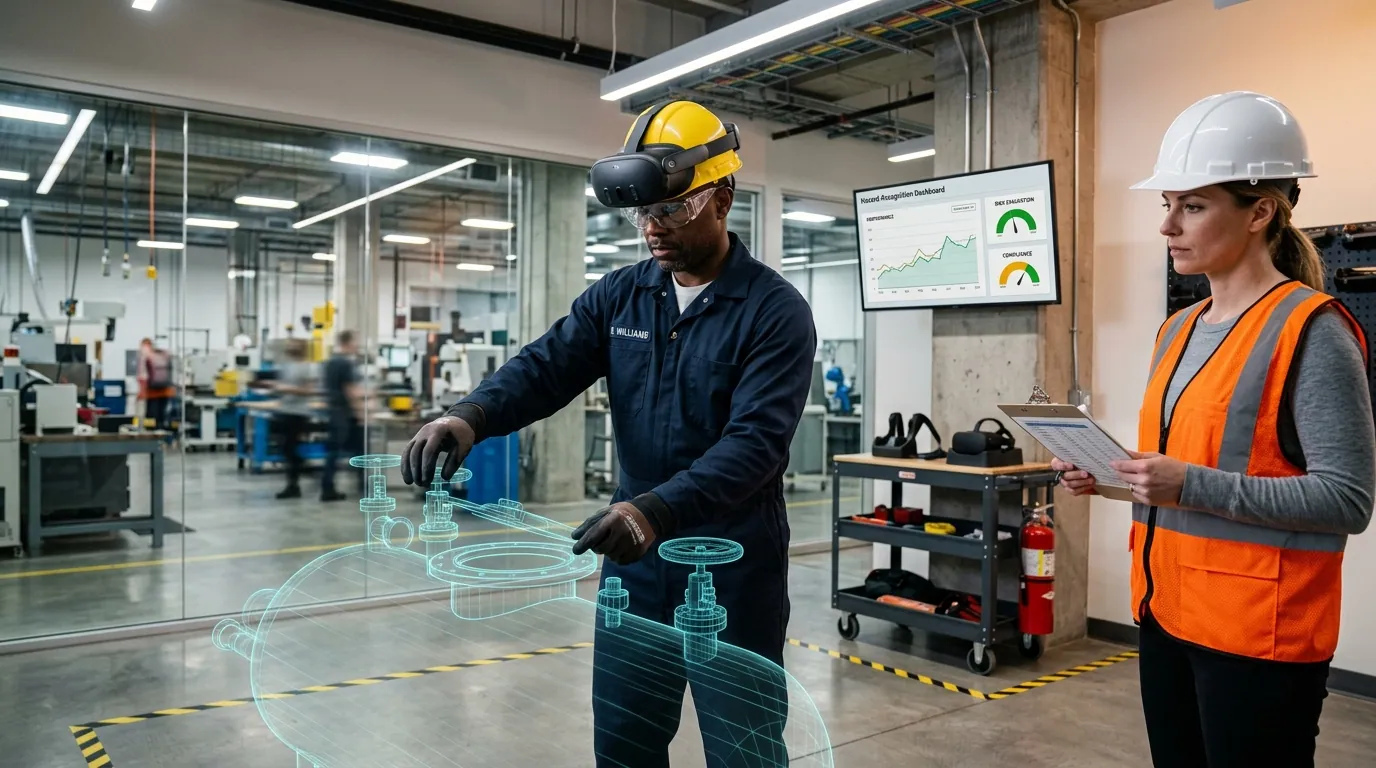
VR simulation trains the doing directly. Instead of watching or describing a procedure, the worker performs it inside a virtual replica of the exact equipment on their floor. They isolate the right energy source, follow the correct sequence, and respond to simulated hazards, repeating the full procedure 10 to 15 times before they ever touch the real machine. Errors trigger a consequence in the simulation, not an injury on the floor.
The second advantage is consistency. On-the-job training varies by shift, supervisor, and equipment condition. Simulation gives every worker the same equipment, the same procedure, the same number of repetitions, and the same evaluation. The wide competency variance that classroom plus inconsistent OJT produces collapses into a measured, uniform standard. This is the same principle behind effective VR safety and operations training across every high-risk environment.
| Method | Practices Procedure | Consistency | Competency Data |
|---|---|---|---|
| Classroom | No, described only | Varies by trainer | Quiz score |
| Video / eLearning | No, watch only | Uniform but passive | Completion only |
| On-the-job training | Once, real stakes | High variance | Supervisor judgment |
| VR Simulation | 10-15 reps, safe | Identical for all | Per-step xAPI log |
The Compliance and ROI Case
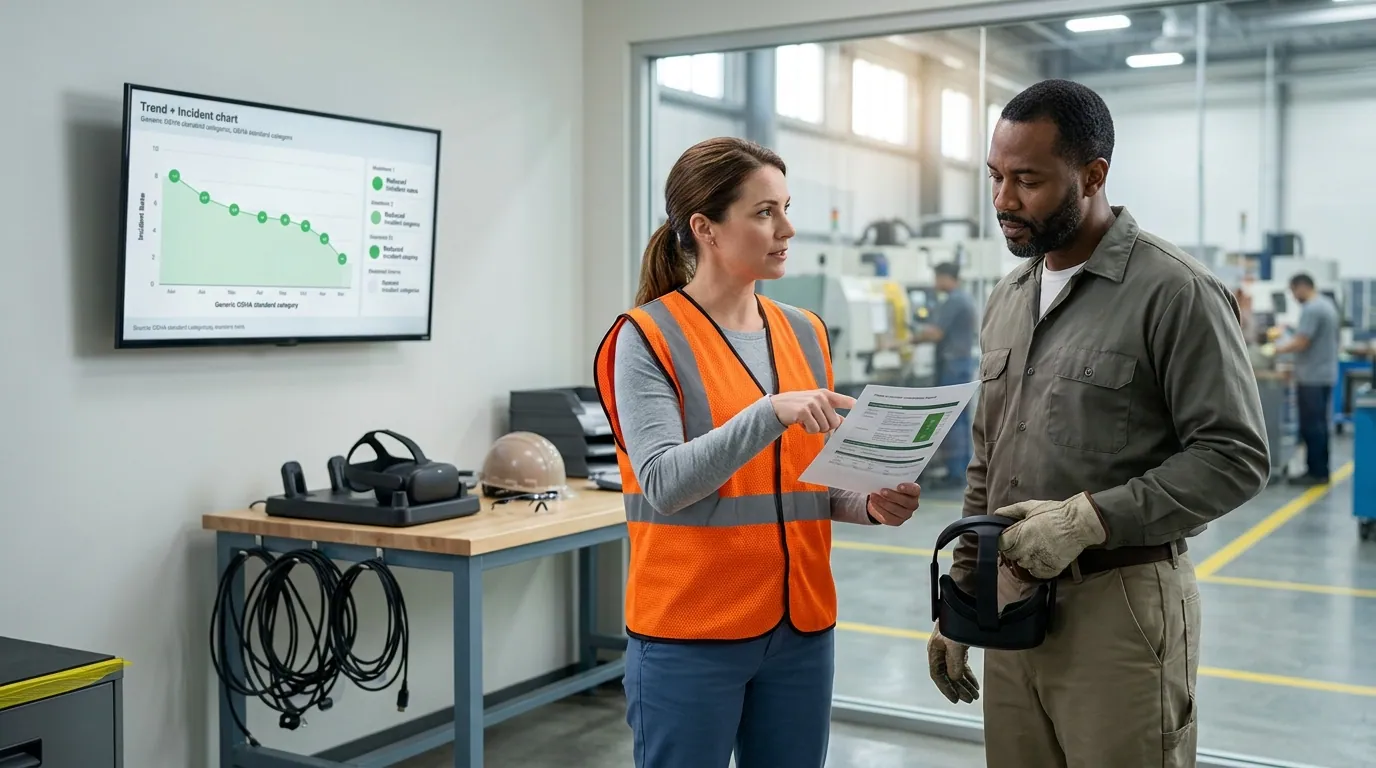
Beyond fewer incidents, simulation produces better documentation. Every session logs which steps a worker completed, where they erred, and what score they achieved, creating a timestamped competency record per worker that supports OSHA 1910.147, 1910.119, and 1910.146 far more defensibly than a sign-off sheet. When an inspector or investigator asks for proof of trained competence, the simulation record answers directly.
The financial case is equally direct. With the average serious manufacturing injury costing roughly $58,000, a program that prevents one incident a year typically pays for itself. Add the ramp-time savings from PwC's 4x faster procedural completion, and multi-site reuse, and most manufacturers recover the investment within 18 months. We walk through the full calculation in our breakdown of VR training cost.
4x
VR-trained workers complete procedural safety tasks up to 4x faster than classroom-trained peers, and report higher confidence applying the procedure (PwC, 2022).
What We See in Manufacturing Safety Deployments
Across the manufacturing safety programs we build, the same patterns hold true:
- The first session exposes hidden competency gaps. Performance data almost always shows that a portion of certified workers cannot complete the correct sequence unprompted, evidence that classroom training never measured execution.
- Short modules beat long sessions for shift workers. Manufacturing safety scenarios in 15 to 20 minute modules, completable at shift change or on break, achieve higher completion and retention than hour-long classroom blocks.
- Multilingual delivery solves a daily reality. Delivering the same procedure in English, Spanish, and other languages without bilingual supervisors extends consistent training and compliance documentation to the entire workforce.
- Equipment-replica fidelity is what makes it transfer. A scenario built on a model of your actual machine, not a generic one, produces procedural memory that carries directly to the floor.
Frequently Asked Questions
Why does classroom safety training fail in manufacturing? +
Classroom safety training fails in manufacturing because it teaches recognition, not execution. A worker who can identify the correct lockout/tagout steps on a written test may still be unable to perform them in sequence on a live machine under time pressure. Classroom and video formats require no physical practice, so they cannot build the procedural memory that high-consequence manufacturing tasks demand. Simulation closes that gap by making workers perform the procedure repeatedly before the real machine.
What safety procedures benefit most from VR simulation in manufacturing? +
High-consequence, step-dependent procedures benefit most: lockout/tagout, confined space entry, machine guarding and changeover, chemical handling, overhead crane operation, and emergency response to fire or chemical release. These are procedures where a missed step has serious consequences but which are rarely practiced under realistic conditions. VR lets workers rehearse the exact sequence 10 to 15 times, with a simulated consequence for errors rather than a real injury.
Does VR safety training satisfy OSHA documentation requirements? +
Yes, and it typically exceeds them. Custom VR safety programs log every session, every procedure step completed, every error, and every score to your LMS via xAPI. This produces a timestamped competency record per worker that directly supports OSHA standards such as 1910.147 (lockout/tagout), 1910.119 (process safety management), and 1910.146 (confined space). The record is far more detailed and more defensible during an audit or incident investigation than a classroom sign-off sheet.
How quickly do manufacturing workers reach competence with VR safety training? +
Faster than with classroom methods. PwC research shows VR-trained employees complete procedural tasks up to 4x faster than classroom-trained peers and report being significantly more confident applying what they learned. In manufacturing, this means a new hire reaches baseline procedural competency on a safety task in fewer sessions, without depending on a supervisor being available for consistent one-on-one on-the-job training.
What does manufacturing safety simulation training cost? +
Custom manufacturing safety VR programs range from $35,000 for a single high-priority procedure to $250,000 or more for multiple scenarios across several facilities with multilingual delivery and LMS integration. Per-facility cost falls sharply for multi-site operations because scenarios are reused. Most single-facility programs recover their investment within 18 months through reduced incident costs, given the roughly $58,000 average cost of a serious manufacturing injury.
Ready to close the gap between certified and competent on your floor?
Tell us your facility type and your top OSHA recordable categories. We will design a simulation program around your specific hazards.