
Manufacturing Training Software: How VR Simulation Is Replacing Legacy Systems
For two decades, manufacturing training software meant a learning management system that delivered videos and tracked completion. That model is breaking down where it matters most: procedural and safety training. The new generation of manufacturing software does not just deliver content. It measures whether a worker can actually perform the procedure.
QUICK ANSWER
Manufacturing training software is shifting from content delivery to performance measurement. Legacy learning management systems record who completed a module; VR simulation systems record whether a worker can actually execute a procedure on a replica of the equipment they operate. For procedural and safety training, manufacturers are replacing legacy systems with custom VR simulation because it builds and measures procedural memory that videos and quizzes cannot. According to PwC, VR-trained workers complete procedural tasks up to 4x faster than classroom peers, and the National Safety Council puts the average serious manufacturing injury at roughly $58,000. Custom programs range from $35,000 to $250,000.
What Legacy Manufacturing Training Software Was Built to Do
The traditional learning management system was designed for a specific job: distribute training content to a workforce, track who consumed it, and store a completion record for compliance. For that job, it works. Safety orientation videos, policy acknowledgments, and knowledge quizzes are delivered and documented at scale, which is genuinely valuable for the information layer of training.
The problem is that manufacturers asked legacy software to do something it was never built for: prepare a worker to physically perform a high-consequence procedure. A lockout/tagout sequence on a multi-energy machine has 12 to 18 steps that must be executed in the correct order on the correct energy source. An LMS can show those steps and quiz on them. It cannot make the worker perform them, and it cannot measure whether they can.
The result is a familiar gap. Every worker holds a completion certificate, yet actual procedural competency varies widely across the floor. That variance is where incidents originate, and it is invisible to software that only records completion.
$58K
Average cost of a serious workplace injury in manufacturing including direct and indirect costs. Preventing a single incident often pays back a full simulation program (National Safety Council, 2023).
What VR Simulation Software Adds: The Practice Layer
VR simulation does not replace the information layer. It adds the practice layer that legacy software is structurally unable to provide. Instead of watching a procedure, the worker performs it inside a virtual replica of the exact equipment on their floor, with the correct controls, energy sources, and hazard points. They repeat the sequence 10 to 15 times before touching the real machine, and the software measures every repetition.
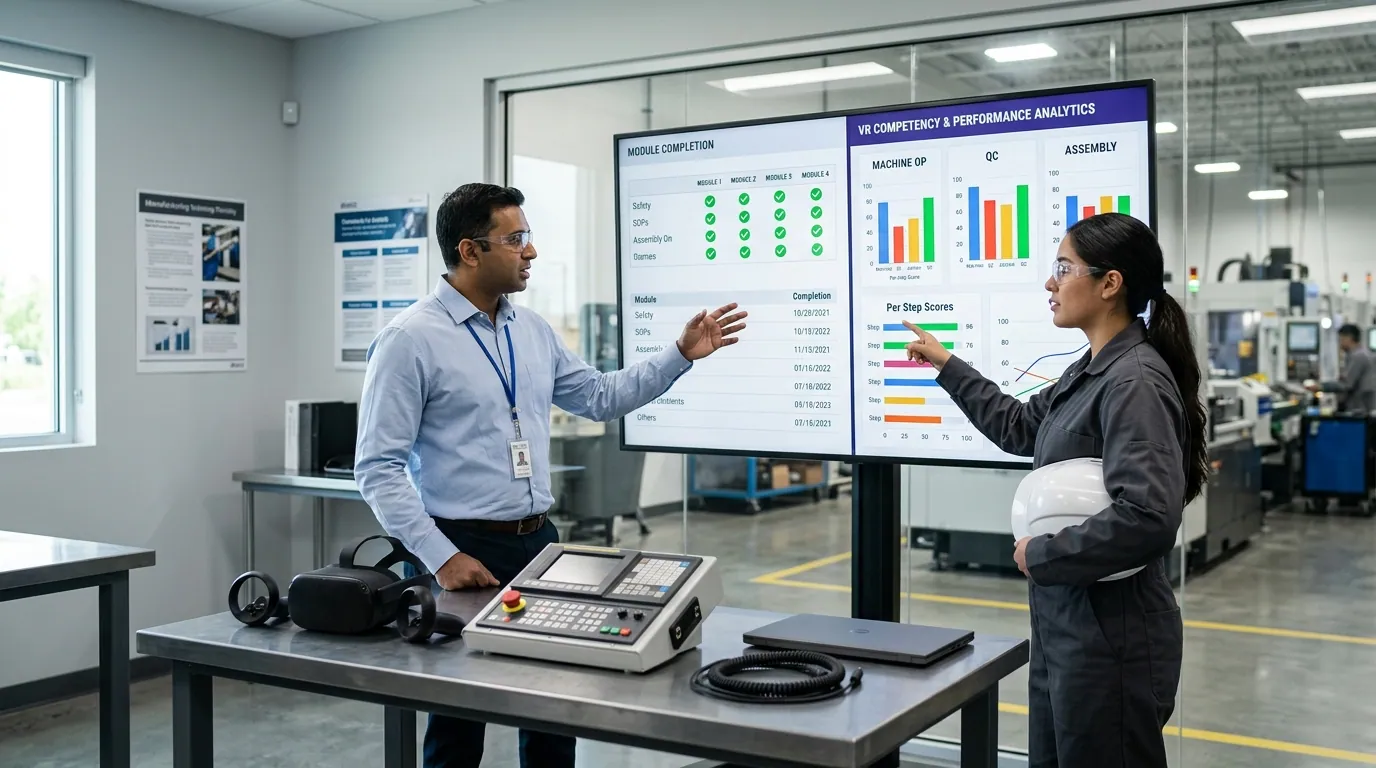
This is the practical difference between manufacturing training software that delivers content and a workforce simulation system that verifies skill. The simulation logs which steps were completed, where errors occurred, how many attempts a competency required, and what gaps remain. That data is the evidence legacy completion records never contained. Manufacturers running this model alongside their existing VR safety and operations training consistently find that the first session reveals competency gaps management did not know existed.
| Capability | Legacy LMS | VR Simulation System |
|---|---|---|
| Content delivery | Strong | Supported |
| Procedure practice | None | 10-15 reps per worker |
| Competency measurement | Quiz score only | Per-step performance data |
| Compliance record | Completion timestamp | Full xAPI step log |
| Cost model | Per seat, recurring | Owned asset, reusable |
The Economics of Replacing vs Supplementing
Legacy manufacturing learning management systems are typically licensed per seat per year, so cost scales with headcount indefinitely and you never own the asset. Custom VR simulation is a project investment, generally $35,000 to $250,000 depending on equipment complexity and facility count, after which the software is owned and reused across shifts, new hires, and sites.
For a single small facility, an LMS may remain the most economical option for the information layer. For large or multi-site manufacturers who need practical competency at scale, the owned-asset model usually costs less over a three to five year horizon than recurring per-seat licensing for comparable hands-on training, before counting incident-cost and ramp-time savings. We break the full math down in our guide to VR training cost.
4x
VR-trained workers complete procedural tasks up to 4x faster than classroom-trained peers, compressing new-hire ramp time on the production floor (PwC, 2022).
What We See When Manufacturers Make the Switch
In the manufacturing programs we develop, a few patterns repeat across nearly every deployment:
- The first session is a diagnostic, not just training. Performance data from the first scenario almost always shows that a meaningful share of certified workers cannot complete the correct sequence without prompts. That is not a workforce problem; it is proof that prior software never measured performance.
- Equipment fidelity, not visual polish, drives transfer. A scenario built on a generic machine teaches generic lessons. A scenario built on a model of your actual press, with the real control layout and energy sources, produces procedural memory that transfers directly to the floor.
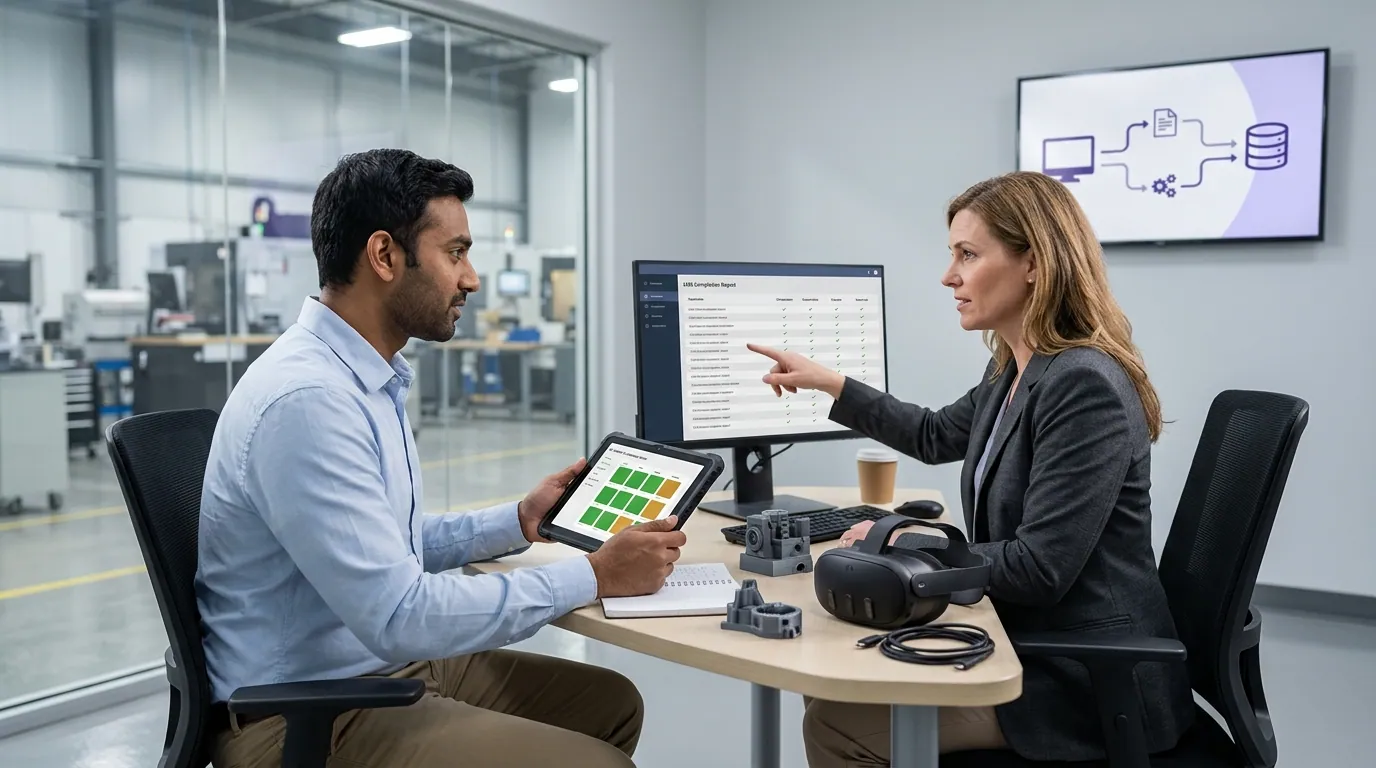
- Integration beats replacement politically. Replacing an LMS outright meets resistance. Connecting VR simulation data into the existing LMS via xAPI lets the training and compliance teams keep their system of record while gaining the performance layer they were missing.
- Reuse is where multi-site manufacturers win. Once a procedure scenario exists, deploying it to a ninth plant costs almost nothing. That reuse is what makes the owned-asset model decisively cheaper than per-seat licensing at scale.
Frequently Asked Questions
Is VR simulation a replacement for manufacturing training software, or an addition? +
For procedural and safety training, VR simulation is increasingly the replacement. For knowledge delivery, compliance tracking, and document distribution, a learning management system remains the right tool. Most manufacturers run both: the LMS handles information and records, the simulation system handles practice and competency verification. Modern programs connect the two, with VR session data flowing into the LMS via xAPI so a single system of record shows both completion and demonstrated skill.
What manufacturing training does legacy software handle poorly? +
Legacy manufacturing training software handles anything requiring physical procedure execution poorly: lockout/tagout sequences, machine changeover, confined space entry, emergency response, and quality inspection. These tasks require the worker to perform a multi-step sequence correctly under realistic conditions. A video can show the steps and an LMS can quiz on them, but neither verifies the worker can actually do it. That verification gap is exactly what VR simulation closes.
How does VR manufacturing software prove training ROI? +
VR manufacturing software proves ROI through three measurable levers. First, incident cost reduction: the National Safety Council puts the average serious manufacturing injury at roughly $58,000 in direct and indirect costs, so preventing one incident often pays for the program. Second, ramp-time compression: PwC research shows VR-trained workers complete procedural tasks up to 4x faster than classroom peers. Third, multi-site efficiency: one scenario deploys identically across every facility, eliminating duplicate per-site training builds.
Does VR manufacturing training integrate with an existing LMS? +
Yes. Custom VR manufacturing programs export performance data through xAPI (Tin Can), SCORM, or direct API integration into your existing LMS, HRIS, or learning record store. Every procedure step, error, and competency score becomes part of your existing system of record. Integration scope is defined during discovery based on your current platform and the compliance documentation you need to maintain.
What does VR manufacturing training software cost compared to legacy systems? +
Legacy manufacturing learning management systems are typically priced per seat per year, which scales with headcount indefinitely. Custom VR simulation is a project investment, generally $35,000 to $250,000 depending on equipment complexity, scenario count, and facility footprint, with the software then owned and reused. For large or multi-site manufacturers, the owned-asset model usually costs less over a three to five year horizon than recurring per-seat licensing for comparable practical training.
Wondering whether VR should replace or supplement your current training software?
Tell us what you train, what systems you run today, and your workforce size. We will give you an honest answer on where simulation fits.