
VR Training vs. Traditional LMS: When Immersive Training Wins
LMS platforms measure completion. VR training measures performance. They solve different problems. The question is which one to use for which training requirement.
QUICK ANSWER
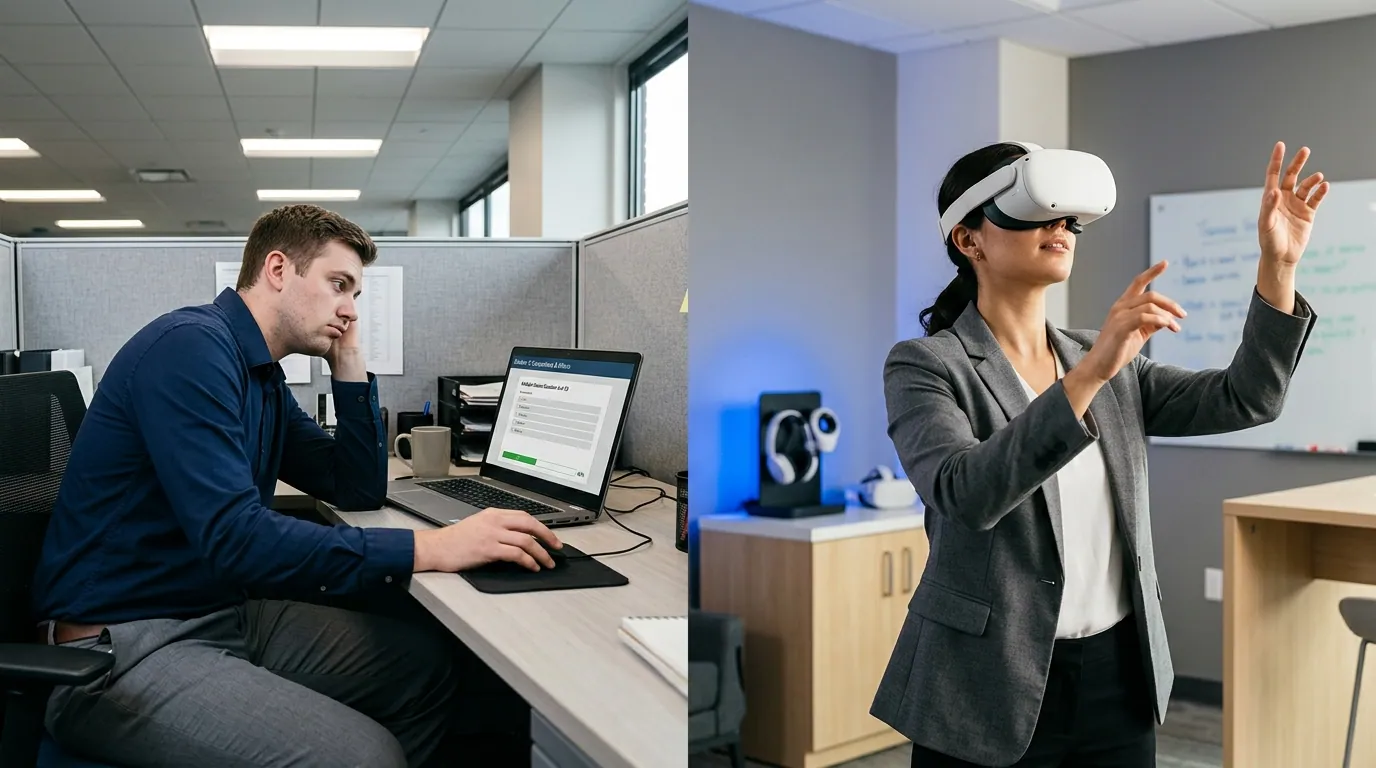
VR training outperforms LMS when the goal is practiced performance, not content completion. LMS platforms are best for compliance records, policy delivery, and knowledge checks. VR is stronger for safety procedures, high-pressure decisions, sales conversations, and any scenario where employees must practice before performing. PwC found VR learners were 275% more confident applying skills and completed training 4x faster than classroom methods. The right approach for most enterprises is both systems serving different training needs.
The Core Tension: Completion vs. Competence
Your LMS dashboard shows 94% training completion across the organization. Leadership sees green checkmarks. Then an employee makes the same mistake the training was designed to prevent. The disconnect is structural: completing a module is not the same as being able to perform the skill.
LMS platforms are designed for information delivery. They excel at it. But for training that requires a practiced response, the completion metric tells you nothing about whether the employee can actually perform under pressure.
275%
VR-trained learners were 275% more confident applying skills compared to classroom training, and 4x faster to train than in-person instruction (PwC, 2020 VR Soft Skills Study)
What LMS Does Well
LMS platforms are not the problem when used for the right applications:
- Compliance documentation: Tracking who completed required training, when, and generating audit-ready records.
- Information delivery: Policy updates, product knowledge, procedural reference materials that employees need to read and acknowledge.
- Scalable simple content: Training that can be delivered effectively through video, text, and multiple-choice assessment.
Where LMS Falls Short
LMS fails when the training goal is behavior change, not information retention:
Safety procedures under pressure
Watching a video on fall protection does not prepare a worker to react correctly when they lose footing at height. Companies investing in VR safety training report that practiced response is fundamentally different from watched instruction.
Customer and sales interactions
Reading about objection handling does not prepare a sales rep to respond in real time when a buyer pushes back on pricing. Organizations using VR for sales team training find that rehearsed delivery converts at higher rates than scripted knowledge.
High-stakes operational decisions
Passing a quiz on emergency response procedures does not mean an employee can execute those procedures when alarms are sounding and adrenaline is flowing.
VR vs. LMS: Side-by-Side Comparison
| Training Need | LMS | VR Training |
|---|---|---|
| Compliance tracking | Strong | Integrates via xAPI/SCORM |
| Safety response practice | Weak (video only) | Strong (active practice) |
| Sales objection handling | Limited (scripted) | Strong (rehearsed delivery) |
| Emergency decisions | Weak (quiz-based) | Strong (simulated pressure) |
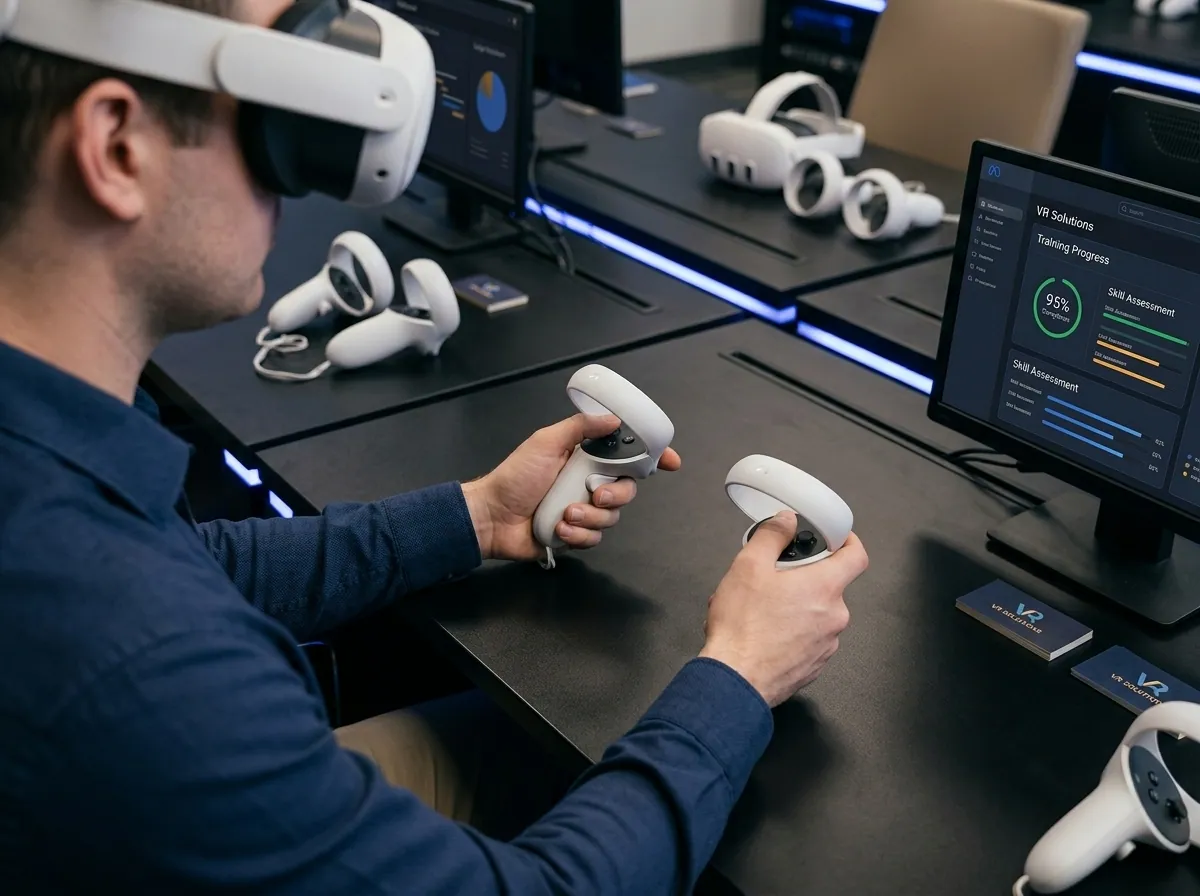
| Performance measurement | Completion rates | Behavior scores, reaction time, decision accuracy |
| Training speed | Self-paced, variable | 4x faster than classroom (PwC) |
| Upfront cost | $5K-$20K/year | $25K-$500K custom build |
| Best for | Know (information) | Do (performance) |
What VR Adds to the Training Stack
VR training addresses the gap between knowing and doing:
Practice under realistic conditions
Employees practice the actual scenario, not a description of it. The environment creates pressure, demands a response, and provides immediate feedback on the decision made.
Repetition without risk
Employees can fail, retry, and improve without real consequences. Walmart used STRIVR's VR platform to prepare associates for Black Friday scenarios, reducing training time from 8 hours to 15 minutes while improving assessment scores by 70% (STRIVR, 2023).
Performance data, not completion data
VR generates data on how the employee performed: what decisions they made, how quickly they responded, where they hesitated. This is measurable competence, not a checkbox.
96%
Walmart reduced VR training time by 96%, from 8 hours of classroom instruction to 15 minutes of immersive practice, while associates scored 70% higher on post-training assessments (STRIVR, 2023)
VR Does Not Replace Your LMS
This is not an either/or decision. VR training programs connect to your existing LMS through xAPI, SCORM, or direct API integration. Your LMS remains the system of record for training administration and compliance. The VR program becomes the practice and performance layer for the 5% to 15% of training moments where mistakes are expensive, dangerous, or impossible to simulate any other way.
The question is not "should we replace our LMS with VR?" It is "which training problems are we failing to solve with our LMS alone?" Those are the problems VR addresses. For a detailed breakdown of program investment, see our VR training pricing guide.
What We See in Custom VR Training Projects
From building enterprise VR training programs, we consistently observe:
- Companies do not need VR for everything. They need it for the 5% to 15% of training moments where the cost of failure is high: safety incidents, lost deals, compliance violations, equipment damage.
- Pilots convert to full programs. Organizations that start with a single-department pilot almost always expand. Once leadership sees performance data instead of completion data, the conversation changes.
- LMS integration is standard, not optional. Every enterprise client requires their VR program to feed data back into their existing LMS. We build xAPI/SCORM integration into every project from day one.
- The biggest ROI comes from the hardest-to-train scenarios. The more dangerous, expensive, or emotionally complex the real-world scenario, the higher the return on VR training investment.
The ROI Argument
LMS ROI is measured in compliance completion rates and cost-per-learner for content delivery. VR ROI is measured differently: reduced incidents, faster time-to-productivity, and fewer errors from employees who practiced before performing.
The National Safety Council estimates workplace injuries cost U.S. employers $171 billion annually. A single prevented safety incident can exceed the cost of an entire VR training program. For enterprise training deployments, the math becomes clear when you compare program cost against the cost of the problems the program prevents.
The investment is higher. The return is measurable in outcomes that affect the bottom line, not just training department dashboards.
Can VR training integrate with an existing LMS? +
Yes, VR training integrates with existing LMS platforms using xAPI (Tin Can), SCORM, or direct APIs to sync performance data automatically. The VR program handles practice and performance measurement. The LMS remains the system of record for training administration and compliance documentation. Most enterprise LMS platforms support xAPI out of the box.
Is VR training more expensive than LMS platforms? +
$25,000 to $500,000 for custom VR programs vs. $5,000 to $20,000/year for off-the-shelf LMS subscriptions. VR has a higher upfront cost because it is custom-built for your scenarios. The comparison is not cost-per-module but cost-per-competent-employee. PwC found VR training was 4x faster than classroom and 1.5x faster than eLearning, which compresses the payback period.
When should a company use VR training instead of eLearning? +
Use VR when the training requires decision-making under pressure, physical procedure practice, or high-stakes interactions where failure is expensive. Use eLearning/LMS when the goal is information delivery, compliance documentation, or simple knowledge transfer. Most organizations benefit from both systems serving different training needs.
Does VR training actually improve retention? +
Yes. PwC found VR learners were 275% more confident applying skills after training compared to classroom learners. STRIVR reported Walmart associates trained in VR scored 70% higher on assessments than those trained with traditional methods. The improvement comes from active practice, not passive consumption.