
Welding Simulation Training: Replace Repetitive Torch Time
Welding simulators let trainees practice arc starts, bead control, and proper technique on virtual workpieces before touching real steel, reducing consumable costs and accelerating certification readiness.

Hugo Ramirez
Quick Answer
Welding simulation training uses VR to let trainees practice arc starts, joint types, and technique before touching real metal. Simulators track arc length, travel speed, and electrode angle, providing objective feedback per pass. Programs using structured simulation report up to 30% faster progression to certification-ready performance and significant reductions in rod and gas consumption during training.
Why Welding Is Hard to Train at Scale
The skilled trades shortage is measurable. The American Welding Society projects a shortfall of 330,000 welders by 2028. Community colleges and apprenticeship programs are absorbing demand, but training space, instructor availability, and consumable costs create real bottlenecks.
A single welding trainee burns through 10 to 15 pounds of rod, gas, and base metal per week during foundation practice. Multiply that by a 20-person cohort and the consumable budget for eight weeks of training can exceed $40,000 before a single trainee picks up a production job.
The deeper problem is feedback quality. An instructor watching five trainees simultaneously cannot give real-time corrective guidance on arc length to each one. Simulation solves both problems: zero consumables for foundation practice, and objective per-pass feedback on every metric an instructor would evaluate.
330K
Welder shortage projected by 2028 (American Welding Society)
40%
Reduction in consumable spend reported by programs using structured simulation for foundation training
What a Welding Simulator Actually Measures
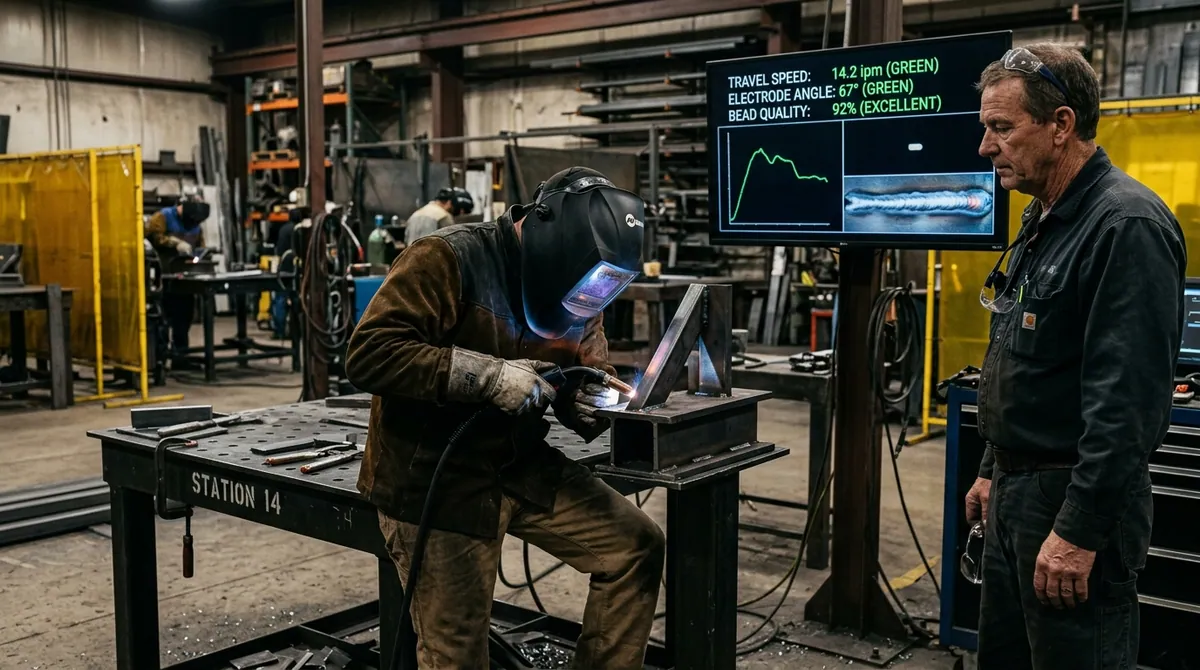
A welding simulator is not a game. It uses a physical torch replica with haptic feedback, a head-mounted display, and physics modeling to replicate the arc environment. The system captures data on every pass:
- Arc length: distance between electrode tip and workpiece, measured continuously
- Travel speed: torch movement rate relative to ideal for the joint and process
- Work angle and travel angle: electrode orientation in both planes
- Heat input: calculated from arc parameters, flags cold laps and burn-through risk
- Bead quality score: composite metric from all of the above
That data feeds into an LMS via xAPI. Instructors see per-trainee progression over time, not just whether someone showed up. For apprenticeship programs with AWS certification requirements, this record supports competency documentation at each stage.
Simulation vs Live Practice: How Programs Use Both
Effective welding training programs do not choose between simulation and live practice. They sequence them. Simulation handles foundational repetitions. Live practice handles job-specific conditions, material thickness variations, and certification runs.
| Training Phase | Best Delivery | Reason |
|---|---|---|
| Arc start and stability | Simulation | Unlimited repetition, no consumables |
| Bead geometry and consistency | Simulation first, live second | Simulation builds muscle memory; live validates real metal behavior |
| Joint types (butt, fillet, T-joint) | Both | Simulation for repetition; live for metallurgical result |
| Position welding (2G, 3G, 4G) | Live, simulation as prep | Certification requires real metal; simulation builds angle confidence |
| AWS certification test | Live only | AWS requires actual coupon; simulation is prep layer |
What We See in Custom Workforce Simulation Programs
- Programs that integrate simulation into the first four weeks of a 12-week program reduce consumable spend by 35 to 45% while maintaining or improving first-attempt certification rates
- Instructor-to-trainee ratios can increase from 1:5 to 1:10 during simulation phases, because the system provides individual feedback the instructor previously had to give manually
- Trainees who complete 20 or more scored simulation passes before live practice show measurably better arc length discipline in their first live sessions
- LMS integration via xAPI allows manufacturers to tie welding competency records to individual employee files, supporting both OSHA and customer quality audits
How to Implement a Welding VR Simulation Program
Welding simulation programs require careful integration with your existing hands-on training curriculum. The goal is to increase productive arc time on real metal by using simulation to build the foundational technique that would otherwise be developed through costly material consumption.
- Define the simulation scope: Identify which weld processes (SMAW, MIG, TIG, flux-core) and joint types your apprentices train on. Build or license simulation content that directly mirrors these. Generic welding simulation that does not match your program's process mix produces limited transfer.
- Set performance thresholds: Configure the simulator's scoring parameters to match AWS certification standards or your program's evaluation rubric. Travel speed, arc length, electrode angle, and bead width tolerances should mirror what your live evaluators assess. If the simulator rewards different behavior than your evaluators, it will build wrong technique.
- Establish a simulation-to-live ratio: A common starting ratio is 60% simulation to 40% live arc time in the first 8 to 12 weeks of an apprenticeship. Adjust based on competency data. Apprentices who reach target scores in simulation faster can move to live practice sooner.
- Track consumable spend as a control metric: Before the program launches, log your average electrode, wire, and material cost per apprentice through the first certification test. After 6 to 12 months with simulation, recalculate. The difference is the measurable ROI of the simulation investment.
- Integrate xAPI records with your LMS: Simulator session data (arc time, travel speed compliance, angle deviation) should export to your training management system automatically. This gives instructors granular data for coaching conversations without requiring them to observe every simulation session.
When Welding Simulation Is Not a Substitute for Live Training
Welding simulation is a pre-training and repetition tool. There are specific points in a welder's development where live metal is required and simulation cannot substitute.
- AWS certification testing: AWS D1.1 and all AWS certification tests require actual coupons welded on real metal. No simulation platform's output satisfies AWS examination requirements. Simulation prepares; live training certifies.
- Heat management and material behavior: Understanding how different base metals respond to heat input, how weld pools behave at elevated temperatures, and how cooling affects bead profile requires live metal. Simulation models these principles, but tactile and visual feedback from real metal is not fully replicated.
- Position welding for certification: 2G, 3G, and 4G position welding requires physical orientation of the torch and body relative to actual gravity and real material. Simulation can build the mental model and angle awareness, but live position practice is required for the physical adaptation to transfer.
- Experienced welders recertifying: A welder with 10 years of experience recertifying on a new process gains minimal value from simulation. VR simulation is most valuable for trainees who have fewer than 200 hours of live arc time.
Frequently Asked Questions
Can VR welding simulators replace hands-on training entirely? +
No. VR welding simulators are a practice layer, not a replacement for real steel time. They accelerate foundational skill development so trainees arrive at the torch with better technique and fewer wasted consumables. Most programs use 40-60% simulation and 40-60% live welding.
Which welding processes can be simulated in VR? +
Modern welding simulators support SMAW (stick), GMAW (MIG), GTAW (TIG), and FCAW processes. Some platforms also simulate plasma cutting and gouging. Process fidelity varies by system, so verify which certifications the platform supports before purchasing.
How much does a VR welding training program cost? +
Off-the-shelf welding simulators (Lincoln VRTEX, Miller Welding Simulator) range from $30,000 to $80,000 per unit. Custom-built VR welding programs integrated into a broader workforce simulation system typically run $75,000 to $250,000 depending on scope, number of processes, and LMS integration.
Does VR welding training help with AWS certification preparation? +
Yes. Simulators that track arc length, travel speed, work angle, and travel angle give trainees the same feedback an AWS examiner evaluates. Programs using structured simulation practice show faster progression to certification-ready performance, though the actual certification test always requires real metal.
What data does a welding simulator capture? +
A welding simulator captures arc-on time, arc length consistency, travel speed, electrode angle, work angle, heat input, and bead quality score per pass. This data feeds directly into an LMS via xAPI, giving instructors a per-trainee competency record instead of a pass/fail stamp.
Building a welding simulation program?
Schedule a discovery call to discuss your training volume, processes, and certification requirements.