
Warehouse Safety Training Programs: Simulation vs Traditional Methods
A warehouse is a moving environment: forklifts, pedestrians, loaded racking, and busy docks sharing tight space. Safety in that environment is spatial judgment, and spatial judgment cannot be learned from a video. The difference between traditional warehouse safety programs and simulation comes down to whether the worker ever actually practices.
QUICK ANSWER
Warehouse safety training programs reduce forklift, racking, and dock incidents far more effectively when workers practice in simulation rather than watch videos. VR lets warehouse workers rehearse forklift maneuvering, load handling, pedestrian awareness, and near-miss response inside a virtual replica of the facility, building the spatial judgment a warehouse demands without real-world risk. According to PwC, VR learners reach competence up to 4x faster than classroom learners. Custom warehouse safety programs range from $35,000 to $200,000 depending on hazard scope and facility count.
Why Traditional Warehouse Safety Training Falls Short
The standard warehouse safety program is a stack of videos and an orientation walkthrough. A new worker watches the forklift safety module, signs the acknowledgment, and is cleared to operate. The video covered the rules. What it could not do is let the worker practice judging a turn radius with a loaded mast, recognizing a pedestrian in a blind aisle, or reacting when a load shifts. Those are spatial, real-time skills, and watching builds none of them.
On-the-job training helps but introduces risk: the worker practices spatial judgment on a real forklift, in a real aisle, around real people. The near-miss scenarios that would teach the most, a pedestrian stepping out, an unstable load, a blind-corner conflict, are exactly the ones too dangerous to stage. So the most valuable lessons are the ones traditional programs can never deliver safely.
$20K+
Forklift and powered-industrial-truck incidents drive significant warehouse injury costs and OSHA citations under standard 1910.178, making prevention training a direct cost lever.
What Simulation Trains That Video Cannot
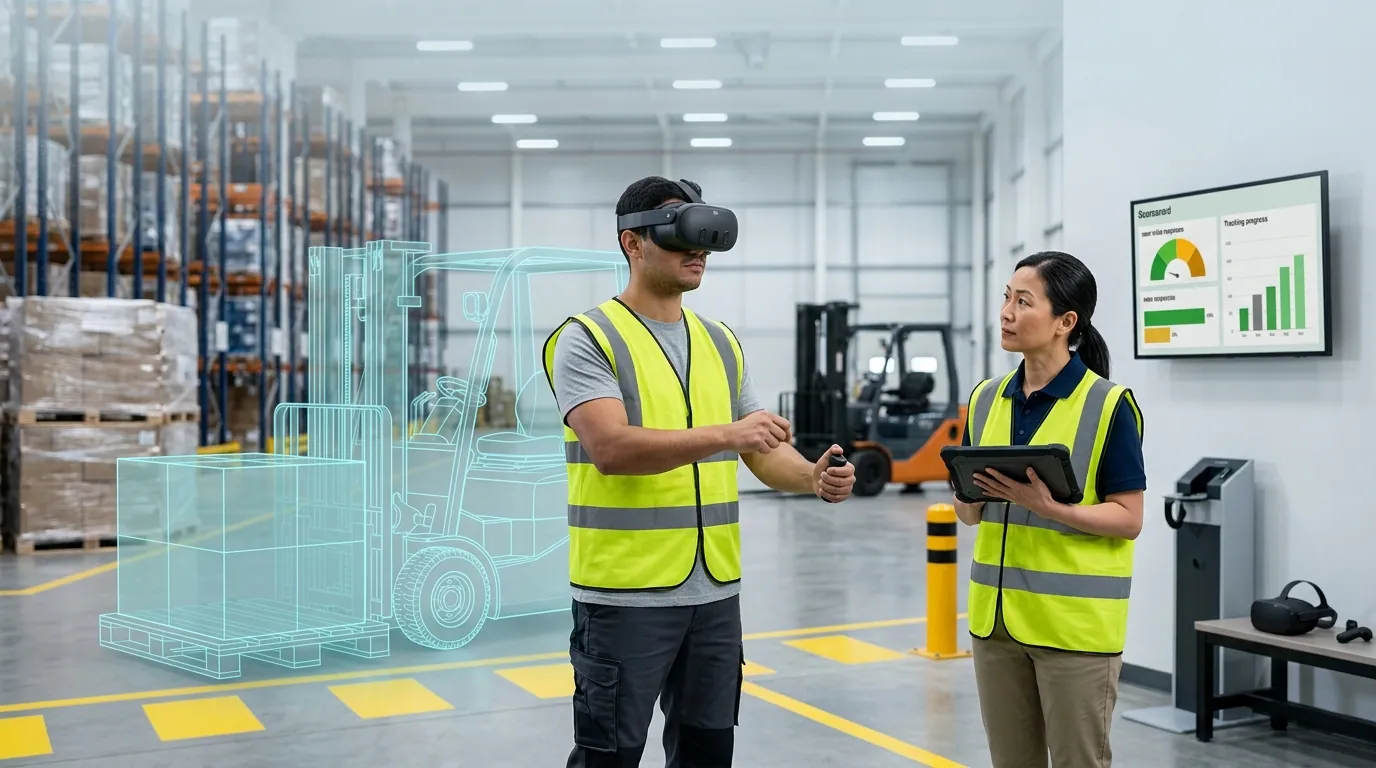
VR recreates the warehouse as an interactive environment where the worker practices the exact spatial decisions the job requires, and where dangerous scenarios can be staged safely. Inside a virtual replica of the facility layout, workers rehearse the situations that cause real injuries, with a simulated consequence for error instead of a real one. This is the same simulation principle behind effective VR safety and operations training in every high-risk setting.
- Forklift operation and load handling: Practice maneuvering, load center judgment, and mast control in tight aisles without risking real product, racking, or people.
- Pedestrian and equipment conflict: Train the blind-aisle and intersection awareness that prevents the most serious warehouse injuries, with simulated pedestrians the worker must anticipate.
- Racking and storage safety: Practice safe load placement and recognizing damaged or overloaded racking before it becomes a collapse hazard.
- Dock and trailer procedures: Rehearse trailer chocking, dock plate use, and the sequence that prevents trailer creep and fall incidents.
| Method | Spatial Practice | Near-Miss Scenarios | Competency Record |
|---|---|---|---|
| Safety video | None | Watch only | Completion only |
| Classroom | None | Described | Quiz score |
| On-the-job training | Real, risky | Too dangerous to stage | Variable |
| VR Simulation | Repeated, safe | Staged safely | Per-step xAPI log |
Compliance and the High-Turnover Advantage
Warehouse operations live with high turnover, which makes safety training perpetual. A simulation program delivers identical, measured practice to every new hire without depending on a trainer's availability, and it documents demonstrated competence per worker, supporting OSHA 1910.178 and general duty requirements far more defensibly than a stack of signed video acknowledgments.
The turnover that makes traditional programs expensive and inconsistent is exactly what makes simulation pay off. With PwC reporting up to 4x faster competence, new workers reach safe operating capability sooner, and the program scales across every distribution center without scaling the trainer headcount. We detail the economics in our breakdown of VR training cost.
4x
VR learners reach competence up to 4x faster than classroom learners, a decisive advantage for high-turnover warehouse operations (PwC, 2022).
What We See in Warehouse Safety Deployments
- Layout fidelity drives transfer. A simulation built on the actual aisle widths, racking heights, and dock configuration of the facility produces judgment that carries to that floor, generic warehouse models do not.
- Near-miss scenarios change behavior fastest. Letting workers experience a simulated blind-aisle conflict, safely, builds the anticipatory habits that prevent the real version.
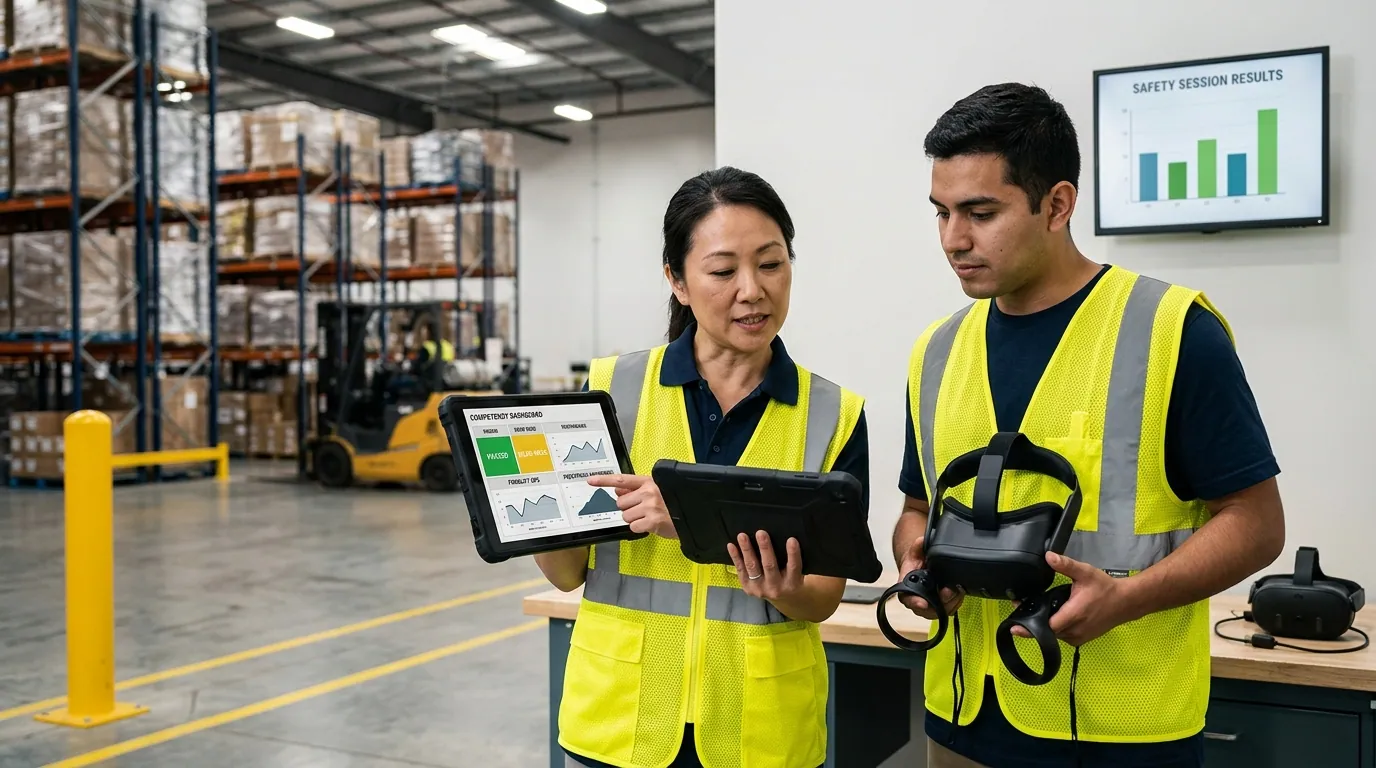
- The first session reveals overconfidence. Performance data frequently shows that experienced operators misjudge load center or pedestrian timing, a gap no completion record would have surfaced.
- Multi-site reuse compounds quickly. One warehouse safety program deployed across every DC standardizes practice and makes the owned-asset model decisively cheaper than per-worker licensing.
Frequently Asked Questions
What makes warehouse safety training programs fail? +
Most warehouse safety training programs fail because they rely on videos and orientation sessions that workers watch once and never practice. Warehouse hazards, forklift operation, racking interaction, dock and trailer safety, and pedestrian-equipment conflict, are dynamic and spatial. They cannot be learned by watching. A worker who passed a forklift safety video can still misjudge a turn radius or a load center on the floor. Simulation closes that gap by letting workers practice the spatial judgment a warehouse demands.
Can warehouse forklift and equipment operation be trained in VR? +
Yes. VR is particularly effective for spatial and equipment-operation tasks. Workers can practice forklift maneuvering, load handling, pedestrian awareness, and dock procedures in a virtual replica of a warehouse layout, including near-miss scenarios that would be far too dangerous to stage in a real facility. The simulation can place a pedestrian in a blind aisle or simulate an unstable load, training the worker recognition and response without any real risk.
How do VR warehouse safety programs support OSHA compliance? +
VR warehouse safety programs log every session, procedure step, and competency score, creating a timestamped per-worker record that supports OSHA standards including 1910.178 (powered industrial trucks) and general duty requirements for warehouse operations. This documentation is more detailed and more defensible than a sign-off sheet, providing evidence of demonstrated competence rather than mere attendance during an audit or incident investigation.
Are warehouse safety simulations worth it for high-turnover operations? +
High turnover is precisely where simulation pays off. The constant inflow of new workers means safety training is continuous, and a simulation program delivers the same consistent, measured practice to every new hire without depending on a trainer being available. PwC research shows VR learners reach competence up to 4x faster, which in a high-turnover warehouse means new workers reach safe operating competence sooner and with less reliance on stretched supervisors.
What does a warehouse safety VR program cost? +
Custom warehouse safety VR programs range from $35,000 for a focused forklift or dock-safety module to $200,000 or more for a full program covering multiple hazard categories across several distribution centers with analytics and LMS integration. For multi-site logistics operations, per-facility cost falls sharply because warehouse layouts and scenarios are reused, and the program is owned rather than licensed per worker each year.
Ready to train warehouse safety the way the floor actually works?
Tell us your facility layout and your top incident categories. We will build a simulation around your real hazards.