
Manufacturing Safety Programs That Actually Reduce Incidents
Most manufacturing safety programs are excellent at one thing: producing the paperwork that proves training happened. Far fewer can prove the training worked. The gap between a program that documents compliance and one that reduces injuries is the difference between attendance and competence.
QUICK ANSWER
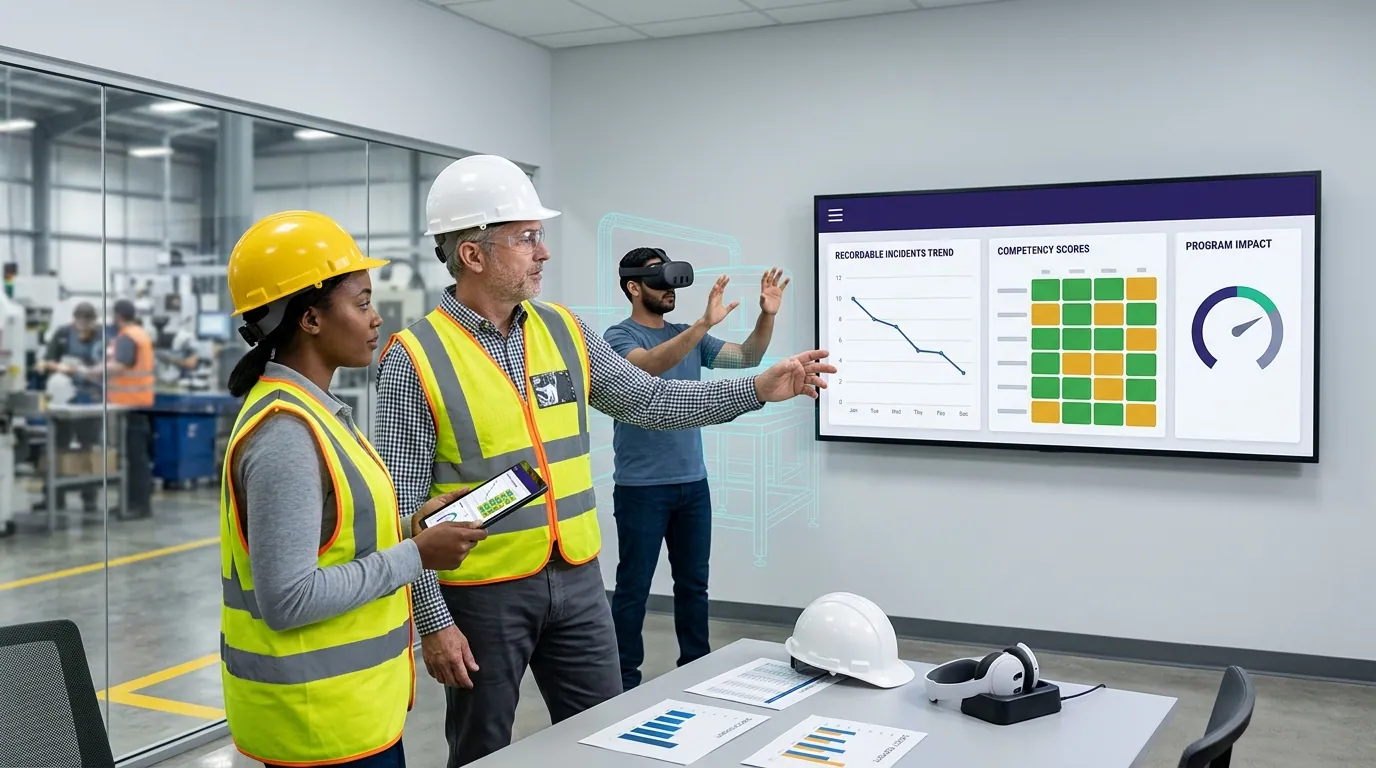
Manufacturing safety programs that actually reduce incidents share one trait: they measure whether workers can perform procedures, not just whether they attended training. Compliance-only programs document attendance and signatures but never verify competence, so incidents continue. Programs that lower injury rates add a practice-and-measurement layer where workers execute high-consequence procedures repeatedly with errors corrected, exactly what VR simulation delivers. With the average serious manufacturing injury near $58,000 and manufacturing at roughly 15% of U.S. workplace fatalities (National Safety Council), the practice layer pays for itself. Custom programs range from $35,000 to $250,000.
The Compliance Trap
A manufacturing safety program is usually judged by its documentation: training records on file, acknowledgments signed, modules completed on schedule. That documentation matters, it protects the company and satisfies regulators, but it measures the wrong thing if the goal is fewer injuries. A signature proves a worker was present. It says nothing about whether that worker can isolate the correct energy source on a live machine.
This is the compliance trap. A program can be fully compliant, audit-ready, and complete on paper while incident rates stay flat, because the program never verified competence. The recordables keep coming from the same gap: workers who were trained, certified, and documented, but never actually proven capable of performing the procedure under real conditions.
$58K
Average cost of a serious manufacturing injury including direct and indirect costs, so even a modest reduction in recordables produces real financial return (National Safety Council, 2023).
What Incident-Reducing Programs Do Differently
Programs that move the incident needle add a layer the compliance-only model lacks: practice with measurement. Workers do not just learn about a high-consequence procedure, they perform it repeatedly until the data shows they can, with errors surfaced and corrected before they reach the floor. That layer is exactly what VR simulation contributes, sitting on top of the existing compliance backbone rather than replacing it.
In practice, the worker completes the same lockout/tagout, confined space, or machine procedure inside a virtual replica of the real equipment, and every step, error, and score is logged to the LMS via xAPI. The safety program keeps its policy, orientation, and documentation; it gains the missing evidence that workers can actually do what they were trained on. This is the principle behind our manufacturing workforce simulation systems and the broader case in safety training for manufacturing.
| Program Element | Compliance-Only Program | Incident-Reducing Program |
|---|---|---|
| What it measures | Attendance | Demonstrated competence |
| Procedure practice | None or one-time OJT | Repeated, measured |
| Evidence on audit | Signatures | Per-step competency log |
| Effect on recordables | Often flat | Measurable decline |
Measuring Whether the Program Works
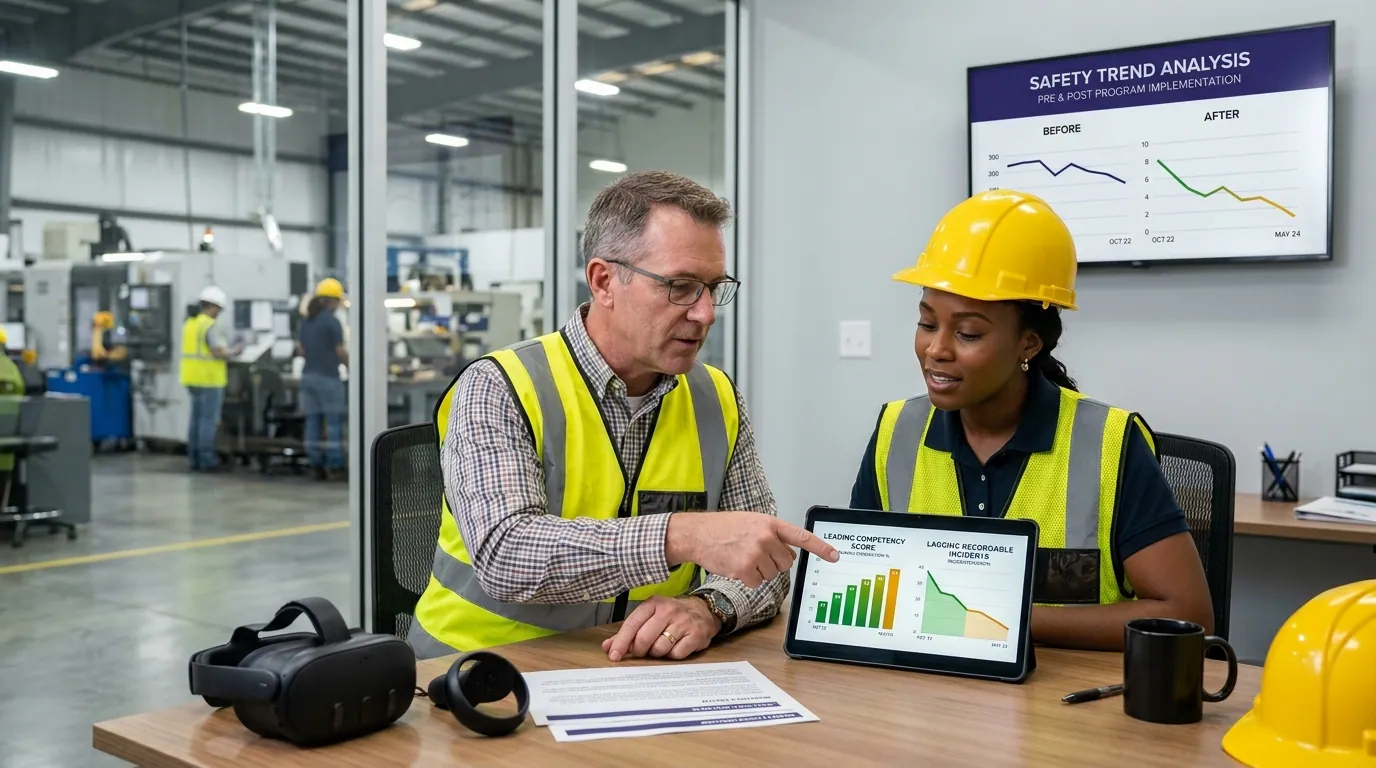
An incident-reducing program is provable. Leading indicators, per-worker competency scores and training error rates, show whether workers are actually getting better at the procedure. Lagging indicators, recordable incident rate, near-miss frequency, and severity, show whether that improvement reaches the floor. A working program shows competency rising in simulation and recordables declining in the quarters that follow.
That measurability is what lets a safety leader defend the program's budget. Instead of reporting that training was completed, they can report that competency improved by a measured amount and recordables fell, tied to a roughly $58,000 cost per serious injury avoided. We lay out the full ROI logic in our breakdown of VR training cost.
15%
Manufacturing accounts for roughly 15% of all U.S. workplace fatalities, the reason a program that only documents compliance is not enough (National Safety Council).
What We See in Safety Program Redesigns
- The baseline data is sobering and useful. The first simulation sessions almost always reveal that a meaningful share of certified workers cannot complete the procedure unprompted, the hidden source of recordables.
- Adding to the program beats replacing it. Layering simulation onto the existing compliance backbone wins faster internal buy-in than scrapping a documented program leadership trusts.
- Leading indicators justify the budget. Safety leaders who can show rising competency scores defend the investment long before lagging incident data confirms it.
- Reuse drives multi-site adoption. Once a procedure scenario exists, extending the incident-reducing program to another plant costs little, which is what makes enterprise rollout viable.
Frequently Asked Questions
Why do most manufacturing safety programs not reduce incidents? +
Most manufacturing safety programs are built to satisfy compliance, not to change behavior. They document that workers attended training and signed acknowledgments, which protects the company on paper but does not verify that any worker can actually perform a procedure safely under real conditions. Incidents keep happening because the program measured attendance instead of competence. Programs that reduce incidents add a practice-and-measurement layer, which is exactly what VR simulation provides.
What separates a compliance program from a program that reduces injuries? +
A compliance program answers "did we train them" with a signature. A program that reduces injuries answers "can they perform the procedure" with performance data. The difference is the practice layer: workers must actually execute high-consequence procedures, repeatedly, with errors measured and corrected, before they face the real equipment. When a safety program can show per-worker competency data rather than just completion records, incident rates follow.
How does VR simulation fit into an existing manufacturing safety program? +
VR simulation slots in as the practice and verification layer for high-consequence procedures while your existing program continues to handle policy, orientation, and documentation. Workers complete the same lockout/tagout, confined space, or machine procedures in simulation, and the performance data flows into your LMS via xAPI. You keep your compliance backbone and add the missing evidence that workers can actually perform what they were trained on.
What metrics show a manufacturing safety program is working? +
The metrics that matter are leading and lagging together: per-worker competency scores and error rates in training (leading), and recordable incident rate, near-miss frequency, and severity trends on the floor (lagging). A program reducing incidents will show competency improving in simulation and recordables declining over the following quarters. With the average serious manufacturing injury near $58,000, even a modest reduction produces measurable financial return.
What does building an incident-reducing safety program with VR cost? +
Adding a VR simulation layer to a manufacturing safety program ranges from $35,000 for a single high-priority procedure to $250,000 or more for multiple scenarios across several facilities with multilingual delivery and LMS integration. Most single-facility programs recover the investment within 18 months through reduced incident costs, and multi-site operations see per-facility cost fall sharply because scenarios are reused.
Ready to turn a compliance program into one that actually lowers recordables?
Tell us your current program and your top incident categories. We will show you where the practice layer fits.