
Best Safety Training Companies in Houston (2026)
Houston is the energy capital of the United States. The Houston Ship Channel moves more than 200 million tons of cargo a year and ranks first in the nation for petrochemical traffic, surrounded by the largest concentration of refineries and chemical plants in the country, plus the Texas Medical Center and a major aerospace presence. That density creates a constant, high-stakes demand for safety training, where a single missed procedure on a unit or a dock can be catastrophic. This guide compares the safety training companies that actually serve Houston, what each is best for, and where immersive practice fits.
QUICK ANSWER
The best safety training companies serving Houston in 2026 include OccuPros, HAZWOPER Center, Compliance Solutions, ABC Safety Solutions, Safety by Design, OSHA Training Services and the National Safety Council. Most deliver on-site across the Ship Channel and West Houston energy corridor, covering HAZWOPER, H2S, confined space, fall protection and OSHA 10 and 30, and several offer bilingual English and Spanish courses. For Houston operators whose workers must actually perform process safety, confined space and hot work procedures under real conditions, not just pass a course, immersive VR safety training from The Prime VR is the emerging complement that turns knowledge into measured, hands-on practice.
Why safety training in Houston is a category of its own
Most cities buy safety training to satisfy general-industry OSHA requirements. Houston buys it to keep refineries, chemical plants, terminals, and offshore operations running without an incident that can injure workers, shut down a unit, or draw federal penalties. The work is concentrated along the Ship Channel, in the West Houston energy corridor, and out to the offshore support base, and it involves hazards that most training catalogs treat as edge cases: hydrogen sulfide exposure, confined space entry into vessels and tanks, hot work near flammable process streams, and hazardous material response.
That is why the Houston provider landscape looks different from a typical metro. Alongside the national brands, the city supports a deep bench of specialist trainers who deliver on-site, run multiple shifts, and teach in both English and Spanish because a large share of the workforce is Spanish-speaking. The differentiator between them is not whether they can issue an OSHA card. It is whether the training actually prepares a worker to perform the procedure correctly when it counts.
The providers, and what each is best for
OccuPros
Best for: HAZWOPER, H2S and confined space rescue
A Houston-based provider delivering HAZWOPER certification, H2S awareness, and confined space entry and rescue on-site at your facility, often across multiple shifts and in bilingual English and Spanish formats, with a second location in Pasadena serving the Ship Channel.
HAZWOPER Center
Best for: On-site and online OSHA and HAZWOPER
Delivers on-site and online courses that meet OSHA and Texas requirements for Houston employers, including 40, 24 and 8-hour HAZWOPER, H2S, and fall protection, useful for dispersed refining and industrial crews.
Compliance Solutions
Best for: In-person EH&S and HAZWOPER classes
Runs scheduled in-person EH&S classes in West Houston, including OSHA 40, 24 and 8-hour HAZWOPER, giving contractors a fixed calendar to certify crews between projects.
ABC Safety Solutions
Best for: OSHA, HAZWOPER and offshore BOSIET
Provides OSHA, HAZWOPER, and BOSIET offshore survival training with certified and licensed trainers, on-site at your facility or in their classrooms, a fit for Houston's offshore and marine energy workforce.
Safety by Design
Best for: Virtual and in-person HAZWOPER
Offers HAZWOPER training virtually or in-person for Houston groups, including 24 and 40-hour courses and 8-hour refreshers, suited to teams that need to blend classroom and remote delivery.
OSHA Training Services
Best for: OSHA 10 and 30 and specialized courses
A long-established Houston OSHA trainer serving local businesses and government agencies with OSHA 10 and 30-hour outreach cards and specialized safety courses.
National Safety Council
Best for: Nationally recognized workplace safety
A leading safety nonprofit offering widely recognized workplace safety, first aid, and defensive-driving training delivered nationally, including to Houston employers that want a recognized brand for general-industry programs.
What the law actually requires in Houston
Refining and petrochemical sites in Houston operate under OSHA's Process Safety Management standard, 29 CFR 1910.119, and the EPA Risk Management Program, 40 CFR Part 68. Together these require covered facilities to run a systematic program: process hazard analysis, mechanical integrity, written operating procedures, management of change, and documented training on the specific processes a worker operates. Training is not a formality inside PSM. It is an auditable element, and gaps in it are cited.
On top of PSM, the day-to-day training stack for a Ship Channel worker usually includes HAZWOPER for hazardous substance operations and emergency response under 29 CFR 1910.120, an annual 8-hour HAZWOPER refresher, H2S awareness, confined space entry and rescue under 29 CFR 1910.146, respiratory protection under 29 CFR 1910.134, hot work permitting, and fall protection. Many operators also require their own site-specific orientation before a contractor sets foot on the property, which is why contractors often carry a stack of current cards from several providers at once.
The stakes: why completion is not competency
Enforcement in Houston is active and expensive. In 2025 the U.S. Department of Labor proposed about 3.5 million dollars in penalties against employers involved in the response to a sulfuric acid release at a Houston-area terminal, after roughly a million gallons of acid were released when fresh and spent acid were mixed and a supply line ruptured. Regulators found that cleanup crews had been sent in without adequate training and without proper respiratory protection. The lesson is blunt: a worker can hold a valid card and still be unprepared to execute the procedure safely when the situation is real and moving.
This is the gap every Houston safety leader recognizes. Classroom training and online modules transfer knowledge. They do not, on their own, build the reflexes a worker needs to don a respirator correctly under stress, recognize an H2S reading and evacuate the right way, or run a confined space rescue without becoming a second casualty. Practice does that, and practice is exactly what most compliance training leaves out.
SPECIAL MENTION: IMMERSIVE TECHNOLOGY
The Prime VR, for VR safety training in Houston
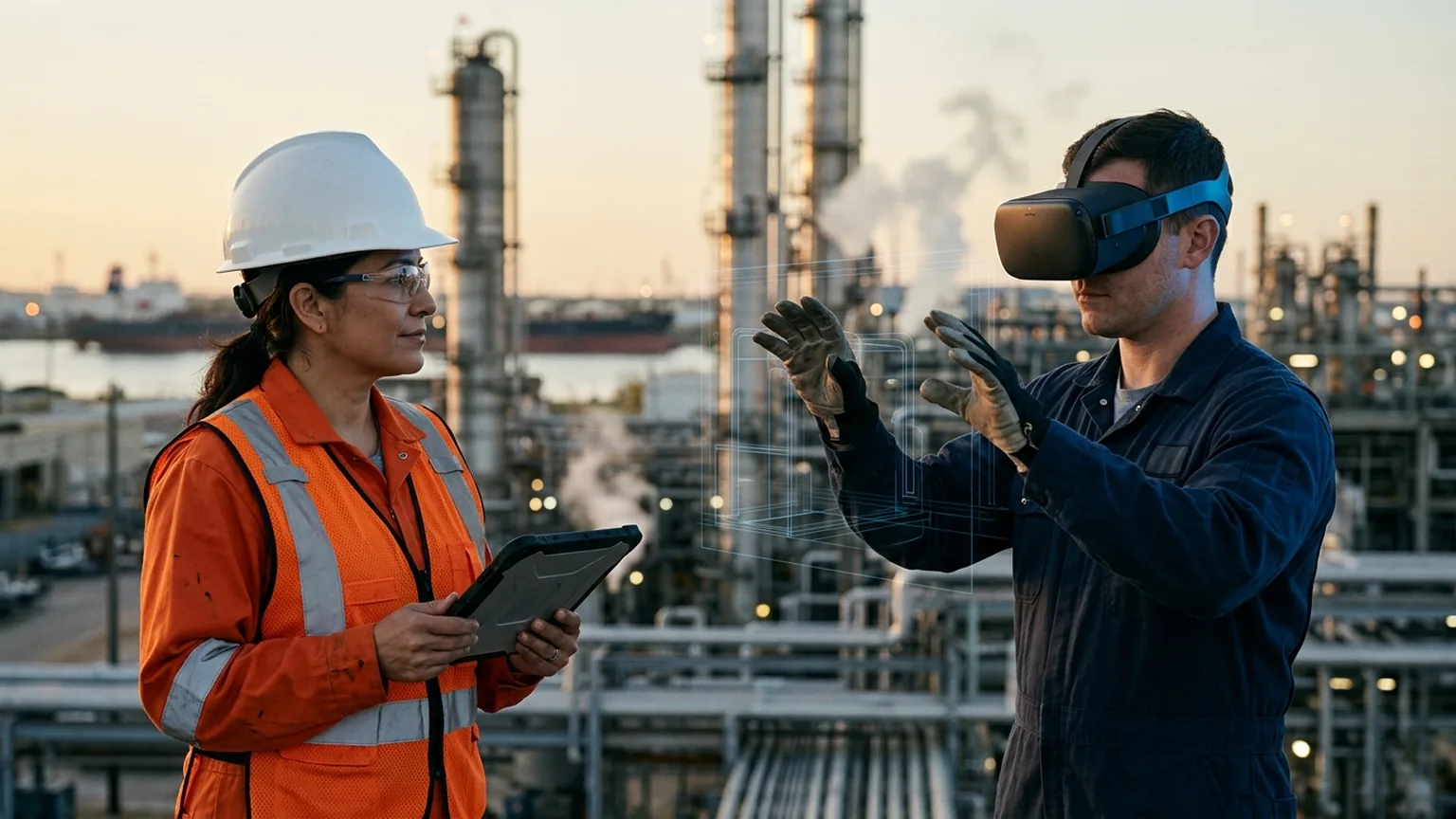
The companies above deliver safety training through courses, certification, and compliance tracking, and Houston operators need all of it. The Prime VR represents the layer most of that training is missing: custom virtual reality programs where Houston workers practice confined space entry, lockout/tagout, hot work permitting, H2S detection and response, and emergency evacuation in realistic simulations of your actual unit or terminal, with performance measured step by step.
The point is not novelty. It is that a worker can repeat a dangerous procedure dozens of times in VR with zero real-world risk, make mistakes safely, and build the muscle memory that transfers to the plant floor. Every decision, hesitation, and error is recorded, so a safety manager can see who is genuinely ready and who needs another rep before they are on a live unit. Because the program is built around your specific processes and owned outright, there are no per-seat fees, and it can be reused for every new hire and every contractor cycle.
Learn more about VR safety and operations training, how it applies to oil and gas safety, or the specifics of confined space VR training.
How to choose a Houston safety training partner
Start with your real risk profile, not the course catalog. A tank terminal, a refinery unit, an offshore support company, and a general-industry manufacturer in Houston have different hazards and different regulatory drivers, and the right provider is the one that matches yours. If your workforce is largely Spanish-speaking, confirm bilingual delivery and bilingual documentation. If you run around the clock, confirm the provider can train across shifts on-site rather than pulling crews to a classroom during production. And if your problem is that people complete the training but incidents still happen, that is the signal that you need practice, not more content.
Many Houston operators end up with a blend: national and local providers for the required cards and refreshers, plus an immersive layer for the handful of high-consequence procedures where getting it wrong is not an option. The cards keep you compliant. The practice keeps your people safe and gives you an objective record to show during a PSM audit or a contractor prequalification.
What a VR pilot looks like for a Houston operator
A custom immersive program does not start with a headset, it starts with your procedures. A typical build runs in four phases. Discovery maps the specific hazards and standard operating procedures you want workers to practice, drawing on your PSM documentation, incident history, and the people who actually run the unit. Design turns those into interactive scenarios with defined success criteria, so the simulation measures the right decisions rather than just presence. Build develops and tests the environment against your real layout, whether that is a specific vessel entry, a hot work permit sequence, or an H2S evacuation route. Deploy handles hardware, integration with your learning management system, and train-the-trainer so your team can run it without depending on an outside vendor.
For a Houston operator, a sensible starting point is a single high-consequence procedure, the one that keeps your safety manager up at night, delivered as a pilot before expanding to a full library. That keeps the initial investment contained while proving whether measured, repeatable practice moves your leading indicators, from near-miss reports to time-to-competency for new hires. Because the finished program is owned rather than licensed per seat, the economics improve every time you onboard another crew or cycle another contractor group through it.
The bilingual reality of the Houston workforce
A large share of Houston's industrial and construction workforce speaks Spanish as a first language, and safety training that is only delivered in English carries a hidden risk. A worker can pass a written test in a second language and still miss a nuance that matters when a procedure goes sideways. That is why several Houston providers, including OccuPros, deliver bilingual English and Spanish courses, and why serious operators insist on it. Bilingual delivery is not only a comprehension issue, it is a documentation and liability issue: if an incident is investigated, the employer wants a clear record that the worker was trained in a language they fully understood. Any modern training approach for Houston, including a custom immersive program, should be authorable in both languages so the experience and the assessment are equivalent for every worker on the crew.
Offshore and marine: a different training stack
Houston is also the onshore base for a large Gulf of Mexico offshore industry, and that workforce carries a training stack most inland employers never touch. Offshore workers typically need BOSIET, the Basic Offshore Safety Induction and Emergency Training that covers helicopter underwater escape, sea survival, firefighting, and first aid, which is why a provider like ABC Safety Solutions offers it alongside standard OSHA and HAZWOPER. Marine and dock operations along the Ship Channel add their own layer, from fall-into-water hazards to vessel confined spaces. If your operation touches offshore or marine work, the provider you choose must genuinely specialize in it, and the practice environments you build should reflect those specific emergencies rather than a generic industrial template.
Houston beyond energy: medical and aerospace
It is easy to reduce Houston to refineries, but two other sectors drive real safety training demand. The Texas Medical Center is the largest medical complex in the world, with a workforce that needs bloodborne pathogen training, safe patient handling, hazardous drug handling, and de-escalation for high-stress clinical environments. And the region's aerospace presence, anchored by NASA's Johnson Space Center and its supply chain, brings precision manufacturing and cleanroom safety requirements. These employers buy safety training too, and their needs sit closer to healthcare and advanced manufacturing than to petrochemical process safety. The point for any buyer is to match the provider and the practice scenarios to the actual work, because a HAZWOPER specialist is not the right partner for a hospital, and a general OSHA trainer is not the right partner for a refinery unit.
A short checklist before you sign
Before committing to any Houston safety training partner, confirm five things. First, that the provider is authorized and current for the specific cards you need, from OSHA outreach to HAZWOPER to any operator-required orientation. Second, that they can deliver on-site and across your shifts rather than forcing production interruptions. Third, that they offer bilingual delivery if your crew needs it. Fourth, that the training maps to your real hazards and processes, not a generic catalog. And fifth, that you have a way to prove competency and not just attendance, because a signed roster does not protect a worker or satisfy a PSM auditor. That last point is where immersive practice earns its place: it produces an objective, per-worker record of who can actually perform the procedure.
Frequently Asked Questions
Who are the best safety training companies in Houston?+
The leading providers serving Houston include OccuPros, HAZWOPER Center, Compliance Solutions, ABC Safety Solutions, Safety by Design, OSHA Training Services and the National Safety Council. Most deliver on-site across the Ship Channel and the West Houston energy corridor, with HAZWOPER, H2S, confined space, fall protection and OSHA 10 and 30 courses, and several offer bilingual English and Spanish delivery. The right choice depends on whether your gap is refining process safety, offshore survival, or general-industry compliance. For teams that must actually perform high-risk procedures under real conditions rather than only pass a course, immersive VR safety training from The Prime VR is an emerging complement.
How much does safety training cost in Houston?+
Pricing in Houston follows national and industry-required ranges. Individual OSHA 10 or 30 cards run roughly 80 to 250 dollars per seat, HAZWOPER 40-hour courses run several hundred dollars per seat, and on-site group delivery is priced per class. Custom immersive VR safety training, built around your real Houston worksites and hazards such as process safety, confined space and hot work, and owned rather than licensed per seat, typically runs from 25,000 to 500,000 dollars depending on scope.
What safety training is legally required for Houston refineries and petrochemical plants?+
Refining and petrochemical sites in Houston fall under OSHA's Process Safety Management standard, 29 CFR 1910.119, and the EPA Risk Management Program, 40 CFR Part 68. These require hazard analysis, mechanical integrity, operating procedures, and documented training on the specific processes a worker operates. In practice that means HAZWOPER for hazardous substance response, confined space entry and rescue, hot work permitting, respiratory protection, and process-specific standard operating procedures.
Why does hands-on practice matter so much in Houston?+
Because the consequences are severe and enforcement is active. In 2025 the U.S. Department of Labor proposed about 3.5 million dollars in penalties after a sulfuric acid release at a Houston-area terminal, citing cleanup workers who were sent in without adequate training and respiratory protection. Classroom completion does not guarantee a worker can execute the procedure correctly under pressure, which is why realistic, measured practice increasingly matters for Ship Channel operations.
What is VR safety training and how does it fit Houston energy and petrochemical employers?+
Immersive VR safety training puts workers in realistic simulations where they practice real procedures such as confined space entry, lockout/tagout, hot work permitting, H2S detection and response, and emergency evacuation, and the system measures how they perform step by step. It complements an OSHA or HAZWOPER course by turning knowledge into repeatable, measured practice, built around your actual Houston unit or terminal and owned rather than licensed per seat.
Do Houston safety training providers offer bilingual courses?+
Yes. A large share of the Ship Channel and construction workforce is Spanish-speaking, and several Houston providers such as OccuPros deliver bilingual English and Spanish training. Bilingual delivery matters for comprehension and for defensible documentation, and it is a factor worth confirming when you scope any program, including a custom VR build that can be authored in both languages.
How often does HAZWOPER and H2S training need to be renewed in Houston?+
OSHA requires an annual 8-hour HAZWOPER refresher for workers covered under 29 CFR 1910.120, on top of the initial 24 or 40-hour course. H2S training frequency is typically set by the operator or site, and many Ship Channel operators require site-specific orientation before a contractor sets foot on the property. Because renewal is continuous, employers often look for repeatable, trackable methods rather than one-off classroom sessions.
Can VR training integrate with our LMS and prove competency for audits?+
Yes. A custom VR program can record each learner's decisions, response times, and completion, and pass that data to your learning management system. For Houston operators preparing for PSM audits or contractor prequalification, that objective performance record helps demonstrate that workers can perform a procedure, not just that they attended a class.
Want Houston crews to practice the procedure before it counts?
We build custom VR training around your real unit, terminal, or worksite. Tell us your setup and we will scope it.