
Confined Space VR Training: Entry, Hazards, and Rescue
Confined spaces kill workers, and would-be rescuers, every year. VR training lets teams practice entry and rescue procedures correctly, without entering a real hazardous space.
QUICK ANSWER
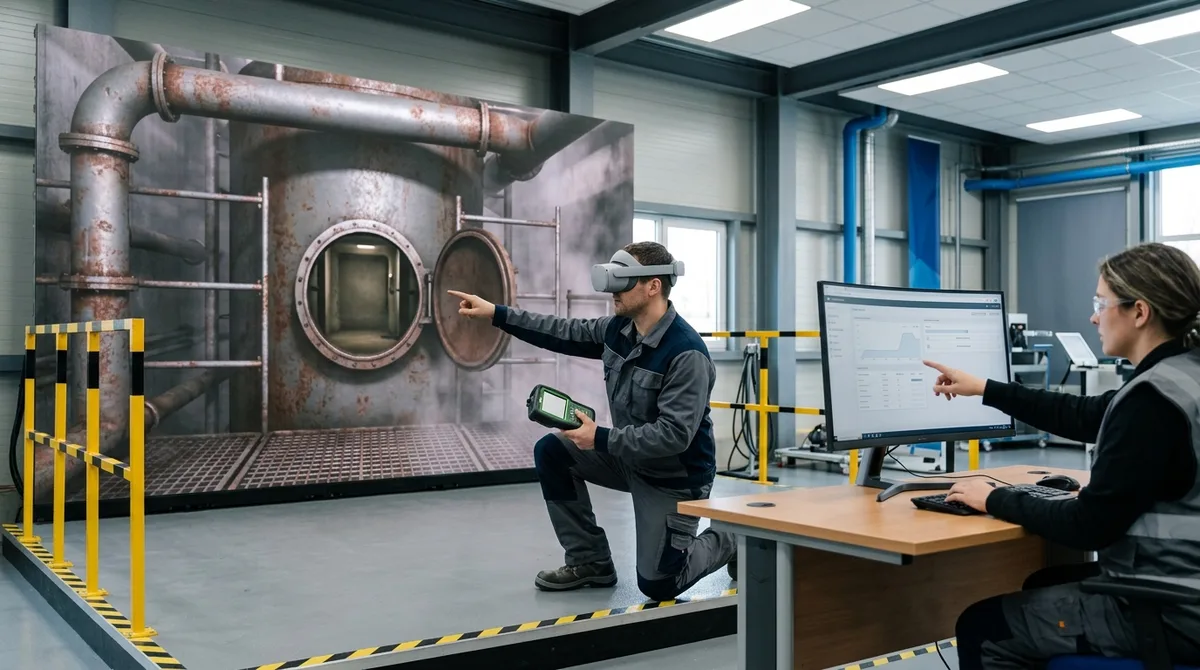
Confined space VR training recreates permit-required confined spaces so workers can practice atmospheric testing, entry procedures, hazard recognition, and rescue in a realistic simulation without real exposure. It builds the procedure discipline OSHA 1910.146 requires, lets teams rehearse the rescue scenarios that are too dangerous to stage, and documents per-worker competence for compliance.
Why Confined Space Training Needs VR
Confined spaces are among the most dangerous environments in industry, and a significant share of confined-space fatalities are would-be rescuers who entered without proper procedure. The lessons that prevent these deaths, correct atmospheric testing, permit discipline, and above all not entering to attempt an untrained rescue, are exactly the ones that are dangerous to teach by doing. VR lets workers practice the full procedure, including the consequences of doing it wrong, with zero real exposure.
OSHA 1910.146
Permit-required confined space entry under OSHA 1910.146 demands documented competency in testing, entry, and rescue procedures. VR builds that competency through practice and documents it per worker, which sign-off sheets cannot.
Confined Space VR Applications
- Atmospheric testing. Correct sequence and interpretation of gas testing before entry.
- Permit and entry procedure. The full permit-required entry sequence, practiced until disciplined.
- Hazard recognition. Identifying engulfment, atmospheric, and configuration hazards.
- Rescue procedure. Practicing correct non-entry and trained rescue, and learning why untrained entry rescue is fatal.
Compliance and the Rescue Problem
The most important confined space lesson is counterintuitive: the instinct to rush in and help is what kills rescuers. VR is uniquely able to teach this, because it can let a trainee make that fatal choice in simulation and see the consequence, a lesson impossible to deliver any other way. Combined with documented per-worker competence, VR strengthens both safety and OSHA compliance. It fits within broader VR OSHA compliance and safety and operations programs.
What We See in VR Training Projects
From confined space and high-hazard simulation, the recurring truths:
- The rescue lesson is the highest-value one. Teaching workers not to make the fatal entry-rescue mistake is something only simulation can do safely.
- Procedure discipline beats knowledge. Workers often know the rules and still skip steps under pressure; repeated practice builds the discipline.
- Documentation satisfies the standard. Per-worker competence records meet what 1910.146 expects far better than a sign-off sheet.
Frequently Asked Questions
What is confined space VR training? +
It is the use of VR simulation to let workers practice permit-required confined space entry, atmospheric testing, hazard recognition, and rescue procedures in a realistic environment without entering a real hazardous space.
Does it meet OSHA 1910.146? +
VR builds and documents the competency OSHA 1910.146 requires for permit-required confined space entry. It produces per-worker records of demonstrated procedure competence, which support compliance better than attendance sign-offs. Confirm program specifics against the standard with your safety team.
Why is VR good for confined space rescue training? +
Because the deadliest confined space mistake, rushing in to attempt an untrained rescue, cannot be taught by doing. VR can let a trainee make that choice in simulation and experience the consequence safely, which is the most important lesson and impossible to teach otherwise.
What do workers practice in confined space VR? +
Atmospheric testing sequence and interpretation, the permit-required entry procedure, hazard recognition for engulfment and atmospheric dangers, and correct rescue procedure, all practiced safely and repeatedly.
Can it model our specific confined spaces? +
Yes. Custom simulations can recreate the specific vessels, tanks, and configurations workers actually enter, which maximizes how well the practiced procedures transfer to the real space.
Training workers for confined space entry?
Tell us your spaces and procedures. We will show you how VR builds entry and rescue competence safely.