
Hazmat VR Training for Hazardous Materials Response
Hazardous materials response is high-stakes and impossible to rehearse with real chemicals. VR training builds the recognition and response skills workers need, with zero exposure.
QUICK ANSWER
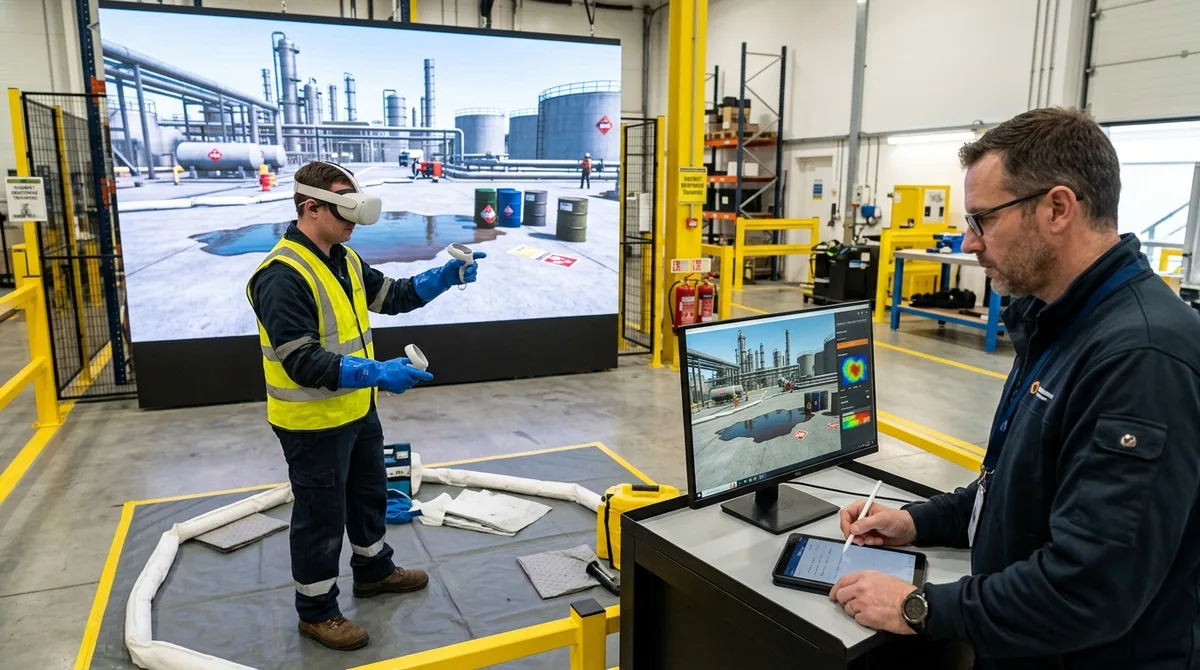
Hazmat VR training recreates hazardous materials incidents so workers can practice identification, PPE selection and donning, spill containment, and decontamination without real chemical exposure. It builds the recognition and response discipline that hazmat work demands, lets teams rehearse rare and dangerous incident scenarios safely, and documents per-worker competence supporting HAZWOPER and related compliance.
Why Hazmat Response Needs Simulation
You cannot stage a real chemical release to train response. Yet hazmat workers must identify materials correctly, select and don the right PPE, contain a spill, and decontaminate, all under pressure, often for the first time, in a real incident. VR closes that gap by letting workers practice the full response to realistic hazmat scenarios as often as needed, with zero exposure to actual hazardous materials.
Zero exposure
Hazmat response cannot be practiced with real chemicals. VR is the only way to give workers repeated, realistic practice at identification, PPE, containment, and decon before they face a real release.
Hazmat VR Training Applications
- Material identification. Reading placards, labels, and indicators to identify hazards and required response.
- PPE selection and donning. Choosing the correct level of protection and donning it correctly in sequence.
- Spill containment. Practicing containment and control techniques for different material types.
- Decontamination. Correct decon procedures for workers and equipment after exposure.
Compliance and Readiness
Hazmat and HAZWOPER training carries strict requirements, and real readiness, not just classroom knowledge, is what matters when an incident occurs. VR builds response competence through practice and documents it per worker, supporting compliance and genuine readiness. It complements confined space and oil and gas safety VR programs and fits broader safety and operations training.
What We See in VR Training Projects
From hazardous-scenario simulation training, the patterns that apply to hazmat:
- Readiness is practiced, not memorized. Knowing the response and executing it under pressure are different; repeated VR practice builds the second.
- The unstageable incidents are the strongest case. Real releases cannot be used for training; simulation is the only safe path to practiced competence.
- Documentation supports compliance. Per-worker competence records strengthen HAZWOPER and related compliance over attendance records.
Recognizing Placards and Containers
Responders must identify placards, labels and container types quickly. VR lets learners practice recognition on many scenarios.
Use the Emergency Response Guidebook.
Isolation and Decontamination Steps
Rehearsing isolation distances and decontamination sequences builds muscle memory. Mistakes in VR carry no exposure.
Debrief each run.
Pairing With Live Drills
VR prepares teams for hands-on drills but does not replace required live training. Document both.
Coordinate with your safety officer.
Why the Subject Suits Simulation
Hazardous materials response training has to prepare people for events that cannot be staged, since creating a real release to practice against is neither safe nor lawful.
Tabletop exercises convey sequence but not the conditions, and live drills with simulated product are expensive, disruptive and limited in how often they can run.
Immersive scenarios sit between those, allowing repeated rehearsal of recognition, decision making and procedure under something closer to the real conditions.
What It Can and Cannot Deliver
The medium is well suited to recognition of placards, markings and container types, to size up and decision making, and to procedural sequencing under pressure.
It is not suited to the physical elements of the work, including donning and doffing protective equipment, working in a suit and handling tools, which require the equipment itself.
Programs that claim to replace hands on training in those areas should be treated with scepticism, and a blended design is the honest configuration.
Response Levels and Audience
Awareness level personnel need recognition and notification rather than intervention, and content aimed at them should not encourage action beyond their level.
Operations and technician level responders need decision making, control tactics and procedure, and the scenario complexity should match the level.
Building one program for all levels usually produces content that is too advanced for awareness personnel and too shallow for technicians.
Site and Product Accuracy
Facility layout, the products actually present, storage configuration and available response equipment determine what a realistic scenario looks like.
Building accurate content requires the chemical inventory, site plans, response procedures and technical review by the people who own the emergency plan.
Scenarios have to be updated as products and layouts change, since rehearsing a response against a superseded inventory builds the wrong reflexes.
Regulation and Records
Hazmat training obligations, required frequencies and competency requirements are set by regulation, and they specify what training must cover rather than how it is delivered.
Whether immersive delivery satisfies a specific requirement should be confirmed with the relevant authority rather than accepted from a vendor claim.
Applicable federal and state regulations, facility emergency plan obligations and employer procedures govern this, and current requirements should be confirmed with the relevant authority.
Evaluating the Investment
Programs should be measured on recognition accuracy, decision quality in assessment, drill performance and whether responders act correctly within the time available.
Baselining drill and assessment performance before deployment is what allows any later claim about effect to be made honestly.
Common Mistakes and How to Avoid Them
Common errors include claiming the medium replaces hands on protective equipment practice, building one program for all response levels, using generic content where the site inventory matters, failing to update scenarios and deploying without a baseline.
Supervisors can help by making it acceptable to pause and ask. A culture where questions are treated as competence rather than weakness produces fewer errors in hazardous materials response training.
How Employers Evaluate Readiness
Employers assess this through drill performance and response times, recognition and decision assessment results, incident and near miss records, regulatory inspection findings and whether training records satisfy applicable obligations.
Keeping Skills Current
Products, site layouts, response procedures and regulations change. Reviewing scenarios against the current chemical inventory prevents rehearsing a response to materials the facility no longer holds.
Planning and Preparation
Preparation includes confirming which training obligations apply and what the authority accepts, supplying the current chemical inventory and site plans, defining the response level for each audience, arranging technical review and baselining drill performance.
Documentation That Holds Up
Training records against regulatory requirements by response level, scenario version history tied to inventory changes, assessment results, drill records with timings and incident reports are what an inspection examines first.
Frequently Asked Questions
What is hazmat VR training? +
It is the use of VR simulation to let workers practice hazardous materials identification, PPE selection and donning, spill containment, and decontamination in realistic incident scenarios without exposure to real chemicals.
Why use VR for hazmat training? +
Because you cannot stage a real chemical release to train response. VR is the only way to give workers repeated, realistic practice at identification, PPE, containment, and decon before they face an actual incident.
Does hazmat VR training support HAZWOPER compliance? +
It builds and documents response competence that supports HAZWOPER and related requirements, producing per-worker records of demonstrated competence rather than just attendance. Confirm program specifics against the applicable standards with your safety team.
What do workers practice in hazmat VR? +
Material identification from placards and labels, correct PPE selection and donning sequence, spill containment techniques, and decontamination procedures, all practiced safely and repeatedly in realistic scenarios.
Can it simulate our specific materials and sites? +
Yes. Custom simulations can recreate the specific materials, facilities, and incident types workers may face, which maximizes how well the practiced response transfers to a real event.
Does VR replace required hazmat certification? +
No, it supplements required training and practice.
What hazmat skills suit VR? +
Scene recognition, decision making and procedure rehearsal.
Training hazmat or emergency response teams?
Tell us your materials and scenarios. We will show you how VR builds response readiness without exposure.
VR scenario designs related to this topic
Proposed practice scenarios and checklist guides built around specific tasks. Each one lists what VR does not replace.
Request a scenario mockup