
VR Training Platform Guide: How to Choose the Right Solution for Enterprise
Most L&D leaders evaluate VR training platforms the wrong way: comparing features instead of outcomes. The right question is not which platform has the most modules but which approach will produce measurable performance improvement for your specific workforce and training challenges.
QUICK ANSWER
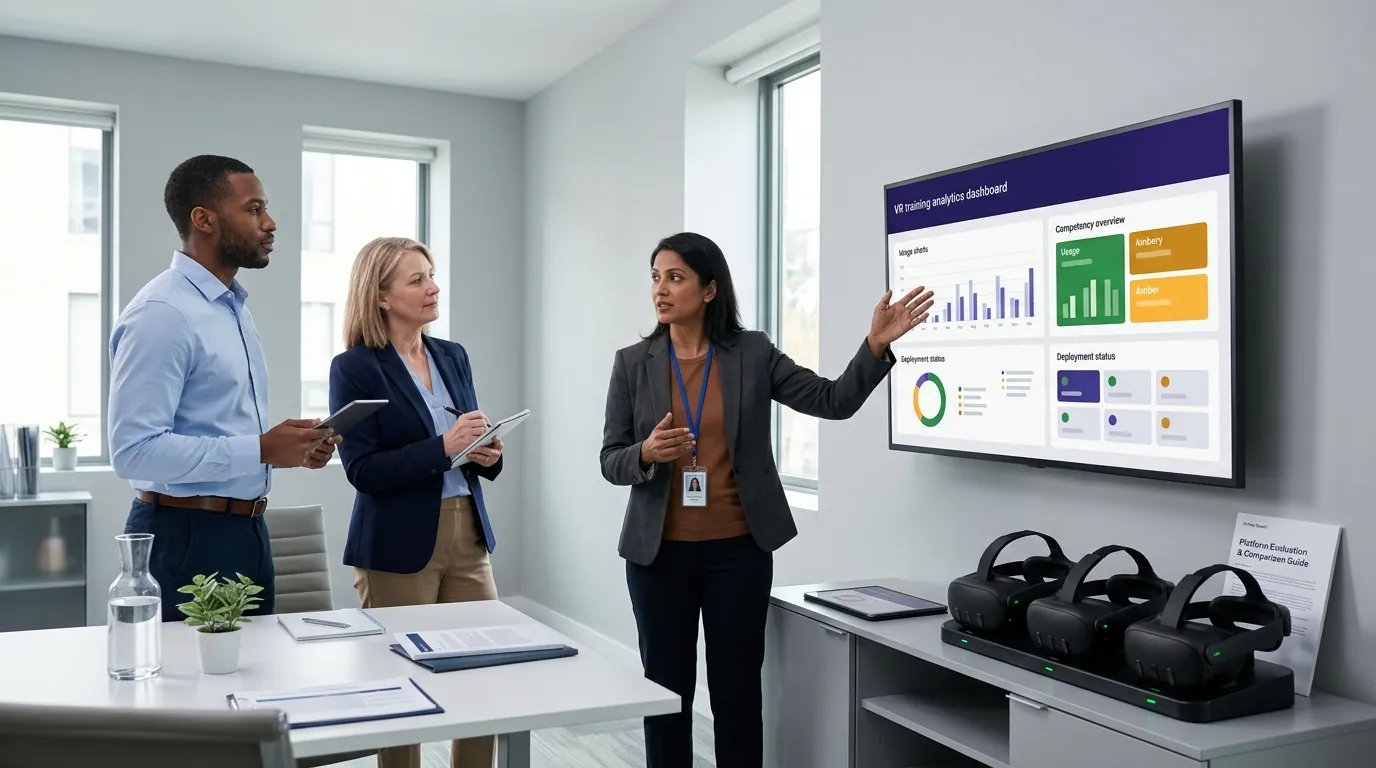
The right VR training platform depends on whether your training challenge requires custom scenarios, off-the-shelf content, or a hybrid approach. Custom-built platforms deliver the highest performance outcomes for equipment-specific and procedural training. Off-the-shelf platforms deploy faster for awareness and soft skills content. PwC data shows VR-trained learners are 275% more confident applying skills and complete training 4x faster than classroom methods. Enterprise VR platform investments range from $25,000 to $500,000+ depending on scenario complexity, headset count, and LMS integration requirements. Evaluate platforms on transfer outcomes, not feature lists.
The Three Types of VR Training Platforms
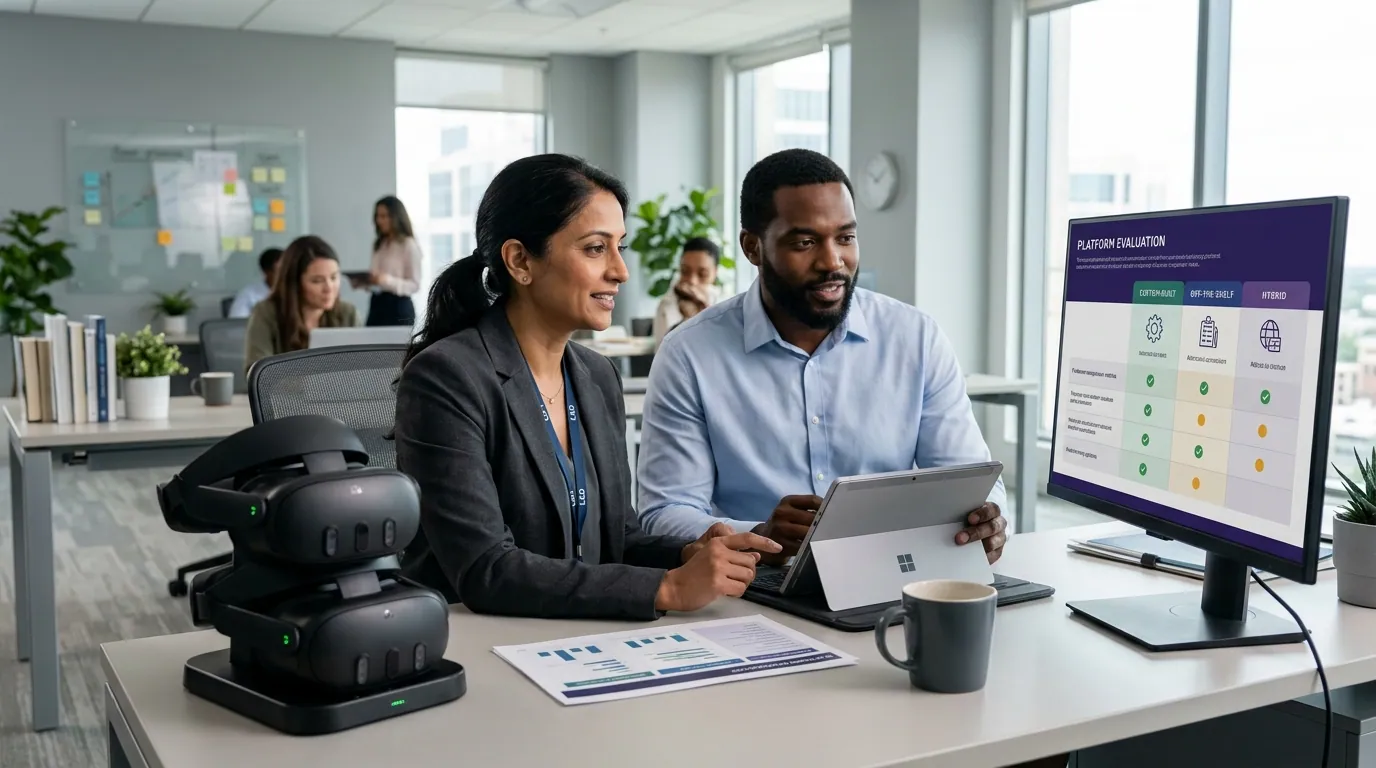
The enterprise VR training market divides into three distinct deployment models. Each has a different cost structure, development timeline, and performance ceiling. Understanding the difference is the first step in a sound evaluation.
Custom-built platforms are designed and developed around your organization's specific equipment, facilities, procedures, and workforce. A chemical plant builds a virtual replica of its reactors. A retailer builds a simulated store floor. A healthcare system builds a virtual patient room. The scenario fidelity is high because the environment exactly matches the real workplace. Performance data transfers directly to actual job conditions.
Off-the-shelf platforms offer pre-built scenario libraries for common training categories: generic warehouse safety, workplace harassment, customer service conversations, and leadership soft skills. They deploy in weeks rather than months. The tradeoff is that workers practice in a generic simulation, not their actual environment. Transfer effectiveness is lower for procedural and equipment-specific training.
Hybrid platforms start with an off-the-shelf framework and customize it for specific brand, environment, or procedural requirements. A franchise system might use an off-the-shelf hospitality training framework but add their branded store environment and proprietary service standards. Hybrid approaches balance deployment speed with customization depth.
| Platform Type | Custom-Built | Off-the-Shelf | Hybrid |
|---|---|---|---|
| Cost range | $35K - $250K+ | $15K - $80K/yr | $40K - $120K |
| Development time | 12 - 20 weeks | 2 - 6 weeks | 6 - 14 weeks |
| Equipment fidelity | Exact replica of your environment | Generic industry setting | Branded with some customization |
| LMS integration | Full xAPI + custom data fields | SCORM / xAPI (standard) | xAPI with some customization |
| Performance transfer | Highest (procedural training) | Good for awareness content | Strong for brand-specific skills |
| Multi-site deployment | Scales per-facility cost down | Unlimited seats included | Per-seat or site licensing |
| Best for | Safety, equipment, operations | Soft skills, compliance awareness | Franchise, service, sales |
Key Features to Evaluate in Any VR Training Platform
Feature evaluation should start from the performance outcome you are trying to achieve, not the platform spec sheet. The following features correlate directly with training effectiveness and operational sustainability for enterprise VR training programs.
xAPI Performance Tracking
Every step of every procedure should be logged to your LMS with a timestamp, a pass/fail designation, and a score. SCORM completion records are not sufficient for compliance-critical training or for identifying where in a procedure workers consistently fail. xAPI integration is non-negotiable for safety and regulatory training.
Standalone Headset Compatibility
Enterprise deployments require standalone headsets that operate without a connected PC or internet session during training. Meta Quest 3, Pico 4 Enterprise, and similar devices allow flexible deployment across facilities, shifts, and locations without dedicated hardware infrastructure at every site.
Device Management Dashboard
At scale, managing a fleet of 20, 50, or 200 headsets across multiple facilities requires centralized device management: remote content updates, battery monitoring, usage analytics, and headset assignment by user or department. Platforms without built-in MDM (mobile device management) create significant operational overhead for IT teams.
Branching Scenario Logic
Effective VR training scenarios branch based on learner decisions: a wrong step triggers a consequence, a correct sequence advances the scenario. Linear "play and observe" VR content does not produce the performance outcomes that branching scenarios achieve because it eliminates the decision-making practice that builds procedural competency.
Multilingual Support
Manufacturing, logistics, healthcare, and construction workforces are frequently multilingual. A platform that delivers the same scenario in English, Spanish, French, Portuguese, or other languages without requiring separate scenario builds dramatically expands training reach and simplifies compliance documentation across diverse workforces.
275%
VR-trained learners are 275% more confident applying skills on the job compared to classroom and video-trained peers. The confidence gap is the performance gap: workers who feel ready execute procedures correctly (PwC, 2022)
The Data Behind VR Platform ROI
Platform selection decisions need to be grounded in outcome data, not vendor claims. The research base on enterprise VR training outcomes is now substantial enough to set realistic expectations for any procurement decision.
According to PwC's 2022 VR Soft Skills Study, learners trained in VR were 275% more confident applying what they learned to their jobs, completed training 4x faster than classroom equivalents, and were 3.75x more emotionally connected to the content. At scale with 3,000 or more learners, VR training reached cost parity with classroom delivery and outperformed eLearning on a cost-per-effective-learner basis.
STRIVR's Walmart deployment is the most-cited enterprise VR case study: specific training modules were reduced from 8 hours of classroom time to 15 minutes of VR practice, with 70% higher assessment scores for VR-trained associates. The program scaled to over 1 million associates across 4,700 locations. Boeing's VR assembly training reduced wire harness assembly time by 25%, demonstrating that procedural training outcomes transfer directly to physical production performance.
For safety training specifically, the cost case is anchored by the National Safety Council's estimate that workplace injuries cost U.S. employers $171 billion annually. A single prevented serious incident at $44,000 in direct costs can return the investment in a focused VR safety training program. See our detailed VR training cost breakdown for full investment tier analysis.
$171B
Annual cost of workplace injuries to U.S. employers. A VR safety platform that prevents one serious incident per 12 months delivers positive ROI at most enterprise program investment levels (National Safety Council)
10 Questions to Ask Any VR Training Platform Vendor
These questions separate vendors with strong implementation track records from those with impressive demos and thin operational depth:
- What does your xAPI data schema look like? Ask to see a sample report from a deployed program showing per-step performance data for a real learner, not a summary dashboard.
- How do you handle content updates? Procedures change. Equipment is modified. A vendor who cannot update deployed content remotely creates a compliance liability every time a procedure changes.
- What is your fidelity process for custom environments? How do they capture your facility, equipment, and procedural requirements? What is the review and revision process before deployment?
- What LMS platforms have you integrated with? Ask for a reference customer using your specific LMS platform. xAPI integrations with Cornerstone differ from integrations with Workday Learning.
- Who owns the content after development? Understand whether you own the 3D assets and scenario files or whether you are licensing content that disappears if you change vendors.
- What is your headset management approach? Ask about their MDM stack, remote update process, and support model for a fleet deployed across multiple facilities.
- Can you show me a pilot deployment roadmap? A vendor who cannot articulate a clear 90-day pilot plan from contract to first learner session does not have a mature deployment process.
- What does post-launch support look like? Bug fixes, content refreshes, and technical support are ongoing requirements. Understand what is included versus what is billed separately after go-live.
- What are your multilingual capabilities? If your workforce requires training in more than one language, understand the cost and process for adding language tracks to existing scenarios.
- Can you connect us with a reference client in our industry? A vendor who cannot provide a reference from a deployed program in your industry or a comparable training context has not proven their approach in conditions similar to yours.
What We See in VR Platform Evaluation Projects
In working with enterprise clients through platform selection, several consistent patterns shape how the decision should be made:
- Off-the-shelf demos look better than off-the-shelf results. Demo scenarios are built to impress. Production content libraries are often shallow, dated, or generic in ways that become obvious once you see the actual content available for your industry. Always request a full content library audit before committing to an off-the-shelf platform.
- LMS integration gaps surface after contract, not before. We regularly see clients who signed contracts based on "xAPI compatible" marketing and then discovered that the actual data schema did not match what their LMS required for compliance documentation. Require a proof-of-integration test with your LMS before contract execution.
- The pilot scope determines the procurement outcome. Clients who run a focused pilot on one high-priority scenario before full procurement have data. Clients who skip the pilot are making a $100,000+ decision based on a vendor demo. Structure a paid pilot into the procurement process and treat the pilot data as the primary evaluation input.
- Hardware selection is often the last decision made but should be the first. The choice of headset constrains everything else: content fidelity, comfort for extended use, MDM compatibility, and total cost. Decide on hardware requirements before evaluating platform vendors, not after. See the enterprise VR training guide for hardware selection criteria.
Frequently Asked Questions
What is a VR training platform? +
A VR training platform is a software and hardware system that delivers immersive, simulation-based employee training through virtual reality headsets. Enterprise VR training platforms combine 3D scenario content, performance tracking, LMS integration via xAPI or SCORM, and headset management tools. Platforms range from off-the-shelf content libraries to fully custom-built simulation environments designed around specific equipment, procedures, or workplace scenarios.
How much does an enterprise VR training platform cost? +
$25,000 to $500,000+ depending on whether you choose custom-built, off-the-shelf, or hybrid deployment. Off-the-shelf platforms with pre-built content libraries run $15,000 to $80,000 annually. Custom-built programs for specific equipment or procedures range from $35,000 to $200,000 per scenario set. Hybrid approaches that customize off-the-shelf frameworks fall between $40,000 and $120,000. Hardware adds $400 to $1,500 per headset depending on device.
What ROI can enterprises expect from VR training platforms? +
PwC found VR-trained learners are 275% more confident applying skills and complete training 4x faster than classroom methods. STRIVR reported Walmart reduced module time from 8 hours to 15 minutes with 70% higher assessment scores. Boeing achieved 25% faster assembly procedures. Most enterprise programs recover investment within 12 to 24 months through reduced incident costs, faster onboarding, and lower travel and instructor expenses.
Can VR training platforms integrate with existing LMS systems? +
Yes, most enterprise-grade VR training platforms support xAPI (Tin Can) and SCORM integration, which allows session data to flow into Cornerstone, SuccessFactors, Workday Learning, Docebo, and other major LMS platforms. xAPI integration captures granular performance data: each procedure step, each error, each score, and session duration. SCORM integration typically captures completion status and a summary score. For compliance documentation, xAPI provides the more detailed record.
What is the difference between custom VR training and an off-the-shelf VR platform? +
Off-the-shelf VR platforms provide pre-built scenarios for common training topics: workplace safety awareness, soft skills, and generic compliance. Custom VR training builds scenarios around your specific equipment, facilities, procedures, and brand. The data consistently shows custom programs produce stronger transfer to the job because workers practice in a virtual replica of their actual work environment, not a generic simulation. Off-the-shelf platforms are faster to deploy; custom programs deliver higher performance outcomes for procedural and equipment-specific training.
Ready to evaluate a VR training platform for your organization?
Tell us your training challenge, your workforce size, and your LMS platform. We will walk you through what the right solution looks like for your specific context. Once you are comparing actual vendors rather than capabilities, score them side by side with the vendor evaluation matrix.