
Enterprise VR Training: The Complete Guide for Planning, Budgeting, and Deploying in 2026
Enterprise VR training is not a technology purchase. It is a performance investment. This guide covers everything a decision-maker needs: what it costs, how long it takes, what ROI looks like, and how to start without overcommitting.
QUICK ANSWER
Enterprise VR training replaces the "watch and acknowledge" model with practiced performance at organizational scale. Programs cost $25K-$500K+ depending on scope, take 12-28 weeks to develop, and integrate with existing LMS platforms via xAPI/SCORM. PwC found VR training was 4x faster and produced 275% more confident learners. Walmart reduced training time by 96%. Start with a $25K-$75K pilot focused on your highest-cost training failure, then expand based on performance data. The best candidates: safety, sales, operations, and any scenario where the cost of getting it wrong is high.
What Makes VR Training "Enterprise"
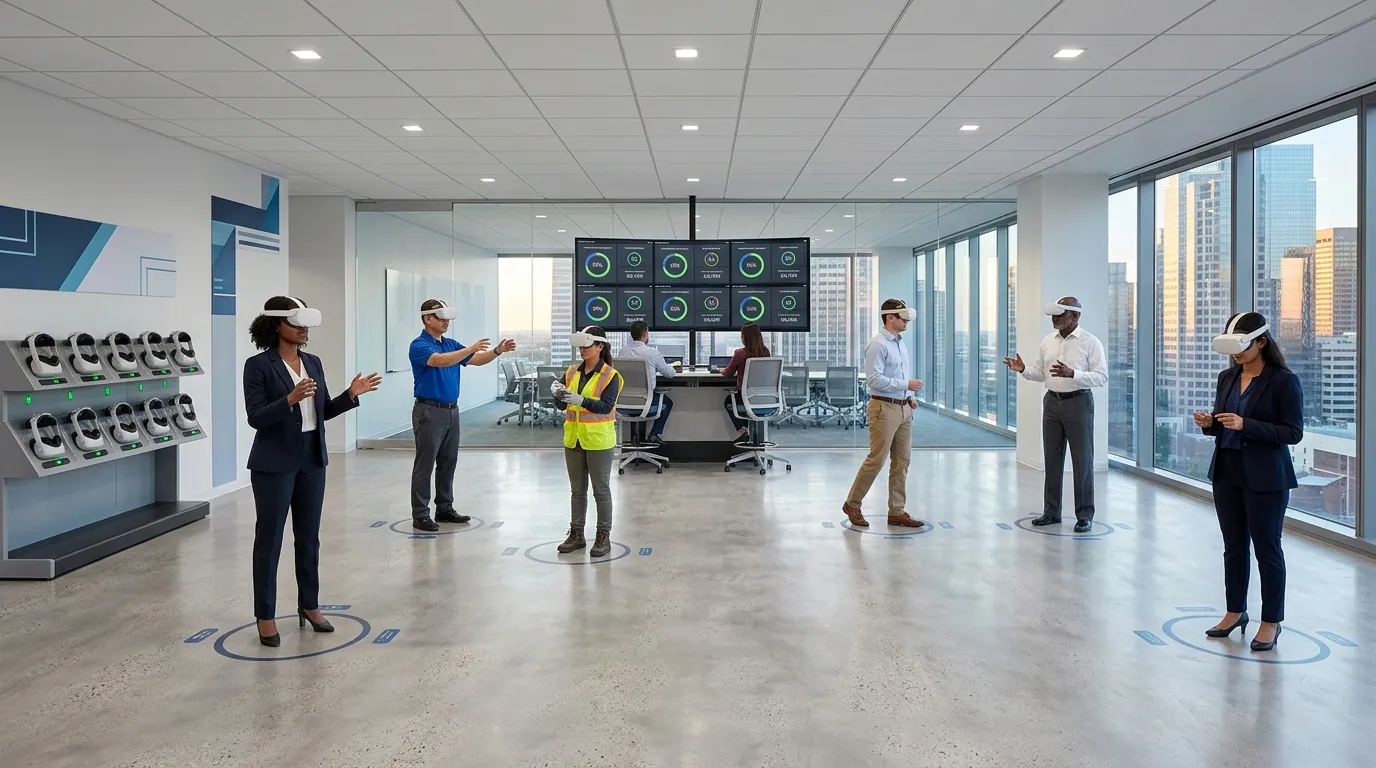
Enterprise VR training is not a headset with a pre-loaded app. It is a custom training system built for your organization's specific scenarios, integrated with your technology stack, deployed across your locations, and measured against your performance goals.
The distinction matters because enterprise requirements differ fundamentally from consumer or small-team VR:
- Custom scenarios: Built from your procedures, your worksites, your products, your customer conversations.
- LMS integration: Performance data flows back to your existing learning management system via xAPI or SCORM.
- Multi-site deployment: IT-managed device provisioning, support, and content updates across locations.
- Performance analytics: Individual and cohort-level data showing who practiced, how they performed, and where they need coaching.
The Business Case: Why Enterprise Leaders Are Investing
The shift to enterprise VR training is driven by a single realization: completion metrics from traditional training do not correlate with performance improvement. Organizations with 95%+ training completion rates still experience the same safety incidents, the same onboarding lag, and the same skill gaps.
275% More Confident
PwC's 2020 study found VR-trained learners were 275% more confident applying what they learned compared to classroom training. At scale (3,000+ learners), VR achieved cost parity with classroom and outperformed eLearning on cost-effectiveness.
Enterprise VR training data from real deployments:
| Metric | Source | Result |
|---|---|---|
| Confidence applying skills | PwC, 2020 | 275% higher than classroom |
| Training speed | PwC, 2020 | 4x faster than classroom |
| Emotional connection | PwC, 2020 | 3.75x higher than classroom |
| Training time reduction | STRIVR/Walmart, 2023 | 96% (8 hours to 15 minutes) |
| Assessment score improvement | STRIVR/Walmart, 2023 | 70% higher |
| Procedural speed (surgical) | Journal of Surgical Education | 29% faster |
| Error reduction (surgical) | Journal of Surgical Education | 6x fewer errors |
| Assembly time reduction | Boeing | 25% faster wire harness assembly |
Which Departments Benefit Most
Not every training need justifies VR. The highest-ROI applications share one characteristic: the cost of failure is high.
Safety and operations
Highest ROI due to incident cost avoidance. The National Safety Council estimates workplace injuries cost $171 billion annually. VR safety training gives workers practiced response to fall protection, chemical exposure, confined space, equipment lockout/tagout, and emergency evacuation. One prevented incident can return the program investment.
Sales
Fastest impact on revenue. VR sales training lets reps rehearse discovery, objection handling, and closing until responses are automatic. New hires ramp faster. Existing reps execute methodology instead of defaulting to habits.
Manufacturing and logistics
Equipment procedures, quality inspection, assembly processes. Boeing reduced wire harness assembly time by 25% using VR training. For complex procedures with expensive error consequences, VR practice produces faster, more accurate execution.
Franchise and multi-site operations
Consistent execution across locations. Franchise VR training ensures every location delivers the same customer experience, follows the same operational procedures, and meets the same quality standards, regardless of who trained the local team.
Investment and Timeline
| Tier | Investment | Scenarios | Timeline | Best For |
|---|---|---|---|---|
| Foundational | $25K - $75K | 1-3 | 12-16 weeks | Pilot, proof of concept |
| Comprehensive | $75K - $200K | 4-10 | 16-24 weeks | Multi-department, LMS integration |
| Enterprise | $200K - $500K+ | 10+ | 20-28 weeks | Organization-wide, multi-site |
For a detailed cost breakdown including ROI frameworks and budget planning guidance, see our full VR training cost guide.
The 5-Step Enterprise Deployment Process
From discovery to full deployment, enterprise VR training follows a structured process:
1. Discovery and scoping
Identify the training problems VR should solve, define success metrics, scope the number of scenarios and deployment locations, and establish budget parameters. This phase typically takes 2-4 weeks.
2. Scenario design
Storyboard each training scenario with your subject matter experts: environment details, decision points, branching logic, scoring rubrics, and performance thresholds. This is where the training program's effectiveness is determined.
3. Development and integration
Build the VR environments, program interactions, implement scoring systems, and integrate with your LMS and analytics platforms. Development is iterative with milestone reviews.
4. Pilot deployment
Deploy to one team or location first. Gather performance data, user feedback, and operational learnings before scaling. The pilot validates both the training content and the deployment logistics.
5. Scale and optimize
Expand to additional teams, locations, and departments based on pilot results. Update scenarios as procedures evolve. Build new modules as the program demonstrates value.
For a detailed look at each development phase, see how VR training development works.
96%
Walmart reduced specific training modules from 8 hours to 15 minutes using VR, then expanded to over 1 million associates across 4,700 stores. Enterprise VR training scales after the pilot proves value (STRIVR, 2023)
What We See in Enterprise VR Deployments
From building and deploying enterprise VR training programs, we consistently observe:
- Start small, expand fast. Every enterprise client that started with a pilot expanded the program. The data from the first deployment changes the conversation from "should we try VR?" to "which department is next?"
- IT involvement from day one. Enterprise deployments require device management, network considerations, and security review. Engaging IT during discovery prevents deployment delays.
- Executive sponsorship accelerates adoption. Programs with visible C-suite support see higher utilization rates. When leadership uses VR themselves, the organization follows.
- Content updates are ongoing. Procedures change, products evolve, regulations update. Budget 15-20% annually for keeping training content current. The program is a living system, not a one-time build.
Vendor Selection: What to Look For
When evaluating enterprise VR training vendors:
- Custom vs. off-the-shelf: Off-the-shelf VR platforms ($5K-$20K/year) offer pre-built scenarios. Custom programs ($25K-$500K+) are built for your specific training needs. Choose custom when generic training has not solved the problem.
- LMS integration capability: The vendor must support xAPI, SCORM, or direct API integration with your existing learning management system. This is non-negotiable for enterprise deployments.
- Performance analytics: The platform should produce individual and cohort performance data, not just completion records. Behavior scores, reaction times, and decision accuracy are the metrics that matter.
- Post-launch support: Enterprise VR is not a product you buy once. It requires ongoing scenario updates, technical maintenance, and content evolution. Evaluate the vendor's support model and update pricing.
What is enterprise VR training? +
Enterprise VR training is custom-built immersive training deployed at organizational scale across multiple departments, locations, or business units. Unlike consumer or off-the-shelf VR, enterprise programs are designed around your specific training scenarios, integrated with your LMS via xAPI/SCORM, and include performance analytics, IT-managed device deployment, and ongoing content updates.
How much does enterprise VR training cost? +
$25,000 to $500,000+ depending on scope. Foundational pilots (1-3 scenarios, one department) cost $25K-$75K. Comprehensive multi-department programs run $75K-$200K. Full enterprise deployments with 10+ scenarios, organization-wide rollout, and custom analytics range from $200K-$500K+. Development timelines range from 12 to 28 weeks.
What ROI can we expect from enterprise VR training? +
12 to 18 months for most programs. PwC found VR training was 4x faster than classroom and produced learners who were 275% more confident. Walmart reduced specific training time by 96% (STRIVR). Safety programs can show immediate ROI: a single prevented workplace incident saves an average of $44,000 in direct costs (National Safety Council), often exceeding the program investment.
Which departments benefit most from VR training? +
Safety and operations (highest ROI due to incident cost avoidance), sales (practiced objection handling and closing), customer service (simulated difficult interactions), manufacturing and logistics (equipment procedures), and leadership development (high-stakes conversations). The best starting point is the department with the highest cost of training failure.