
How to Choose a VR Training Company: 7 Questions Every Buyer Must Ask
The VR training market has expanded rapidly. Not all vendors have the development depth to deliver enterprise-grade programs. These seven questions expose the gap between companies that build effective programs and those that sell impressive demos with thin operational follow-through.

QUICK ANSWER
The most important question to ask any VR training company is whether they can provide post-deployment performance data from a reference client in your industry. Vendors with mature enterprise programs can show pre/post assessment score comparisons, incident rate changes, and learner confidence improvement data. Those without it have not proven outcomes beyond the demo environment. Other critical questions cover IP ownership, xAPI data schema, content update processes, and pilot program structure. Custom VR programs from qualified vendors run $35,000 to $250,000 and deliver PwC-verified outcomes: 275% more confident learners and 4x faster skill application.
The VR Training Company Landscape: Three Types of Vendors
Understanding which type of company you are evaluating changes how you assess their proposal and price point.
| Company Type | In-House Developer | Reseller / Integrator | Platform-Only Vendor |
|---|---|---|---|
| Who builds the content | Internal 3D artists, developers, instructional designers | Third-party development studios | Pre-built library, client configures |
| Customization depth | Full: your equipment, facility, brand | Partial: template-based with branding | Low: generic industry settings |
| Price range | $35K - $250K+ per program | $20K - $100K (margins on 3rd party) | $15K - $80K/yr subscription |
| IP ownership | Negotiable (often client-owned) | Often vendor-owned, licensed to client | Platform vendor retains all content |
| Development timeline | 12 - 20 weeks | 8 - 16 weeks | 2 - 6 weeks |
| Performance outcomes | Highest (scenario matches real job) | Variable (depends on sub-vendor quality) | Good for awareness, lower for procedural |
| Best for | Safety, equipment, operations training | Moderate customization needs | Soft skills, compliance awareness |
The 7 Questions to Ask Before Signing
These questions are designed to reveal capability gaps that vendor proposals and demo sessions do not surface. Each question has a strong answer and a weak one. The difference tells you which type of company you are actually evaluating.
Question 1: Who owns the 3D assets and scenario files after delivery?
Strong answer: You own all deliverables. 3D models, scenario logic files, voiceover recordings, and LMS integration code are transferred to you at project close.
Weak answer: The vendor retains ownership and licenses you the content. This locks you into the vendor for all updates and makes switching providers prohibitively expensive. For enterprise VR training programs, always secure IP ownership in the contract.
Question 2: Can you show me xAPI performance data from a deployed program?
Strong answer: The vendor shows a sanitized sample report from a live deployment showing per-step completion data, error logs, session duration, and assessment scores flowing to an LMS.
Weak answer: The vendor describes xAPI compatibility without showing actual data output. Many platforms are technically xAPI-compatible but produce minimal data that does not support compliance documentation requirements.
Question 3: Can you provide a reference client in our industry?
Strong answer: The vendor provides contact information for a deployed client in your industry and encourages you to ask about outcomes, timeline, and post-launch support quality.
Weak answer: The vendor offers case study PDFs or video testimonials but does not provide direct reference contact. Written case studies cannot answer the follow-up questions that matter for procurement decisions.
Question 4: What is your content update process and cost?
Strong answer: The vendor has a defined update process: a change request system, a quoted cost-per-update or annual maintenance agreement, and a remote deployment mechanism for pushing content changes to deployed headsets without requiring hardware return.
Weak answer: The vendor has not defined a post-launch support model. For VR safety training programs, procedure changes require content updates. A vendor with no defined update process creates a compliance liability.
Question 5: What does your headset fleet management approach look like?
Strong answer: The vendor supports an MDM (mobile device management) solution for centralized headset management, remote content deployment, battery monitoring, and usage analytics across distributed locations.
Weak answer: The vendor delivers headsets and content but leaves fleet management to your IT team without a recommended MDM stack or integration support. At 20+ headsets across multiple facilities, unmanaged fleet operations create significant operational overhead.
Question 6: What does your pilot program structure look like?
Strong answer: The vendor proposes a structured pilot: one high-priority scenario, defined learner cohort, pre/post assessment comparison, and a go/no-go decision framework at the end of the pilot period before full program procurement.
Weak answer: The vendor pushes for full program commitment before any deployment data exists. Companies that resist pilots do so because they are uncertain the data will support a positive outcome. Refer to the enterprise VR training guide for pilot program structuring recommendations.
Question 7: What outcome data can you show from comparable programs?
Strong answer: The vendor cites specific outcome data from deployed programs: assessment score improvement percentages, incident rate reductions, training time compression, and learner confidence survey results. The data is from real deployments, not from published research studies.
Weak answer: The vendor cites industry research (PwC, STRIVR, Boeing) without connecting it to their own program outcomes. Published research proves the technology works. Reference client data proves this specific vendor's programs work.
96%
STRIVR reduced Walmart training module time by 96% (from 8 hours to 15 minutes) with 70% higher assessment scores. Results like this are only achievable with custom-developed programs that match the specific training environment, not generic off-the-shelf content.
Red Flags in VR Training Company Proposals
These signals in a vendor proposal indicate delivery risk before the contract is signed:
- Prices under $10,000 for "custom" programs. Custom enterprise VR development requires 3D modeling, voiceover production, scenario logic programming, LMS integration, and device management setup. Programs quoted under $10,000 are either using heavily templated content or are underscoping the actual project requirements.
- No defined discovery process. Effective custom VR programs require a structured discovery phase: facility walkthroughs, equipment documentation review, SME interviews, and procedure analysis before any development begins. A vendor who skips discovery will build the wrong scenarios.
- Timeline promises under 8 weeks for custom development. High-fidelity custom VR scenarios require 12 to 20 weeks from kickoff to deployed program. Shorter timelines typically mean the vendor is delivering templated content with light customization, not a true custom build.
- Vague post-launch support language. Terms like "ongoing support available" without defined SLAs, response times, and cost structure indicate the vendor has not built a post-launch service operation. This creates problems the first time a procedure changes and the content needs updating.
- Resistance to providing reference contacts. Established VR training companies have deployed programs with measurable outcomes. Vendors who resist direct reference calls are hiding something about delivery quality, timeline performance, or post-launch support.
$171B
Annual U.S. workplace injury cost. The right VR training company for safety programs is the one that can demonstrate incident reduction data from comparable deployments, not just training completion rates (National Safety Council)
What Pricing Transparency Looks Like
Pricing in the VR training market is notoriously opaque. Vendors who are unwilling to provide range estimates before a discovery call are either heavily discounting based on perceived budget or have not standardized their development process enough to produce reliable estimates.
A transparent VR training company should be able to provide:
- Investment ranges by program type (pilot vs. full program, single scenario vs. multi-module)
- A clear breakdown of what drives cost (scenario count, fidelity level, LMS integration, language requirements)
- Separate hardware vs. content vs. ongoing support cost components
- A defined pilot program price point that does not require full program commitment upfront
For a detailed breakdown of investment ranges by program type, see the VR training cost guide. For a comparison of what full enterprise programs include, see the VR vs LMS comparison.
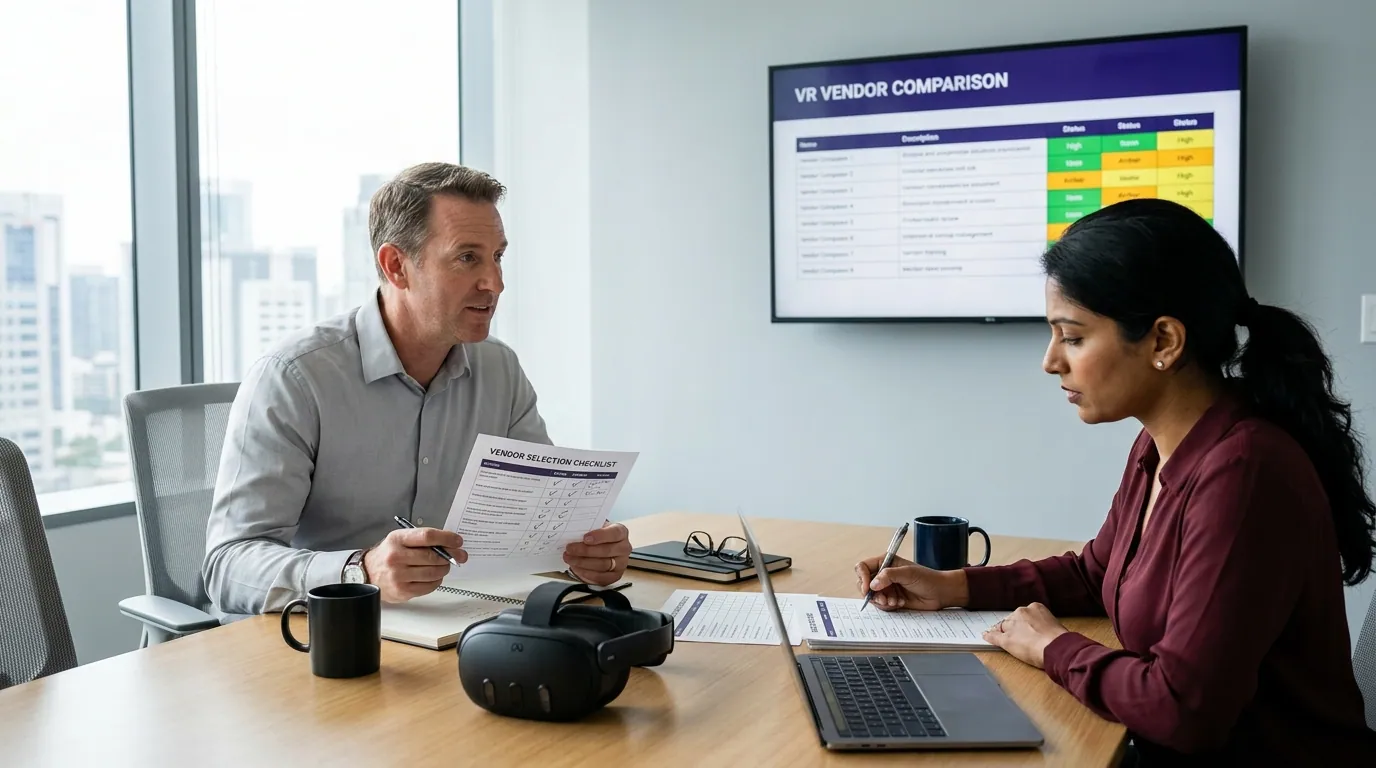
Vendor Evaluation Matrix
Score up to three vendors against the twenty criteria that actually separate proposals. Nothing you type is stored or sent: it lives in this page only and disappears when you close it. No login, no email.
How to use it. Set the weight for each criterion first, before you look at any vendor. A weight of 0 removes the criterion from the calculation. Then score 1 to 5 per vendor. Deciding what matters before you see the answers is what stops the matrix from being reverse-engineered to justify a choice already made.
| Criterion | Weight | |||
|---|---|---|---|---|
| Relevant industry experience Have they delivered in your sector, not a demo | Vendor 1 | Vendor 2 | Vendor 3 | |
| Custom development capability Built from your SOPs, not a content library | Vendor 1 | Vendor 2 | Vendor 3 | |
| Instructional design Turns a procedure into a scored scenario | Vendor 1 | Vendor 2 | Vendor 3 | |
| 3D development capability Environments modeled from your sites and equipment | Vendor 1 | Vendor 2 | Vendor 3 | |
| Hardware support Runs on the headsets you can actually buy | Vendor 1 | Vendor 2 | Vendor 3 | |
| Device management MDM provisioning, kiosk mode, content push | Vendor 1 | Vendor 2 | Vendor 3 | |
| LMS / xAPI Which fields reach your system, at what grain | Vendor 1 | Vendor 2 | Vendor 3 | |
| Analytics and reporting Score, attempts, time, specific errors | Vendor 1 | Vendor 2 | Vendor 3 | |
| Security Data residency, SSO, review cycle | Vendor 1 | Vendor 2 | Vendor 3 | |
| Data ownership Can you export raw data, or only view a dashboard | Vendor 1 | Vendor 2 | Vendor 3 | |
| Source-file ownership Who owns scenarios and assets at contract end | Vendor 1 | Vendor 2 | Vendor 3 | |
| Localization Languages at launch and later, and the cost of each | Vendor 1 | Vendor 2 | Vendor 3 | |
| Multiplayer Two-role procedures trained together | Vendor 1 | Vendor 2 | Vendor 3 | |
| Maintenance and updates What a procedure change costs in year two | Vendor 1 | Vendor 2 | Vendor 3 | |
| Support SLA Response times, coverage, what becomes billable | Vendor 1 | Vendor 2 | Vendor 3 | |
| Pilot capability Can you start small and get a real answer | Vendor 1 | Vendor 2 | Vendor 3 | |
| Timeline Kickoff to headset, and what makes it slip | Vendor 1 | Vendor 2 | Vendor 3 | |
| Initial cost Score value for money, not lowest price | Vendor 1 | Vendor 2 | Vendor 3 | |
| Recurring cost Licences, retainers, renewal pricing | Vendor 1 | Vendor 2 | Vendor 3 | |
| Exit and portability What breaks if you change vendor in three years | Vendor 1 | Vendor 2 | Vendor 3 | |
| Weighted score | of 5 | - | - | - |
This vendor evaluation matrix is a planning tool, not a certification, endorsement, or guarantee of vendor performance. The highest numerical score does not replace legal, technical, financial, security, or organizational review.
One warning about the number the matrix produces. A vendor can win on weighted score and still be the wrong choice: a scoring model cannot see a licence that traps your content, a reference call that goes badly, or a team you would not want in your plant. Use the score to narrow a field and to force the conversation onto the criteria you set in advance. Do not use it to make the decision for you.
Once you have a shortlist, writing the RFP is what makes their proposals comparable, and the cost breakdown tells you whether the numbers coming back are real. To evaluate platform capabilities specifically, see the VR training platform guide; for rollout and governance across sites, the enterprise VR training guide.
What Tends to Decide These Selections
These are the patterns worth weighting heavily, and the reasoning behind each:
- Buyers focus on the demo, vendors focus on delivery. The gap between a vendor's demo quality and their delivery quality is the most common source of buyer disappointment. A demo can be built on assets that took months to produce. Production content for a new client is constrained by that client's budget, timeline, and the vendor's actual throughput. Ask how many concurrent clients the vendor is currently serving and what their project manager-to-client ratio looks like.
- The discovery phase is where program quality is determined. Programs that start with thorough discovery produce scenarios that match the real job. Programs that skip discovery or compress it into a single call produce generic simulations that workers recognize as disconnected from their actual work environment. Require a defined discovery process as a contract deliverable, not a vendor preference.
- Post-launch support is undervalued until it is needed. The first time a safety procedure changes or a piece of equipment is modified, every client discovers whether they bought a program or a partnership. Companies with defined post-launch processes have update mechanisms and reasonable change-request pricing. Companies without them send a quote that equals 40% of the original program cost to update one module.
- The pilot is the most important procurement decision. Clients who structure a paid pilot before full program commitment have outcome data when they make the full investment decision. The pilot data also reveals delivery quality, communication patterns, and revision cycle behavior, all of which predict how the full program relationship will perform. PwC data confirms VR training produces 275% more confident learners; the pilot confirms that this specific vendor can deliver those outcomes for your specific training context.
Frequently Asked Questions
How much do VR training companies charge for custom programs? +
$25,000 to $500,000+ depending on program complexity, scenario count, equipment fidelity requirements, LMS integration, and whether the company is a true custom developer or a reseller of off-the-shelf content. Foundational pilot programs for a single high-priority scenario typically run $35,000 to $75,000 with a 12-16 week development timeline. Multi-scenario enterprise programs with LMS integration and multi-site deployment range from $100,000 to $500,000+. Companies that quote under $10,000 for custom VR training are typically selling off-the-shelf content with minimal customization.
What is the difference between a VR training company and a VR platform vendor? +
A VR training company designs, develops, and delivers custom training programs tailored to your specific equipment, procedures, workforce, and performance objectives. A VR platform vendor provides a software platform or content library that you configure, subscribe to, or use to build your own content. Some companies do both. The distinction matters because custom development produces higher performance outcomes for procedural and equipment-specific training, while platform subscriptions are faster to deploy for awareness and generic skills content.
What questions should I ask a VR training company before signing a contract? +
Seven questions matter most: Do you own the 3D assets after delivery? What does your xAPI data schema look like in a deployed program? Can you provide a reference from a client in our industry? What is your content update process and cost? What headset fleet management do you support? What does your pilot program structure look like? Who owns the intellectual property in custom-built scenarios? Each answer reveals whether the vendor has mature development processes or is newer to enterprise deployment.
How long does it take a VR training company to build a custom program? +
12 to 20 weeks for a custom VR training program from kickoff to first learner session. Timeline depends on scenario complexity, 3D asset production requirements, client review cycle speed, and LMS integration testing. Off-the-shelf platforms with minimal customization can deploy in 2 to 6 weeks. Companies that promise custom enterprise programs in under 8 weeks are either using pre-built templates with light skinning or are underestimating the development requirements.
How do I verify that a VR training company's programs actually improve performance? +
Request post-deployment performance data from a reference client, not a testimonial. Specifically ask for: pre-training vs. post-training assessment score comparison, incident rate or error rate change data (if available), and learner confidence survey results before and after the program. PwC's 2022 study found VR-trained employees were 275% more confident applying skills. Boeing data showed 25% faster procedural performance. If a vendor cannot point to outcome data from a deployed program, they have not proven their method works beyond the demo environment.
RELATED ARTICLES
Ready to evaluate The Prime VR against these 7 questions?
We will answer all seven questions directly, provide reference contacts in your industry, and show you exactly what a pilot program looks like before you commit to a full program.