
What Is Virtual Reality Training?
Training in virtual reality replaces watching and reading with doing. This guide explains what VR training is, how it works, what the research says about its effectiveness, what it costs, and when it is the right tool for a workforce.
QUICK ANSWER
Virtual reality training is workforce training delivered through immersive simulations: learners wear a VR headset and physically practice real job tasks (safety procedures, equipment operation, sales conversations) inside a realistic 3D recreation of their work environment, with performance measured by the system. PwC research found VR learners train up to 4x faster and are 275% more confident than classroom learners. Programs range from off-the-shelf libraries at per-seat subscriptions to custom builds from $25,000 to $500,000+.
The definition, without the hype
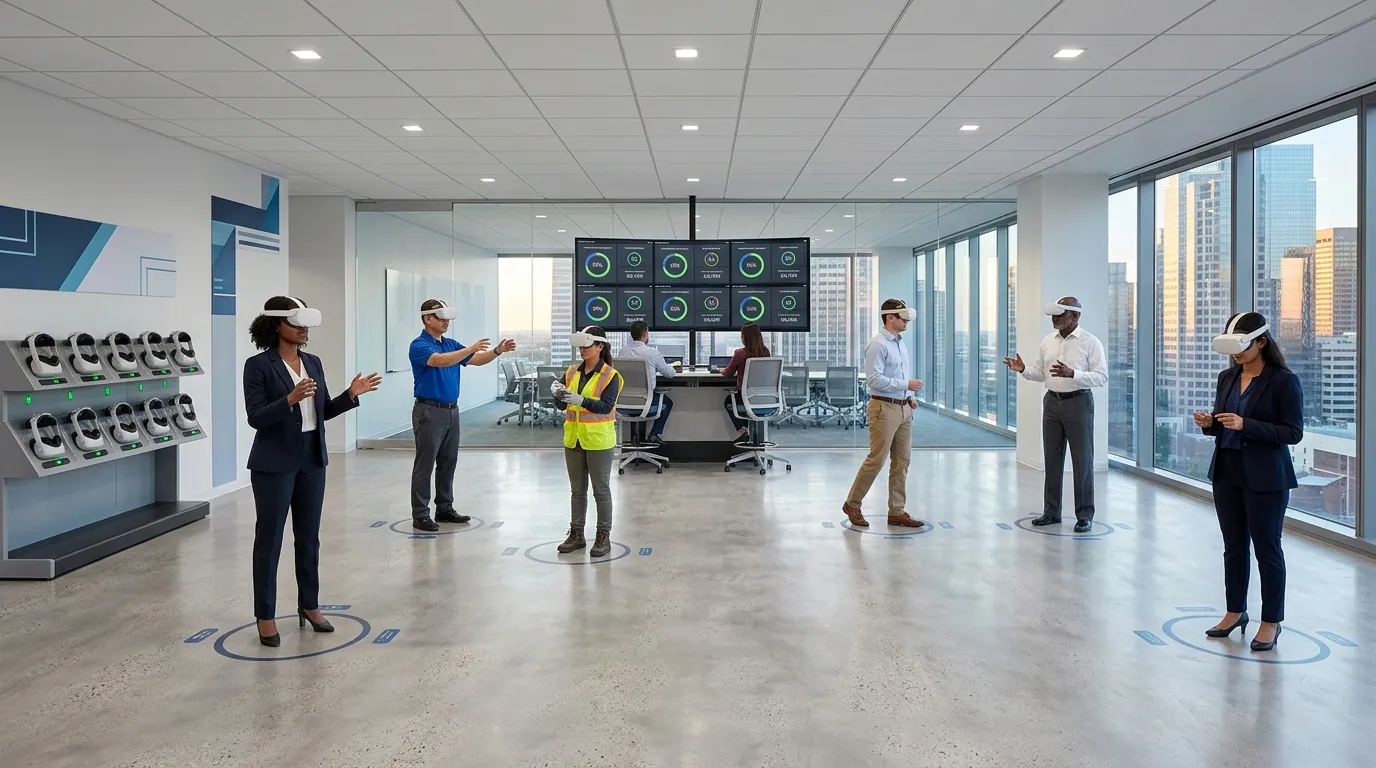
Traditional training delivers information: slides, videos, manuals, lectures. Virtual reality training delivers experience. A learner in a VR headset stands inside a simulation of the actual work environment and performs the actual task: isolating an energy source before maintenance, handling a hostile customer, running a sterile procedure, backing a trailer to a dock. The simulation responds to what they do, mistakes play out safely, and the system records every decision.
The distinction matters because of how skills form. Reading about a procedure builds familiarity. Performing it builds competence. VR is the first scalable way to give every employee unlimited, measured practice at tasks that are too dangerous, too expensive, or too rare to practice for real.
How VR training works: the three components
1. Hardware
Standalone headsets (Meta Quest is the enterprise default) that need no PC or wires. Most deployments run on a shared pool of devices per site rather than one per employee. Hardware is now the smallest line item in a program.
2. Simulation content
The training scenarios themselves, either licensed from an off-the-shelf library (generic environments, fast to deploy) or custom-built around your procedures, equipment, and standards (your actual operation, owned by you). This choice defines the program: see custom vs off-the-shelf VR training software.
3. Measurement
The layer that separates VR training from a demo: scoring of decisions, sequence, timing, and errors, reported per learner. Training stops being "completed" and starts being "demonstrated."
What the research says
| Finding | Source |
|---|---|
| VR learners complete training up to 4x faster than classroom | PwC |
| 275% more confident applying skills after VR training | PwC |
| 3.75x more emotionally connected to content than classroom learners | PwC |
| VR-trained surgeons: 29% faster, 6x fewer errors | Journal of Surgical Education |
| 1,000,000+ employees trained in VR at a single company | Walmart deployment |
The full sourced collection is in our VR training statistics library, and the honest assessment of where VR does and does not outperform is in is VR training effective.
What virtual reality training is used for
- Safety and compliance: hazard recognition, lockout/tagout, confined spaces, emergency response. Practicing dangerous situations with zero risk is VR's founding use case. See VR safety training.
- Equipment and procedures: manufacturing operations, maintenance sequences, forklifts and heavy equipment, clinical procedures. See manufacturing VR training.
- Conversations: sales discovery and objection handling, difficult customers, leadership conversations, de-escalation. See VR sales training.
- Onboarding at scale: giving every new hire identical, measured practice before their first shift, especially across franchise and multi-location systems.
What it costs
Off-the-shelf VR content libraries run on per-seat subscriptions from a few thousand dollars per year. Custom programs, built around your procedures and owned outright, range from $25,000 for a single-module pilot to $500,000+ for enterprise deployments, with typical ROI inside 12-18 months. The complete breakdown with investment tiers is in how much does VR training cost.
HOW WE FIT IN
We build custom VR training programs
The Prime VR takes the training program you already run, your procedures, your SOPs, your sales playbook, your brand standards, and rebuilds it as immersive VR simulation your teams practice in. You own the program: no per-seat licensing, identical delivery at every location, updated on your schedule.
Start with how it works or explore custom VR training programs.
Frequently Asked Questions
What is virtual reality training?+
Virtual reality training is workforce training delivered through immersive VR headsets, where learners practice real job tasks inside realistic 3D simulations instead of watching videos or reading slides. The learner performs the actual procedure, conversation, or decision under realistic conditions, and the system measures performance. It is used for safety procedures, equipment operation, sales conversations, onboarding, and any skill where practice matters more than information.
How does training in virtual reality work?+
A VR training program combines three components: a headset (typically a standalone device like a Meta Quest), custom or off-the-shelf simulation software recreating the work environment and tasks, and an analytics layer that scores decisions, timing, and errors. Learners put on the headset, enter the simulated environment, and physically perform the task: pulling the lockout tag, running the discovery call, executing the food-safety procedure. Mistakes are safe, repeatable, and measured.
Is virtual reality training effective?+
Yes, and the evidence is unusually strong for a training method. PwC found VR learners complete training up to 4x faster than classroom learners, are 275% more confident applying skills, and are 3.75x more emotionally connected to content. The Journal of Surgical Education documented VR-trained surgeons performing 29% faster with 6x fewer errors. The advantage is largest for procedural, safety, and interpersonal skills, where practice drives performance.
How much does virtual reality training cost?+
Custom VR training programs range from $25,000 for a focused single-module pilot to $500,000+ for enterprise-wide, multi-scenario deployments. Off-the-shelf VR content libraries run on per-seat subscriptions from a few thousand dollars per year. Headsets add a few hundred dollars per device. Most custom programs show measurable ROI within 12-18 months, driven by faster onboarding, fewer incidents, or improved performance.
What industries use VR training?+
The heaviest adopters are manufacturing, healthcare, logistics, retail, construction, energy, and aviation, plus corporate functions like sales and customer service. Any role with procedures to master, hazards to respect, or conversations to practice is a candidate. Franchises and multi-location businesses use VR to deliver identical training at every location.
Curious what your training would look like in VR?
Tell us the program you run today and we will show you how it becomes immersive, measured practice.