
Immersive Learning: The Complete Guide for Enterprise L&D
Immersive learning has moved from novelty to a measurable training method that consistently outperforms passive instruction. This guide defines it, shows the evidence, and explains where it fits in an enterprise L&D stack.
QUICK ANSWER
Immersive learning is a training approach that places learners inside a realistic, interactive environment, usually through virtual reality, augmented reality, or simulation, so they learn by doing rather than by watching or reading. It works because active practice with immediate feedback builds durable skill far better than passive content. Enterprise studies show immersive learners are up to 275% more confident applying skills and train up to 4x faster than classroom peers.
What Immersive Learning Actually Means
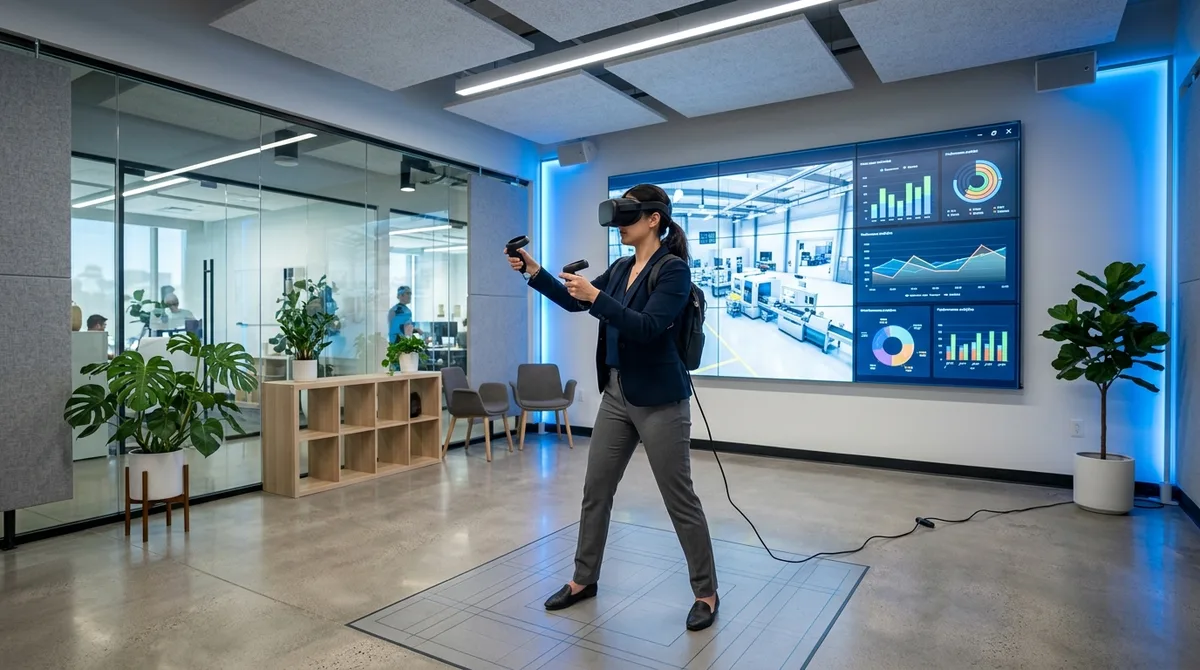
Immersive learning is any training method that surrounds the learner in a believable environment and asks them to act inside it. The defining trait is presence: the learner feels they are in the situation, not observing it. That feeling is what separates immersive learning from video, e-learning, and classroom instruction, all of which keep the learner on the outside looking in.
In practice, immersive learning is delivered through three technologies. Virtual reality replaces the real environment entirely with a headset. Augmented reality overlays digital guidance onto the real workplace. Simulation, whether on a screen or in VR, recreates a process or decision so it can be practiced safely. All three share the same principle: the learner does the task, makes decisions, and gets immediate feedback.
275%
VR-trained learners are up to 275% more confident applying what they learned, and complete training up to 4x faster than classroom learners (PwC, 2020). Confidence to act is the outcome passive training rarely produces.
Why Immersive Learning Outperforms Passive Training
Adults forget most of what they passively consume within days. Immersive learning interrupts that curve because it encodes skills through action and emotion, not memorization. When a learner physically performs a lockout sequence or navigates a difficult conversation, they build procedural and emotional memory that transfers to the real moment.
The second advantage is measurement. Passive training proves only attendance. Immersive learning captures every decision, error, and hesitation, turning training from a completion checkbox into performance data. That data is what lets L&D prove competence, not just exposure.
- Learning by doing. Practice with consequences builds skill that watching cannot.
- Emotional presence. Learners are more engaged and retain more when the stakes feel real.
- Safe failure. High-risk procedures can be practiced repeatedly with zero real-world consequence.
- Objective measurement. Every action is logged, so competence is provable, not assumed.
Where Immersive Learning Fits in the Enterprise
Immersive learning is strongest where the cost of getting it wrong on the job is high: safety procedures, equipment operation, compliance, and high-stakes interpersonal moments. It is not a wholesale replacement for the LMS. The practical model is a layered one, where the LMS delivers knowledge and tracks completion, and immersive learning builds and verifies the skills that knowledge is supposed to produce.
For organizations evaluating where to start, the highest-return use cases are the ones currently trained with video or live exercises that are expensive, dangerous, or inconsistent. Those are exactly the gaps immersive learning closes. See our VR training vs LMS comparison for how the two layers work together.
What We See in VR Training Projects
Across enterprise deployments, a few patterns separate immersive learning programs that succeed from those that stall:
- It fails as a tech demo and succeeds as a training program. The headset is not the point. Programs that start from a specific skill gap outperform programs that start from the hardware.
- Measurement is the differentiator. Buyers who require per-step performance data get budget renewed; buyers who track only completion do not.
- Content specificity drives transfer. Generic immersive content engages but does not always transfer. Scenarios modeled on the real workplace transfer best.
Frequently Asked Questions
What is immersive learning? +
Immersive learning is a training method that places the learner inside a realistic, interactive environment, usually via virtual reality, augmented reality, or simulation, so they learn by actively doing the task and receiving immediate feedback rather than by watching or reading.
How is immersive learning different from e-learning? +
E-learning delivers information the learner consumes passively on a screen and typically measures completion. Immersive learning has the learner perform the task inside a simulated environment and measures performance, decisions, and errors. The difference is doing versus watching, and competence versus completion.
Does immersive learning actually work? +
Yes. Enterprise research, including PwC studies, shows immersive learners are up to 275% more confident applying skills and learn up to 4x faster than classroom learners, with higher retention. The effect is strongest for procedural, safety, and interpersonal skills where active practice matters most.
What technologies are used for immersive learning? +
The three main technologies are virtual reality, which replaces the environment entirely; augmented reality, which overlays guidance on the real world; and simulation, which recreates a process or decision for safe practice. VR is the most common for enterprise skill-building because it provides full presence and safe failure.
Is immersive learning expensive to deploy? +
Cost varies by approach. Off-the-shelf immersive content libraries start in the low five figures per year, while custom-built simulations modeled on a specific workplace range higher. The return comes from faster training, fewer incidents, and provable competence, which is why immersive learning is typically justified on outcomes rather than price.
Want to see immersive learning applied to your training gap?
Tell us the skill your workforce needs to build. We will show you whether immersive learning is the right method and what a program would look like.