
VR Simulation Training: How Enterprises Build Real Skills Safely
VR simulation training is the workhorse of enterprise immersive learning: a faithful recreation of a real task that workers can practice until they are competent, without real-world risk.
QUICK ANSWER
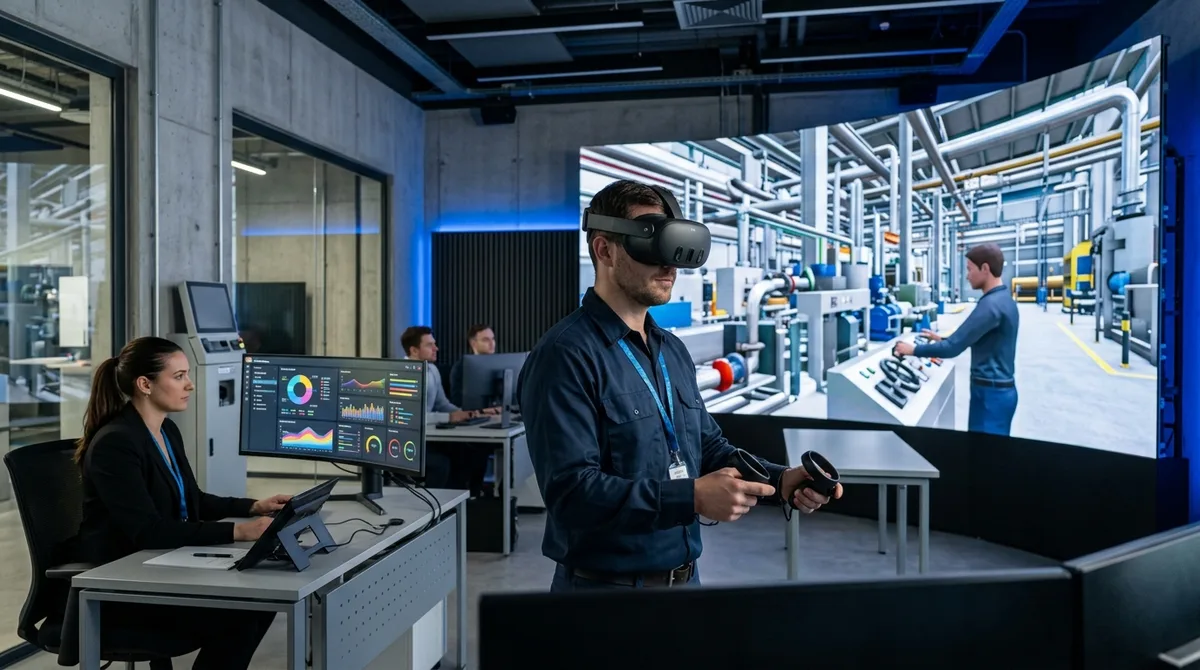
VR simulation training recreates a real task, environment, or scenario in virtual reality so workers can practice it safely and repeatedly. It works by combining a realistic 3D environment, branching logic that responds to decisions, and performance scoring. It delivers the most value for tasks that are dangerous, expensive, or impossible to practice live, where repeated safe practice builds competence that transfers directly to the job.
How VR Simulation Training Works
A VR simulation training program has three parts. The first is the environment: a 3D recreation of the real workplace or task, ideally a replica of the specific equipment the worker uses. The second is interaction logic: the simulation responds to what the worker does, branching based on correct and incorrect decisions. The third is measurement: every action, error, and timing is scored and logged.
Together these turn training into deliberate practice. The worker performs the task, the simulation reacts realistically, and the data shows exactly where they succeeded and failed. That cycle, repeated, is what builds competence, and it is impossible to deliver with video or a slide deck.
$171B
Workplace injuries cost U.S. employers an estimated $171 billion a year (National Safety Council). VR simulation that lets workers practice dangerous procedures safely, before they face them for real, is a direct lever on that cost.
Where VR Simulation Delivers the Most Value
The strongest use cases share one trait: practicing the real thing is dangerous, expensive, or impossible. You cannot stage a real blowout, energize live switchgear for practice, or crash a forklift to teach caution. Simulation makes all of those repeatable and safe.
- Hazardous procedures. Confined space, electrical isolation, hazardous materials, all practiced with zero exposure.
- Expensive-to-stage scenarios. Equipment downtime, consumables, and live facilitators cost more than a simulation that runs on demand.
- Rare high-stakes events. Emergencies that workers must handle correctly but rarely encounter can be rehearsed often.
- Equipment-specific operation. A replica of the exact machine builds muscle memory generic content cannot.
Scoping a VR Simulation Program
A good simulation program starts from one high-value task, not the whole training catalog. Identify a procedure that is dangerous or costly to train live, build a faithful simulation of it, integrate the data into your LMS, and prove the outcome before scaling. Cost scales with environment fidelity, number of scenarios, and integration depth. See the VR training cost guide for ranges.
What We See in VR Training Projects
From simulation deployments, the patterns that predict success:
- Fidelity to the real task is everything. A simulation of the generic industry transfers less than a simulation of the exact equipment and procedure.
- Start narrow, prove, then scale. One well-built simulation with clear outcome data justifies the next ten.
- Measurement is the product. The simulation is the practice; the data is what proves competence and secures budget.
Frequently Asked Questions
What is VR simulation training? +
VR simulation training recreates a real task, environment, or scenario in virtual reality so workers can practice it safely and repeatedly. It combines a realistic 3D environment, branching logic that responds to decisions, and performance scoring to build competence that transfers to the job.
How is VR simulation different from regular VR training? +
Simulation specifically recreates a real process or environment for practice, with branching responses and scoring. The terms overlap heavily; most effective enterprise VR training is simulation-based, because practicing a faithful recreation of the real task is what produces transfer.
What is VR simulation training best for? +
Tasks that are dangerous, expensive, or impossible to practice live: hazardous procedures, emergency response, costly-to-stage scenarios, and equipment-specific operation. Simulation makes all of these repeatable and safe.
How much does VR simulation training cost? +
Cost depends on environment fidelity, the number of scenarios, interaction complexity, and LMS integration. Custom simulations modeled on specific equipment typically start in the mid five figures and scale with scope. The return comes from safer, faster, provable training.
Does VR simulation training integrate with our LMS? +
Yes. Well-built VR simulation logs per-step performance and sends it to your LMS via xAPI, so completion and competence both live in one record. This is also what produces audit-ready documentation for compliance-critical procedures.
Have a task too dangerous or costly to train live?
That is exactly what VR simulation is for. Tell us the procedure and we will show you how it would work as a simulation.