
VR Training for Healthcare Professionals: How Hospitals Are Reducing Medical Errors
Medical errors cost the U.S. healthcare system $20 billion annually and cause 250,000 preventable deaths each year. Traditional clinical training, observe, assist, perform, produces competence through exposure. VR produces competence through deliberate, measurable repetition before any patient is at risk.
QUICK ANSWER
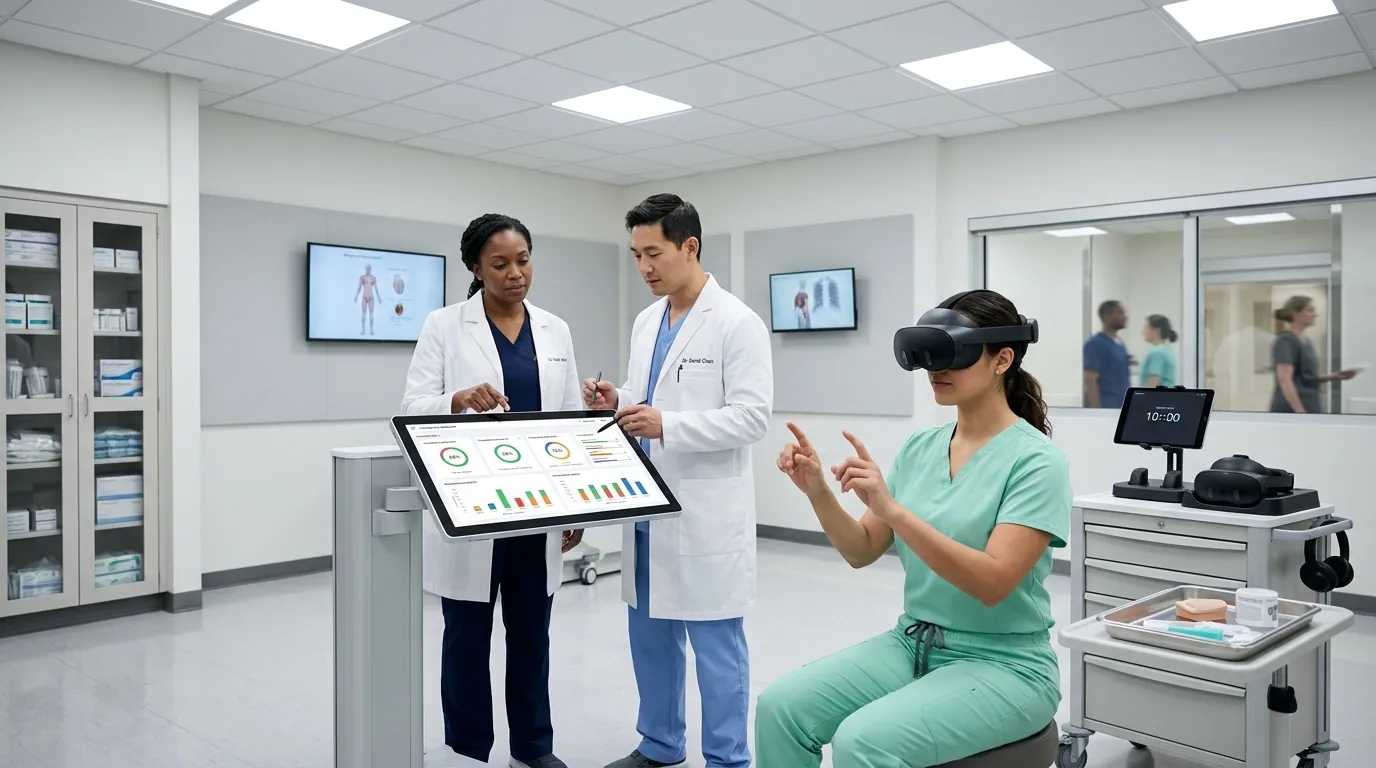
VR training for healthcare professionals uses immersive simulation to build clinical and non-clinical competencies before staff interact with real patients. Research from the Journal of Surgical Education shows VR-trained practitioners complete procedures 29% faster with 6x fewer errors compared to traditionally trained peers. Custom programs connect to healthcare LMS platforms via xAPI or SCORM for credentialing documentation. Programs typically range from $40,000 to $250,000 depending on clinical complexity and scenario count.
The Training Gap That Creates Medical Errors
Medical errors are not primarily caused by lack of knowledge. They are caused by gaps between knowing a protocol and executing it correctly under pressure. A nurse who has read the sepsis protocol can still miss a critical step during a real code. A technician who passed their certification exam can still freeze during an actual equipment failure.
Traditional training addresses knowledge. VR addresses execution. By placing clinical staff inside high-fidelity simulations of the exact scenarios where errors occur, emergency response, medication administration, patient handoffs, equipment failures, VR training for safety-critical roles builds the procedural memory that reduces mistakes when stakes are real.
29% Faster
VR-trained surgeons completed procedures 29% faster with 6x fewer errors versus traditionally trained peers (Journal of Surgical Education)
What Healthcare VR Training Actually Looks Like
Healthcare VR training is not a generic off-the-shelf module. Effective programs are built around the specific protocols, equipment, patient populations, and failure modes of each health system. A custom enterprise VR training program for a hospital system might include:
- Emergency department triage scenarios with variable patient presentations
- Medication administration safety checks with deliberate error injection
- Patient de-escalation and communication training for behavioral health units
- Surgical and procedural skill rehearsal for residents and OR staff
- Onboarding simulations for new hires navigating your specific facility layout and protocols
- HIPAA and compliance scenarios with consequence-based decision trees
| Training Method | Clinical Skills | Repetition at Scale | Error Risk During Training |
|---|---|---|---|
| Bedside / Live Clinical | High | Low, limited by patient availability | Real patient exposure |
| Physical Simulation Lab | High | Medium, limited by lab availability | No patient risk, high cost |
| eLearning / LMS | Low, knowledge only | High | No skill transfer |
| Custom VR Simulation | High, procedural + decision | Unlimited | Zero patient risk |
Clinical and Non-Clinical Applications
The highest-ROI healthcare VR programs are not always in the OR. Non-clinical staff, patient access representatives, billing teams, security personnel, environmental services, interact with patients and families constantly. How they perform directly affects patient experience scores, compliance outcomes, and safety incident rates.
Communication-based VR scenarios for non-clinical staff follow the same design logic as clinical simulations: place the learner in a high-stakes moment, let them make decisions, measure the outcomes, and debrief with data. A patient access rep who has practiced delivering bad news in VR handles it differently at the real desk.
LMS Integration and Credentialing Documentation
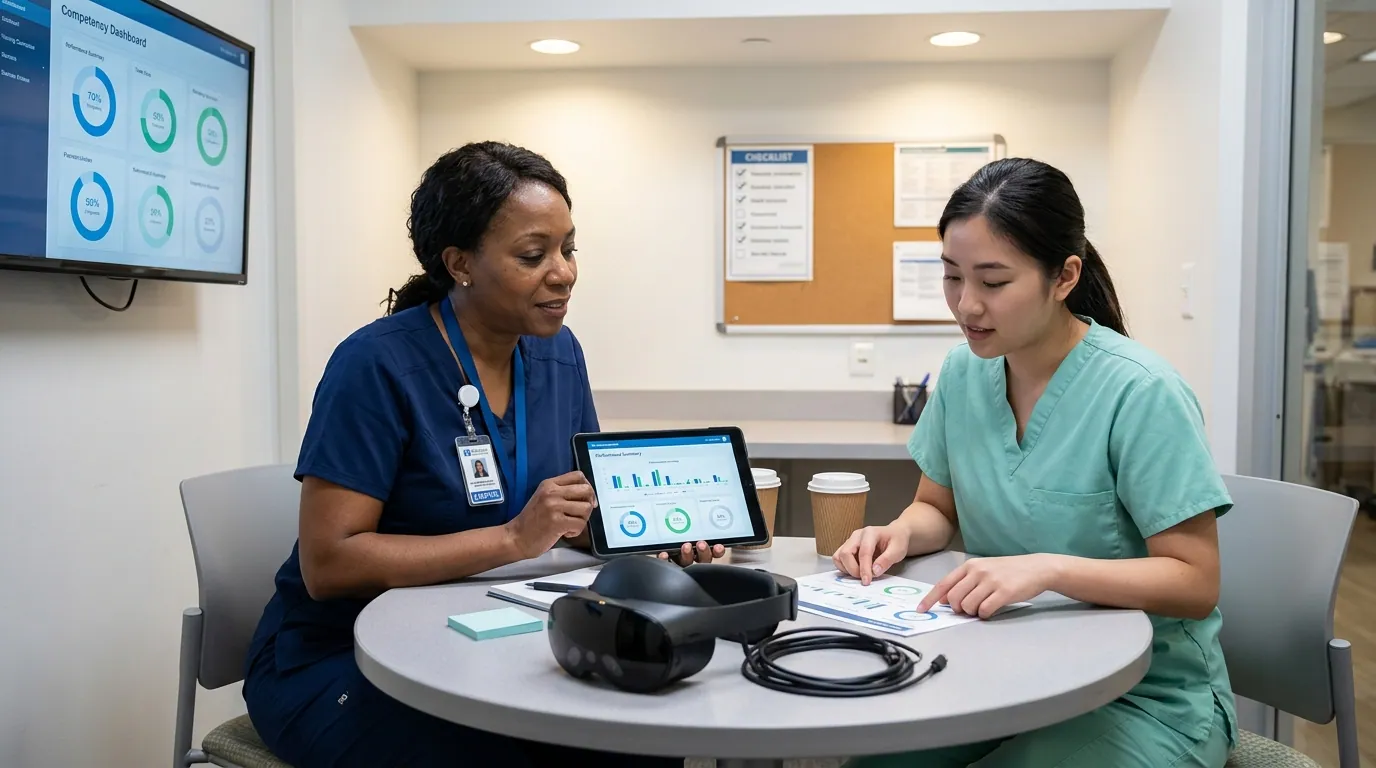
Healthcare organizations operate under strict documentation requirements: Joint Commission standards, CMS Conditions of Participation, state licensure boards, and internal competency frameworks all require verifiable training records. Custom enterprise VR programs built with xAPI or SCORM 2004 integration push detailed performance data, completion timestamps, competency scores, scenario-level decision logs, directly into platforms like HealthStream, Relias, and Cornerstone.
This means VR training is not a parallel system, it becomes a documented, auditable component of your existing credentialing workflow. Surveyors see completion records. Managers see performance trends. Staff get credit for demonstrated competency, not just time in seat.
4x Faster
VR-trained learners reach proficiency 4x faster than classroom-trained peers, with 275% greater confidence applying skills on the job (PwC VR Soft Skills Study, 2020)
What We See in Healthcare VR Training Projects
In healthcare VR programs we develop, a few patterns hold consistently:
- Clinical educators are the key stakeholder. When clinical education directors are involved in scenario design from day one, not just signing off at the end, the resulting simulations are significantly more accurate and accepted faster by staff.
- Non-clinical modules often show the fastest ROI. Patient communication and de-escalation VR scenarios for front-line non-clinical staff frequently show measurable improvements in HCAHPS scores and incident reports within 60 days of deployment.
- Branching complexity is where most programs underinvest. A scenario with only one correct path teaches compliance, not judgment. Healthcare scenarios that present genuinely ambiguous decision points, where multiple approaches are defensible, produce the deepest skill transfer.
- Credentialing integration is a prerequisite, not an afterthought. Healthcare clients who plan their LMS integration at the build phase avoid a 6-12 week delay that frequently derails rollout timelines.
Frequently Asked Questions
How is virtual reality used in medical training? +
Virtual reality in medical training lets clinicians practice procedures, emergency response, and patient communication inside realistic simulations before performing them on real patients. The Journal of Surgical Education found VR-trained surgeons performed 29% faster with 6x fewer errors than traditionally trained peers. Beyond surgery, virtual reality in medical training covers nursing protocols, EMT decision-making, infection control, and HIPAA-compliant patient communication. The Prime VR builds custom virtual reality medical training programs modeled on each health system's actual clinical scenarios, with xAPI performance tracking for credentialing and Joint Commission documentation.
Can VR training be used for healthcare professionals beyond surgeons? +
Yes, VR training works across the full healthcare workforce: nurses, EMTs, pharmacy technicians, hospital administrators, and patient-facing staff. Clinical simulations focus on procedures and emergency response. Non-clinical simulations address patient communication, de-escalation, HIPAA compliance scenarios, and safety protocols. The same platform that trains OR staff can train front desk and billing teams.
How does VR healthcare training compare to simulation labs? +
VR healthcare training costs significantly less than physical simulation labs, no mannequins, no consumables, no room overhead, while delivering comparable or superior procedural outcomes. The Journal of Surgical Education found VR-trained surgeons performed 29% faster with 6x fewer errors versus traditionally trained peers. Simulation labs remain valuable for hands-on haptic feedback; VR excels at decision-making, protocol adherence, and high-repetition scenario practice.
Does VR healthcare training integrate with hospital LMS or credentialing systems? +
Yes, custom VR training programs built on xAPI (Tin Can) or SCORM 2004 connect to any major healthcare LMS: HealthStream, Relias, Cornerstone, and SAP SuccessFactors. Completion data, competency scores, and time-on-task metrics export automatically. This supports Joint Commission documentation requirements and competency-based credentialing workflows.
What does a custom VR healthcare training program cost? +
$40,000 to $250,000+ depending on scope: number of scenarios, clinical complexity, hardware requirements, and LMS integration. High-fidelity surgical or emergency scenarios require more development time than communication or compliance modules. Most hospital systems deploy 3-5 modules in an initial program, then expand based on measurable outcomes.
RELATED ARTICLES
Ready to reduce clinical errors through VR training?
Tell us about your training challenge. We will scope a program that fits your clinical and compliance requirements.