
VR Employee Onboarding: How to Cut Ramp Time Without Cutting Corners
Most onboarding programs tell new hires what to do. VR onboarding makes them practice it. The difference shows up in week two, when one employee is already productive and the other is still figuring out what they learned in orientation.
QUICK ANSWER
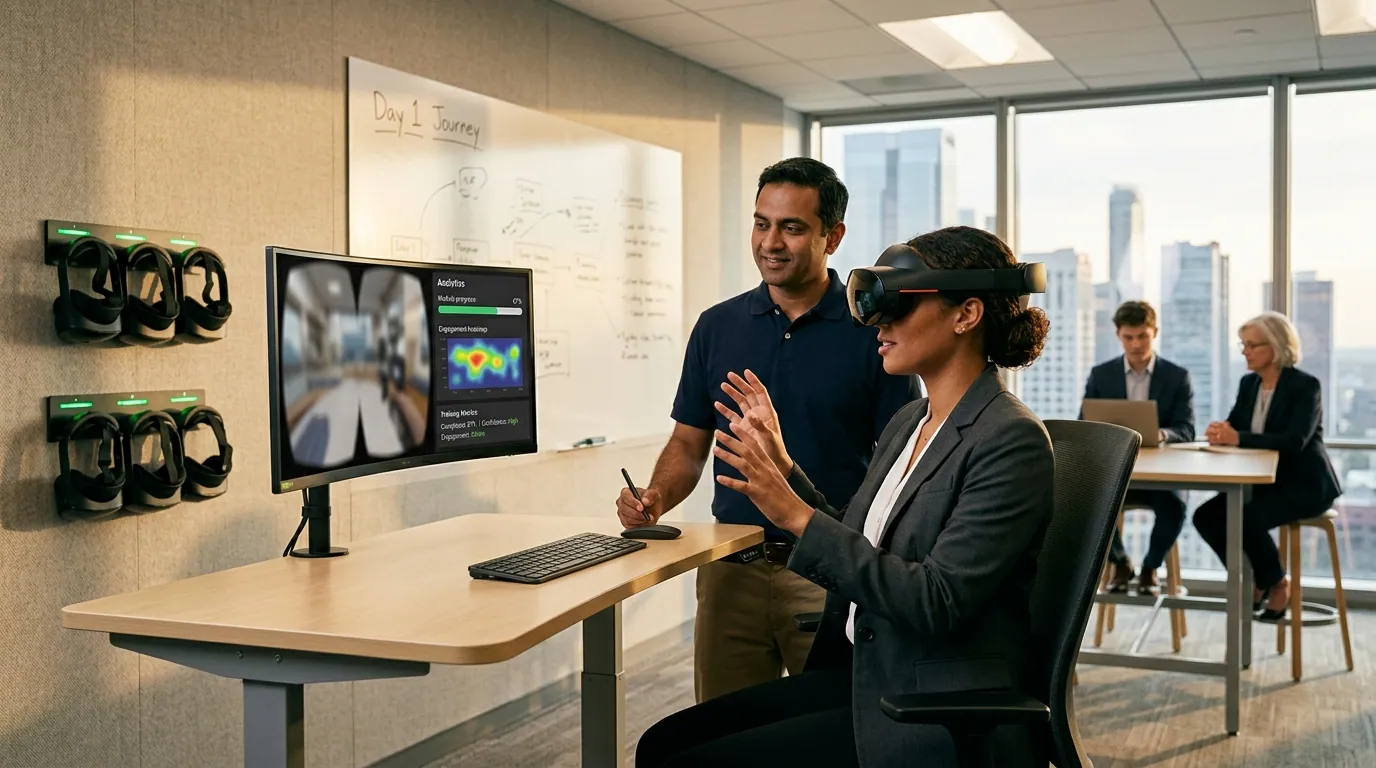
VR employee onboarding cuts ramp time by giving new hires practiced experience with their job before they perform it live. PwC found VR training was 4x faster than classroom and produced learners who were 275% more confident applying skills. STRIVR reported Walmart reduced specific training modules from 8 hours to 15 minutes. Programs cost $25,000 to $150,000 and show ROI within 3 to 6 months for organizations hiring 20+ people per year. The best starting point is a pilot focused on your highest-volume role with the longest current ramp time.
The Real Cost of a Slow Ramp
Every week a new hire is not fully productive costs money. The fully-loaded cost of an unproductive employee includes salary, benefits, manager time, training overhead, and lost output. For most mid-market roles, that number runs $1,500 to $4,000 per week per person.
Multiply that by your annual hiring volume and the math becomes significant. For a company hiring 50 people per year with a 6-week ramp, that is 300 weeks of unproductive time annually, somewhere between $450,000 and $1,200,000 in real cost. Cutting ramp time by even 2 weeks per hire changes that calculation dramatically.
4x Faster
VR training delivers skills 4x faster than classroom instruction and 1.5x faster than eLearning, meaning new hires reach competence in a fraction of the time required by traditional onboarding methods (PwC, 2020)
Why Traditional Onboarding Creates Slow Ramps
Standard onboarding programs share a common structural flaw: they deliver information and then expect performance. The gap between the two is filled by trial-and-error on the job, which is slow, inconsistent, and costly.
Day one information overload
New hires absorb policies, procedures, systems, and culture in the first week. Research consistently shows that without immediate application, 70% of new information is forgotten within 24 hours. The onboarding checklist gets completed; the knowledge does not stick.
Inconsistent peer training
The quality of on-the-job training depends entirely on who is doing the training. A new hire paired with your best performer learns differently than one paired with a mediocre trainer. VR delivers the same scenario, the same standard, and the same scoring to every new hire regardless of who their assigned buddy is.
No safe environment to fail
New employees hesitate to make mistakes in front of colleagues or customers. That hesitation slows learning. VR creates a consequence-free environment where failure is a learning mechanism, not a professional risk. Employees practice until the response is automatic before the stakes are real.
What VR Onboarding Looks Like in Practice
A VR onboarding program gives new hires structured practice with the specific scenarios they will face in their first 90 days:
| Role Type | Traditional Onboarding | VR Onboarding Scenario |
|---|---|---|
| Sales rep | Read playbook, shadow calls | Practice 10 discovery calls and 5 objection scenarios before first live call |
| Warehouse associate | Watch safety video, walk the floor | Practice equipment operation, hazard recognition, and emergency response in simulation |
| Customer service | Role-play with trainer, listen to calls | Handle 15 simulated customer interactions including complaints, escalations, and billing disputes |
| Restaurant manager | Follow a shift supervisor for 2 weeks | Manage simulated rush-hour scenarios, staff conflict, and food safety incidents before first solo shift |
| Manufacturing technician | Classroom instruction, observed practice | Complete assembly and quality inspection procedures in VR until accuracy threshold is met |
The ROI Calculation for VR Onboarding
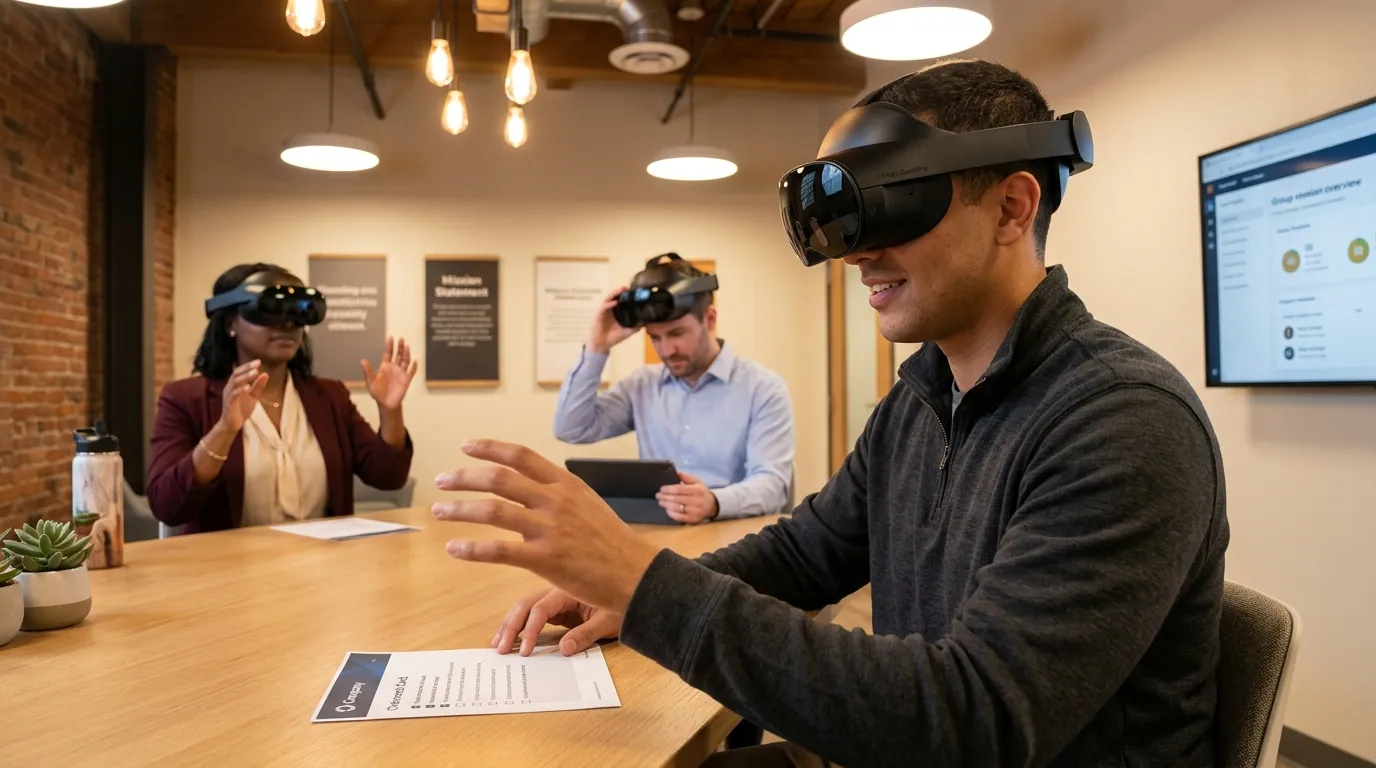
Three inputs determine whether a VR onboarding program pays for itself:
Weekly cost of an unproductive new hire
Total salary plus benefits divided by weeks per year, plus estimated manager time spent on support, plus lost output versus a fully ramped employee. For most roles this is $1,500 to $4,000 per week.
Weeks of ramp time saved per hire
PwC's data showing 4x faster training delivery means a 6-week ramp can compress to 2 to 3 weeks for the VR-trained portion of onboarding. Conservative estimate: 2 weeks saved per hire. For enterprise training programs with 50+ annual hires, that is 100 weeks of productivity recovered per year.
Annual hiring volume
The more people you hire, the faster the program pays back. A $75,000 VR onboarding program that saves 2 weeks of ramp time for 30 hires per year, at $2,000 per week per hire, returns $120,000 in year one alone.
275%
New hires trained with VR were 275% more confident applying skills on the job compared to those trained through classroom methods. Confidence on day one translates directly to faster productive contribution (PwC, 2020)
VR Onboarding vs. Traditional Methods
| Factor | Traditional Onboarding | VR Onboarding |
|---|---|---|
| Training delivery | Watch, read, shadow | Practice, perform, score |
| Consistency across hires | Varies by trainer quality | Identical standard for every hire |
| Readiness measurement | Manager judgment | Scored performance data |
| Training speed (PwC) | Baseline | 4x faster |
| Remote/distributed delivery | Expensive, inconsistent | Ship headset, train anywhere |
| Safe environment to fail | No, stakes are live | Yes, unlimited retries with scoring |
What We See in VR Onboarding Projects
From building custom enterprise VR training programs for onboarding, we consistently observe:
- The highest-volume roles have the fastest payback. Companies with high turnover in frontline roles benefit most. When you are training 100 warehouse associates per year, a 2-week ramp reduction represents 200 weeks of recovered productivity annually.
- Managers stop carrying new hires. One of the hidden costs of slow ramp is manager time spent supporting unready employees. VR onboarding shifts that burden to a simulated environment, freeing managers to manage instead of babysit.
- Performance data replaces gut-feel readiness checks. Instead of a manager deciding someone is "ready," the VR program produces a competency score that defines readiness objectively. HR directors gain a consistent, defensible standard for promotion eligibility.
- Retention improves alongside ramp time. New hires who feel competent faster stay longer. The confidence PwC documented at 275% above baseline directly correlates with early-tenure job satisfaction and 90-day retention rates.
How to Start: Scoping a VR Onboarding Pilot
The most effective starting point is your highest-volume role with the longest current ramp time. Define 3 to 5 scenarios that represent the most common performance gaps in the first 90 days. Build those scenarios first, measure the ramp difference between VR-onboarded and traditionally-onboarded cohorts, and use that data to build the business case for expansion.
A foundational VR onboarding program costs $25,000 to $75,000 with a 12 to 16 week development timeline. The pilot produces both ramp-time data and performance comparison data that makes the expansion conversation straightforward. For a full picture of how the development process works, see our process page.
How does VR improve employee onboarding? +
VR onboarding gives new hires practiced experience with their actual job scenarios before they perform them live. PwC found VR learners complete training 4x faster than classroom and are 275% more confident applying skills. Instead of watching videos about procedures, new employees practice the procedures, make decisions, and receive scored feedback before their first real shift.
How much does a VR onboarding program cost? +
$25,000 to $150,000 depending on scope. A focused onboarding program covering 2-4 core job scenarios for one role type costs $25,000 to $75,000. Multi-role or multi-site onboarding programs with full LMS integration run $75,000 to $150,000. See our full pricing guide. for details.
How long does it take to see ROI from VR onboarding? +
3 to 6 months for most programs. The ROI calculation is straightforward: multiply the number of new hires per year by the weekly fully-loaded cost of an unproductive employee, then multiply by the weeks of ramp time saved. For organizations hiring 20+ people annually, even a 2-week ramp reduction produces ROI within the first quarter of deployment.
Can VR onboarding work for remote or distributed teams? +
Yes. Enterprise VR headsets ship to employee locations and the training program runs locally without requiring a central training facility. Performance data syncs to your LMS via xAPI when the device connects to the network. Distributed teams often see the highest ROI from VR onboarding because traditional in-person onboarding is logistically expensive to deliver consistently across locations.