
Nursing Simulation Training: From Manikins to VR
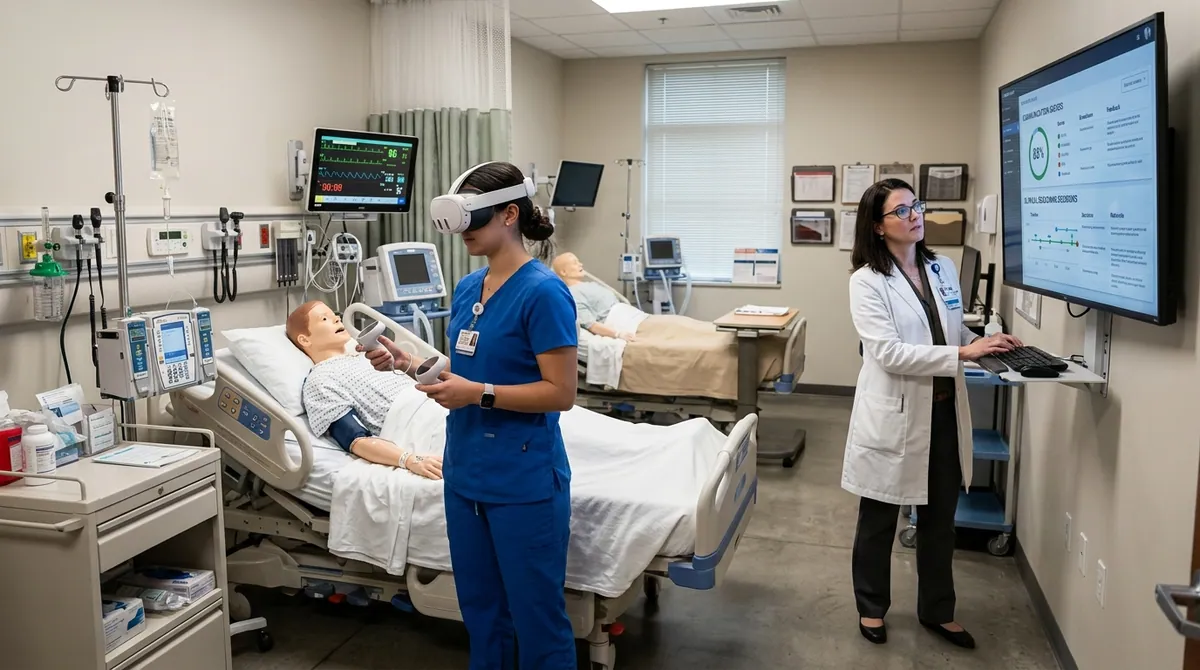
Nursing simulation has moved beyond high-fidelity manikins. Immersive VR puts student nurses and clinical staff inside responsive patient scenarios where clinical reasoning, communication, and deterioration recognition are practiced with realistic behavioral fidelity and zero patient risk.

Hugo Ramirez
Quick Answer
VR nursing simulation adds a responsive, speaking patient to scenarios that manikins cannot provide. Students practice clinical reasoning, SBAR communication, deteriorating patient recognition, and code blue response in immersive environments. NCSBN guidelines allow up to 50% of required clinical hours to be replaced by simulation meeting specific criteria. VR-trained learners show 275% more confidence applying clinical skills compared to classroom-only peers (PwC).
The Gap Between Manikin Simulation and Clinical Reality
High-fidelity manikins are excellent tools for procedural skill practice. A student learning IV insertion, airway management, or chest compressions benefits from tactile feedback that only a physical task trainer provides. Manikins have a different limitation: they do not talk back.
A nursing student entering a patient room for the first time faces a patient who asks questions, expresses fear, and changes clinically during the encounter. The communication and reasoning demands are different from any procedure practice. VR provides that responsive, dynamic patient in a repeatable environment without requiring a standardized patient actor or a clinical facilitator for every session.
50%
Maximum clinical hours replaceable by simulation under NCSBN guidelines when criteria are met
275%
More confidence applying skills after VR training versus classroom instruction (PwC, 2020)
VR vs Manikin: Choosing the Right Tool by Competency
| Competency | Best Tool | Why |
|---|---|---|
| IV insertion, intubation, central line | Task trainer / manikin | Tactile feedback is essential for motor skill acquisition |
| Deteriorating patient recognition (sepsis, respiratory) | VR | Realistic behavioral deterioration with repeatable scenario conditions |
| SBAR communication and handoff | VR | Interactive receiving provider; communication scored objectively |
| Code blue team response | Multi-user VR or manikin | VR enables multi-user team coordination; manikin provides procedural haptics |
| Therapeutic communication with distressed patients | VR | Responsive patient avatar; emotional fidelity manikins cannot provide |
What We See in Healthcare VR Training Programs
- Nursing schools using VR for clinical reasoning practice report improved NCLEX first-attempt pass rates when simulation is integrated early in the curriculum, not added at the end
- Hospital systems using VR for new graduate nurse orientation report faster competency sign-off on unit-specific protocols, reducing preceptor burden in the first 90 days
- Programs that integrate VR with HealthStream or Relias via xAPI maintain accreditation documentation without manual record entry
- The most valuable scenarios are high-acuity, low-frequency events: sepsis recognition, rapid deterioration, and family notification, because these are the moments where simulation practice most directly translates to patient safety
How to Implement a VR Nursing Simulation Program
Successful VR nursing programs follow a structured implementation sequence that mirrors the INACSL Standards of Best Practice for Simulation. Rushing any phase, particularly debriefing design, is the most common reason programs fail to show learning outcomes.
- Competency mapping: Identify which clinical competencies you are targeting. List the scenarios where VR adds the most value (high-acuity, low-frequency events). Exclude procedural skills that require tactile feedback from the VR scope.
- Platform selection: Evaluate existing nursing VR platforms (Oxford Medical Simulation, Shadow Health, Simul8) versus custom development. Off-the-shelf platforms deploy in weeks and cost less upfront. Custom programs match your specific patient population and facility protocols but require 16 to 28 weeks to build.
- LMS integration: Connect the VR platform to HealthStream, Relias, or your institutional LMS via xAPI. This ensures competency records feed directly into your accreditation documentation system without manual data entry.
- Facilitator preparation: VR simulation requires trained debriefers, not just technical operators. Designate simulation faculty who complete a structured debrief training program before the first student session. The debrief drives learning outcomes more than the scenario itself.
- Pilot cohort: Run the first 15 to 30 students through a structured pilot before full deployment. Collect scenario completion data, student confidence ratings, and facilitator debrief notes. Use this data to refine scenarios before scaling.
- Outcome tracking: Set baseline metrics before launch: NCLEX first-attempt pass rate, clinical preceptor evaluation scores, and time-to-competency sign-off. Measure at 6 and 12 months post-deployment to build the evidence base for program continuation.
When VR Is Not the Right Tool for Nursing Training
VR nursing simulation is a powerful tool for specific training objectives. It is not appropriate for all nursing education contexts, and misapplying it produces poor outcomes and wastes program budget.
- Procedural motor skills: IV insertion, intubation, chest compressions, and central line placement require tactile feedback that current VR technology cannot replicate. Use task trainers and manikins for these. VR is the wrong tool.
- Small programs under 50 students annually: The cost-per-learner math does not work at very small scale unless the program can share infrastructure with other clinical departments or use a subscription-based off-the-shelf platform.
- Programs without trained debriefers: VR without structured debriefing is a game, not a simulation. If your faculty cannot commit to INACSL-aligned debrief facilitation, the program will not produce the learning outcomes the research supports.
- Replacing all clinical hours: Even at the 50% substitution limit allowed by NCSBN guidelines, VR cannot replace direct patient care entirely. Graduates still need authentic clinical exposure to develop the environmental awareness and adaptability that simulation cannot fully reproduce.
Frequently Asked Questions
How is VR nursing simulation different from high-fidelity manikin simulation? +
High-fidelity manikins provide tactile feedback for procedures like IV insertion and intubation, but they cannot replicate realistic patient behavior, facial expressions, or verbal communication. VR adds a responsive simulated patient who speaks, reacts, and deteriorates in real time, making clinical reasoning and communication practice more authentic. The most effective programs combine both: VR for decision-making and communication scenarios, manikins for procedural skill practice.
What nursing competencies can be trained in VR? +
VR nursing simulation covers patient assessment (SBAR, head-to-toe), medication administration safety checks, sepsis and deteriorating patient recognition, code blue response and team roles, fall prevention and patient mobility, therapeutic communication, and difficult family interactions. Procedural skills like IV insertion are better trained on task trainers or manikins.
Does VR nursing simulation meet ACEN or CCNE accreditation requirements? +
ACEN and CCNE accreditation standards require evidence-based simulation practices but do not specify delivery method. VR simulation used in accordance with INACSL Standards of Best Practice for Simulation satisfies the evidence-based requirement. Schools must document prebriefing, simulation design, facilitation, debriefing, and evaluation whether using VR or manikin-based simulation.
Can VR replace clinical hours in nursing education? +
NCSBN guidelines allow up to 50% of required clinical hours to be replaced by simulation under specific conditions. VR simulation qualifies when it meets the NCSBN Simulation Guidelines criteria, which include prebriefing, a clinical scenario with fidelity, and structured debriefing. Not all states have adopted the 50% standard, so nursing programs must verify current state board requirements.
What is the cost of a custom VR nursing simulation program? +
Custom VR nursing simulation programs range from $80,000 to $300,000 depending on the number of scenarios, patient avatar complexity, integration with clinical LMS platforms like HealthStream or Relias, and multi-user capability for team scenarios. Off-the-shelf nursing VR platforms (Shadow Health, Oxford Medical Simulation) provide subscription-based access to pre-built scenarios at lower upfront cost.
Building a nursing simulation program?
Schedule a discovery call to discuss your clinical competency requirements and LMS integration needs.