
VR Compliance Training: Moving Beyond Checkbox Training
Annual compliance training is the most consistently ineffective category of corporate learning. Employees complete it because they are required to. They retain almost none of it. And the organizations that deploy it cannot demonstrate that completion translates into compliant behavior. VR changes the outcome by changing what the training actually requires.
QUICK ANSWER
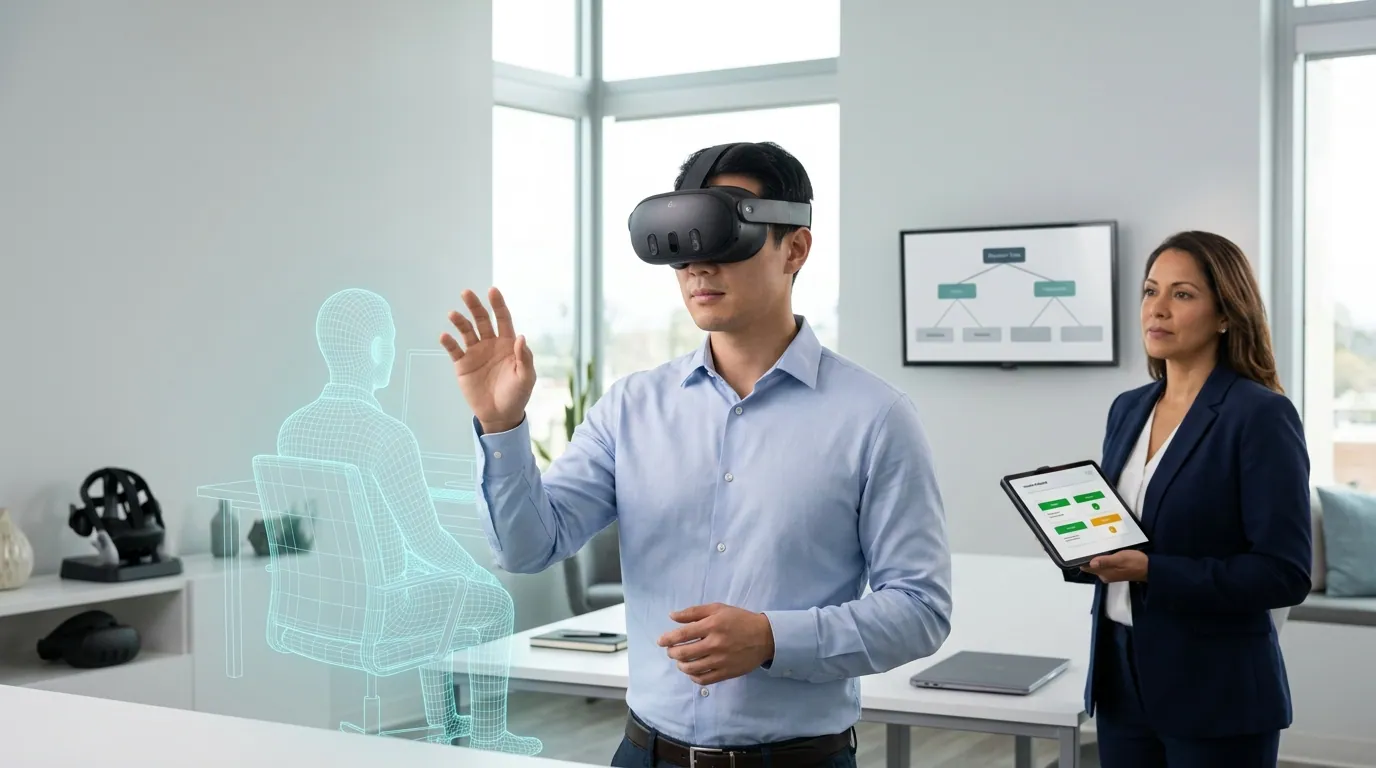
VR compliance training replaces annual video modules, which employees click through to completion without engaging, with decision-based scenarios that require employees to apply the policy, not just watch it being described. Programs cover workplace harassment, ethics and anti-bribery, OSHA safety standards, data privacy, and industry-specific regulatory requirements. Every decision is logged via xAPI, creating a documented competency record that goes beyond a completion timestamp. PwC research shows VR-trained employees are 275% more confident applying skills than classroom-trained peers.
The Problem with How Most Compliance Training Works
Most compliance training operates on a documented-completion model: an employee watches a video, clicks through a quiz, and receives a certificate. The organization can demonstrate that training occurred. It cannot demonstrate that the employee understands what they are supposed to do when they encounter the actual situation the training was designed to address.
Research consistently confirms what every training manager already knows: 87% of employees admit to clicking through compliance training as fast as possible to reach the completion screen. The format is designed to minimize friction, because its purpose, from the employee's perspective, is to be finished, not to learn. The result is organizations with 100% completion rates and no documented evidence that anyone retained or can apply what they completed.
This creates significant legal and regulatory exposure. Courts and regulators have increasingly shifted from asking "did employees complete the training?" to asking "did the training produce behavioral understanding?" A video completion timestamp is weak evidence that an employee understands how to identify and report workplace harassment, apply anti-bribery policies in a gray-area vendor relationship, or handle a data privacy breach correctly. A timestamped log of decisions made in a scenario that replicated the actual situation is substantially stronger.
87%
Of employees admit to clicking through compliance training as fast as possible to reach the completion screen, the current standard produces documented completion, not documented competency
What VR Changes About Compliance Training
VR compliance training requires the learner to make decisions inside the scenario, not observe someone else making them. A workplace harassment scenario does not show the employee a video of a manager behaving inappropriately and explain why it is wrong. It places the employee in a realistic workplace interaction where they must decide, in the moment, what to do and what to say. The decision is logged. The consequence follows. The debrief explains the policy behind the correct response.
This structure, decision, consequence, debrief, produces learning outcomes that passive video cannot replicate, for two reasons. First, the act of making a decision under simulated social pressure activates the same cognitive and emotional processes as making that decision in the real situation. Watching someone else navigate a difficult conversation does not. Second, seeing a consequence, even a simulated one, creates a memorable association between the decision and the outcome that reading a policy document cannot.
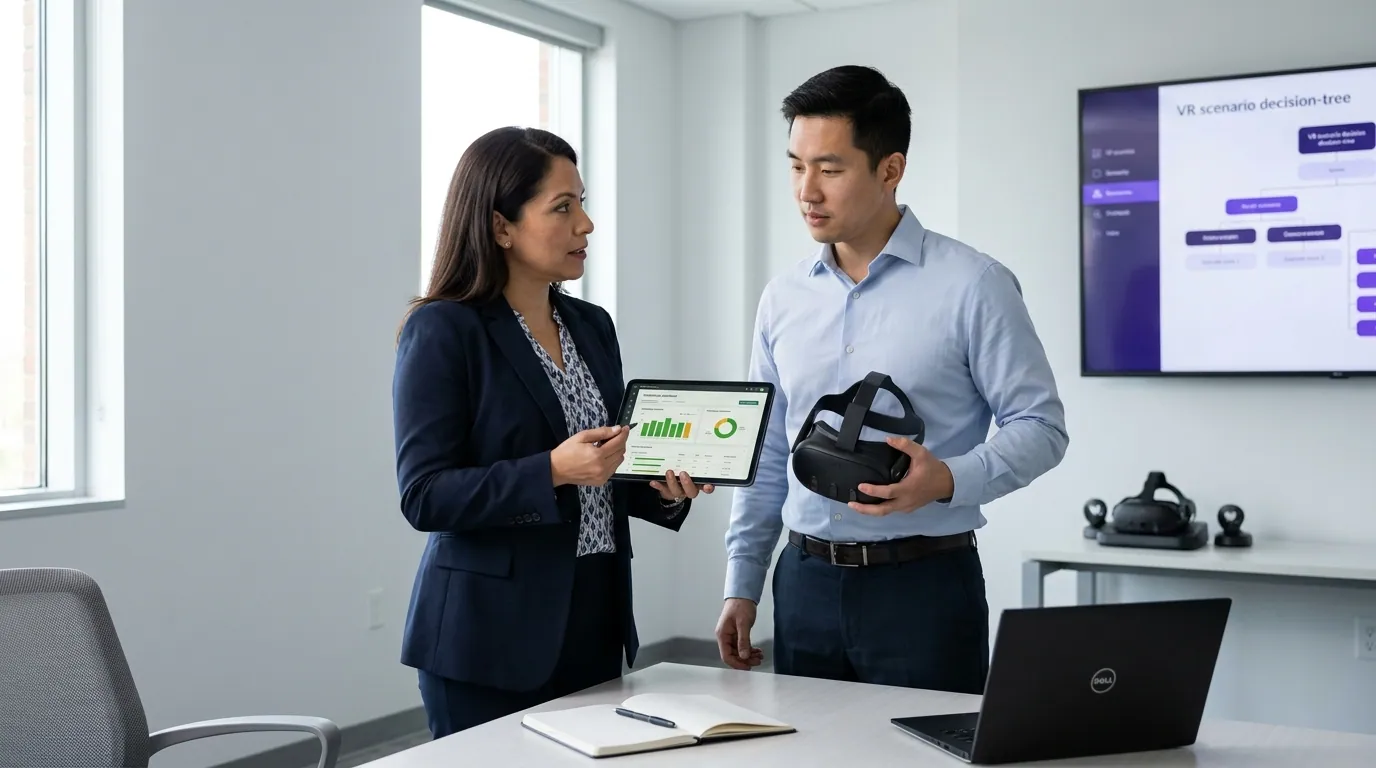
The documentation advantage is equally significant. Every decision in a VR compliance scenario is timestamped and logged to your LMS via xAPI. This creates an audit record showing not just that an employee completed training, but what decisions they made, whether those decisions aligned with policy, and whether they achieved the required competency threshold before certification. That record has substantially more evidentiary value than a completion certificate.
| Compliance Format | Engagement Level | Documentation | Behavior Change Evidence |
|---|---|---|---|
| Annual video module | Passive / click-through | Completion timestamp | None |
| Instructor-led session | Moderate | Attendance record | Low |
| eLearning module | Low to moderate | Score + completion | Limited |
| VR scenario | High / active decisions | Full xAPI decision log | Documented choices under simulated pressure |
Compliance Training Use Cases Across Industries
VR compliance training applies across every regulated industry, but the highest-value use cases share a common structure: a situation where the employee must apply judgment, not just recall a rule.
In healthcare, HIPAA compliance training built around realistic patient information handling scenarios, where an employee must decide whether a request for information is authorized under the correct exception, produces documented competency that audit staff and OCR investigators find meaningful. The scenario is more representative of real HIPAA risk than a quiz about which information is covered.
In financial services, SOX compliance and anti-money laundering training built around transaction review scenarios require employees to identify suspicious patterns and apply reporting thresholds under realistic conditions, not just read a definition of what constitutes a suspicious transaction.
In manufacturing and construction, OSHA compliance scenarios that place supervisors in situations where they must decide how to respond to an observed safety violation, report it, correct it immediately, stop work, produce behavior that video training describing the supervisor's obligations does not. The decision moment is where compliance behavior is built or fails.
Corporate HR compliance, harassment prevention, ethics and anti-bribery, manager conduct, benefits most consistently from VR because the scenarios where HR policy matters most are exactly the situations that video training cannot realistically simulate: ambiguous social interactions, power dynamics in manager-employee relationships, and gray-area gift and vendor situations where the correct response depends on reading the context correctly.
275%
VR-trained employees are 275% more confident applying policies on the job than peers trained through classroom or video, the gap between knowing and doing (PwC, 2020)
What We See in VR Compliance Training Projects
In compliance VR programs we develop, several consistent patterns determine what produces real behavior change versus what simply replaces one format of checkbox training with another:
- First scenario always surfaces policy gaps management assumed were covered. The performance data from the first compliance VR deployment almost always reveals that employees cannot apply the policy correctly when placed in a realistic situation, even when completion rates for prior training were at 100%. This is not a workforce failure. It is evidence that the prior training measured awareness, not application.
- Scenario design must mirror real workplace situations, not textbook examples. A harassment scenario built around an obviously egregious behavior, a manager making explicit comments to a subordinate, does not train the decisions that actually create liability. Effective compliance VR scenarios are built around the ambiguous situations: the comment that is borderline, the request that could be interpreted multiple ways, the relationship dynamic where reporting feels risky. That is where behavior change matters.
- Multi-language deployment is not optional for distributed workforces. Organizations with employees in multiple countries, or with multilingual domestic workforces, face the same compliance training obligation across every employee. VR compliance programs that deliver the same scenario with the same decision quality in multiple languages, without requiring localized facilitators for each language group, solve a deployment problem that traditional compliance training addresses inconsistently.
- Consequence visibility, not severity, is what drives behavior change. VR compliance scenarios do not need to simulate extreme consequences to produce learning. An employee who sees that their decision in a harassment scenario resulted in a formal complaint process, not a dramatic firing, understands the real-world consequence clearly. Realism of consequence, not intensity, is what makes the association between decision and outcome stick.
Frequently Asked Questions
What types of compliance training work best in VR? +
Scenario-based compliance content produces the strongest outcomes: workplace harassment recognition and reporting, ethics and anti-bribery decision points, safety procedure compliance, data privacy and handling, diversity and inclusion conversations, and manager decision-making under HR policy. Content that requires a judgment call, not just recall of a policy statement, is where VR creates measurably better outcomes than video. Pure information transfer (regulatory definitions, legal text) is better delivered through traditional formats; VR handles the application layer.
How does VR compliance training integrate with existing LMS platforms? +
Custom VR compliance programs built with xAPI (Tin Can) or SCORM export detailed completion data to any LMS that accepts these standards, Cornerstone, SuccessFactors, Workday Learning, Docebo, and others. Each learner's session logs scenario choices, decision timestamps, policy references accessed, and final scores. This creates an audit trail that goes significantly further than a video-completion timestamp for regulatory and legal purposes.
Does VR compliance training satisfy regulatory requirements? +
Yes, when designed correctly. VR programs built with documented scenario content, xAPI logging, and competency thresholds can satisfy the training requirements of OSHA standards, Title VII, EEOC guidance, SOX compliance programs, and GDPR training requirements. The key difference from video: regulators and courts increasingly consider whether training produced behavioral understanding, not just completion. A timestamped decision log from a VR scenario is stronger evidence of actual learning than a completion certificate.
What does a VR compliance training program cost? +
Enterprise VR compliance programs range from $25,000 for a single scenario module to $150,000+ for a multi-module annual compliance curriculum covering harassment, ethics, safety, and data privacy. Organizations with 500+ employees typically see cost recovery within the first deployment cycle when compared to the per-seat cost of third-party eLearning subscriptions that produce click-through completion rather than documented competency.
Ready to replace compliance checkboxes with documented competency?
Tell us your compliance training requirements, your industry, and your workforce size. We will design a VR program that satisfies your regulatory needs and produces evidence that employees can actually apply the policy.