
VR Safety Training vs. Video-Based Safety Training: What the Data Shows
Video safety training proves your employees watched something. VR safety training proves they can do something. The difference is the gap between compliance documentation and actual workplace safety.
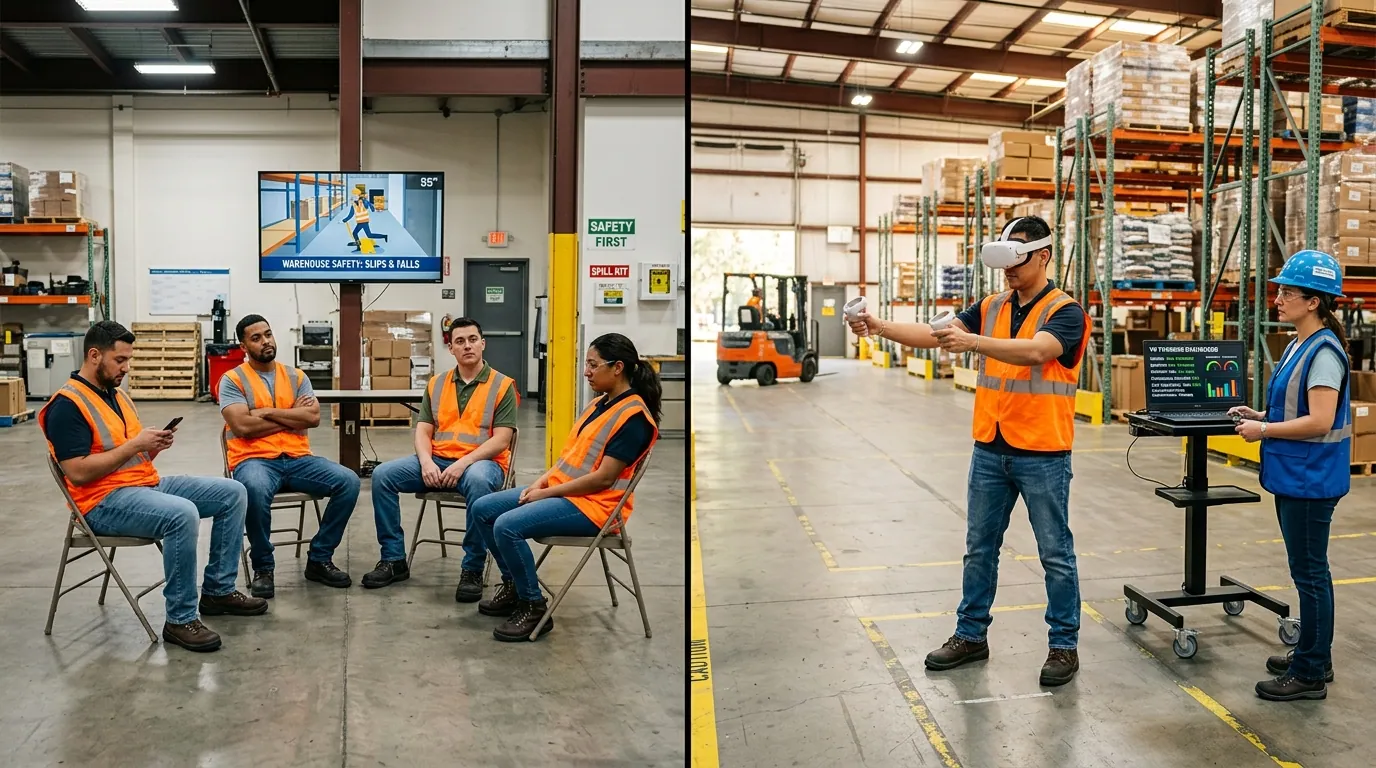
QUICK ANSWER
VR safety training outperforms video-based training when the goal is practiced performance, not watched awareness. PwC found VR learners were 275% more confident applying skills and completed training 4x faster than classroom methods. Video training remains effective for compliance documentation, policy updates, and awareness-level content. Use VR when the cost of a safety failure is high: fall protection, hazardous material response, confined space entry, emergency evacuation. Use video when the goal is information delivery. Most safety programs benefit from both.
The Problem with Video-Based Safety Training
Video-based safety training has been the standard for decades. Workers watch a video, pass a quiz, sign a form, and they are "trained." The compliance record is complete. The question is whether the worker can actually perform the safety procedure when the situation demands it.
The answer, supported by research and incident data, is often no. Watching someone demonstrate fall protection on a screen does not build the same neural pathways as physically practicing the response. The knowledge exists, but the practiced competence does not.
$171 Billion
Annual cost of workplace injuries to U.S. employers. Construction, manufacturing, and logistics account for the highest share of preventable incidents where training quality directly impacts outcomes (National Safety Council)
How the Brain Learns Safety Procedures
Neuroscience research distinguishes between declarative knowledge (knowing facts) and procedural knowledge (knowing how to do something). Video training builds declarative knowledge: the worker can describe the fall protection procedure. VR training builds procedural knowledge: the worker can execute the fall protection procedure under pressure.
PwC's 2020 VR Soft Skills Study quantified this difference. VR-trained learners were 3.75x more emotionally connected to the content than classroom learners, which directly correlates with retention and real-world application. They were also 4x faster to complete the training, meaning less time away from productive work.
For safety training specifically, the distinction matters because emergencies do not wait for workers to recall what they watched. They require automatic, practiced responses. That is what VR builds and video cannot.
VR vs. Video Safety Training: Side-by-Side
| Factor | Video Training | VR Safety Training |
|---|---|---|
| Learning method | Watch and acknowledge | Practice and perform |
| Knowledge type built | Declarative (knows facts) | Procedural (can execute) |
| Confidence applying skills | Baseline | 275% higher (PwC) |
| Emotional connection | Low (passive viewing) | 3.75x higher (PwC) |
| Training speed | Variable, self-paced | 4x faster than classroom (PwC) |
| Assessment method | Multiple-choice quiz | Observed performance with scoring |
| OSHA documentation | Attendance record | Performance record with scores |
| Cost per module | $500 - $5,000 | $25,000 - $75,000+ |
| Best for | Awareness, compliance records | Practiced response, high-stakes scenarios |
When to Use VR vs. When to Use Video
This is not an either/or decision. The right safety training program uses both methods for different purposes:
Use video training when:
- The goal is awareness of a policy or regulation
- Compliance documentation is the primary output
- The content is informational, not behavioral
- Annual refresher acknowledgment is sufficient
- Budget is under $5,000 per module
Use VR training when:
- The cost of failure is high (injury, death, equipment damage)
- The skill requires practiced physical response
- Workers must react under pressure or time constraints
- Performance data (not just attendance) is needed
- Traditional training has not reduced incident rates
Real-World Performance Data
Enterprise VR training results are consistent across industries and deployment sizes:
Walmart (STRIVR, 2023)
Reduced specific training modules from 8 hours of classroom time to 15 minutes of VR practice (96% reduction). Associates scored 70% higher on post-training assessments. The company expanded VR training to over 1 million associates across 4,700 stores.
PwC VR Soft Skills Study (2020)
Learners trained in VR were 275% more confident applying what they learned, 4x faster to train than classroom, and 3.75x more emotionally connected to the content. At scale (3,000+ learners), VR training achieved cost parity with classroom and was more cost-effective than eLearning.
Boeing (Assembly Training)
VR-based assembly training reduced wire harness assembly time by 25% and improved first-time quality, demonstrating that procedural training in VR transfers directly to physical performance on complex tasks.
Journal of Surgical Education
VR-trained surgical residents completed procedures 29% faster with 6 times fewer errors than traditionally trained peers. The principle transfers to any high-stakes procedural training: when the procedure must be executed correctly under pressure, VR practice produces superior outcomes.
3.75x
VR learners were 3.75x more emotionally connected to the training content than classroom learners. Emotional connection drives retention: workers who felt the scenario remember the response (PwC, 2020)
What We See in Safety Training Projects
From building custom VR safety training programs, we consistently observe:
- Video-trained workers often fail VR scenarios. Workers who scored 100% on video-based safety quizzes frequently struggle when placed in VR scenarios that require them to execute the same procedures under simulated pressure. The gap between knowledge and performance is immediate and measurable.
- VR does not replace video. It replaces the missing practice layer. The most effective safety programs we build keep video for awareness and compliance, then add VR for the critical 5-15% of scenarios where practiced response determines whether someone gets hurt.
- Safety managers become the strongest advocates. Once they see performance data showing which workers can actually execute procedures vs. which ones only passed a quiz, the value proposition becomes self-evident.
- The ROI calculation is straightforward for safety. If the VR training program costs $50,000 and prevents one incident that would have cost $200,000 in medical, legal, and insurance expenses, the math is clear.
How to Start: VR Safety Training Pilot
The most effective entry point is a focused pilot. Choose the single safety scenario that has the highest cost of failure: fall protection, confined space entry, chemical spill response, or equipment lockout/tagout. Build one VR module, deploy it to one team, and compare performance data against your existing video-trained baseline.
A foundational pilot program runs $25,000 to $75,000 with a 12-16 week development timeline. The data from the pilot provides the business case for expansion. For a full overview of how VR training development works, see our process page.
Is VR safety training better than video-based training? +
Yes, for scenarios requiring practiced performance. PwC found VR learners were 275% more confident applying skills and 3.75x more emotionally connected to the content compared to classroom and video methods. Video training is effective for awareness and compliance documentation. VR training is stronger when workers need to physically practice a safety response before encountering the hazard on the job.
Can VR safety training replace OSHA video requirements? +
No, VR supplements OSHA-required training rather than replacing it. VR adds a practice layer that video cannot provide: simulated hazard exposure, scored performance, and documented competence verification. Organizations use VR alongside existing OSHA compliance training to close the gap between watched instruction and practiced response.
How much more does VR safety training cost than video training? +
$25,000 to $200,000+ for custom VR safety programs vs. $500 to $5,000 for video-based safety courses. The comparison is not cost-per-module but cost-per-prevented-incident. The National Safety Council estimates the average medically consulted workplace injury costs $44,000. A single prevented incident can return the VR program investment.
What retention rates does VR training produce vs. video? +
275% higher confidence applying skills after VR training compared to classroom/video methods (PwC, 2020). STRIVR reported 70% higher assessment scores for VR-trained Walmart associates versus traditional methods. The retention advantage comes from active practice and embodied learning, not passive viewing.