
Best Safety Training Companies in Dallas (2026)
Dallas-Fort Worth is one of the largest inland logistics and distribution hubs in the United States. Dense warehousing, fulfillment centers, and freight operations sit alongside a heavy base of corporate headquarters and manufacturing, and that mix shapes the region's safety training needs. The recurring, high-consequence hazards here are forklift and powered-industrial-truck operation, dock and pedestrian safety, and the struck-by risks of moving product at volume. This guide compares the safety training companies that actually serve Dallas, what each is best for, and where immersive practice fits.
QUICK ANSWER
The best safety training companies serving Dallas-Fort Worth in 2026 include OccuPros, Forklift Safety, Shoppa's Material Handling, Dallas Forklift Service, Elite Material Handling, OSHA Training Services and the National Safety Council. They deliver forklift and powered-industrial-truck certification, dock and warehouse safety, OSHA 10 and 30, and hazard communication on-site and in Spanish. For Dallas operations whose workers must actually perform forklift, dock and lockout/tagout procedures under real conditions, not just pass a course, immersive VR safety training from The Prime VR is the emerging complement that turns knowledge into measured, hands-on practice.
Why Dallas safety training is a logistics problem
Most metros buy safety training to cover a broad slate of general-industry requirements. Dallas-Fort Worth buys a lot of it to keep an enormous logistics machine running safely. The region sits at the crossroads of the nation's freight network, and the density of distribution centers, cross-docks, and fulfillment operations means that on any given day tens of thousands of workers are operating forklifts, loading docks, and moving product around pedestrians. That concentration is why DFW has an unusually deep bench of forklift and material-handling training specialists, several of them tied directly to equipment dealers and service operations.
The differentiator between these providers is not whether they can issue a forklift card. It is whether the training actually prepares an operator to work safely in a crowded, fast-moving dock, and whether the employer can keep a large operator pool genuinely competent through constant turnover and three-year re-evaluation cycles. That is a harder problem than a single class solves, and it is where the choice of training approach starts to matter.
The providers, and what each is best for
OccuPros
Best for: Forklift, dock and warehouse safety
A complete Dallas-Fort Worth safety partner offering forklift operator certification, dock safety, powered industrial truck training, and hazard communication for warehouses and distribution centers across the Metroplex, with bilingual delivery and on-site options.
Forklift Safety
Best for: OSHA forklift certification at scale
Has provided expert forklift certification and OSHA-compliant training across Texas for more than three decades, with services in Dallas and Fort Worth, a fit for high-volume warehousing operations that certify large operator pools.
Shoppa's Material Handling
Best for: Operator training at your facility
Provides training that meets or exceeds OSHA standards at its Fort Worth location and on-site at your facility, convenient for distribution centers that cannot pull operators off the floor.
Dallas Forklift Service
Best for: Long-established local forklift training
A trusted Dallas forklift safety training provider since 1988 with certified instructors focused on OSHA compliance, a good fit for operators that want a local, equipment-savvy partner.
Elite Material Handling
Best for: On-staff OSHA authorized trainer
Operates in Dallas-Fort Worth with an on-staff OSHA authorized trainer, useful for facilities that want training tightly integrated with equipment service and maintenance.
OSHA Training Services
Best for: OSHA 10 and 30 in English and Spanish
Provides OSHA 10 and 30-hour outreach cards and specialized safety courses in English or Spanish, important across a Metroplex workforce where bilingual delivery matters.
National Safety Council
Best for: Nationally recognized workplace safety
A leading safety nonprofit offering widely recognized workplace safety, first aid, and defensive-driving training, a fit for Dallas employers that want a national brand for general-industry programs.
What the law requires in a Dallas warehouse
Powered industrial truck operators must be trained and evaluated under OSHA 29 CFR 1910.178. The standard requires formal instruction, hands-on practical training, and an evaluation of each operator performing in the actual workplace, with a re-evaluation at least once every three years and additional retraining after an accident, a near-miss, or an observed unsafe practice. It is not enough to show a worker a video. The employer has to verify that the specific operator can safely run the specific equipment in the specific environment.
Around that sit the other warehouse standards: lockout/tagout under 29 CFR 1910.147 for conveyor and equipment maintenance, hazard communication under 29 CFR 1910.1200, and the general-duty obligation to protect pedestrians from powered equipment. Dock and trailer operations add their own hazards, from trailer creep to falls between the dock and the truck. For a large Dallas distribution operation, the training obligation is continuous and administratively heavy, which is exactly why competency, not just paperwork, is the real challenge.
Cold chain and specialized distribution
Dallas-Fort Worth is also a major hub for cold-chain and food distribution, and refrigerated warehousing brings hazards that dry storage does not. Workers face cold stress in freezer environments, and large refrigeration systems often use anhydrous ammonia, a hazardous chemical that places those facilities under OSHA's Process Safety Management standard and the EPA Risk Management Program. That means confined space, respiratory protection, and emergency response training tied specifically to an ammonia release, on top of the standard forklift and warehouse curriculum.
Specialized distribution raises the stakes for training because the consequences of an error change. A forklift mistake in a dry-goods aisle is serious, but an ammonia release in a refrigerated facility is a life-safety and community event. For these operations, the argument for realistic, measured practice is even stronger, because the highest-consequence scenarios are also the ones workers are least likely to have ever experienced firsthand. Rehearsing an ammonia evacuation or a cold-environment rescue in VR, before it ever happens for real, is exactly the kind of preparation a card-based course cannot provide.
Beyond forklifts: the wider warehouse hazard picture
Forklifts get the most attention, but a Dallas distribution operation carries a broader hazard picture that a good training program has to cover. Storage rack safety is a serious and often underestimated risk: overloaded or forklift-damaged racking can fail catastrophically, and rack collapse in a busy facility endangers everyone nearby. Training on load limits, inspection, and immediate reporting of rack damage is part of a mature warehouse safety program, not an afterthought.
Manual material handling is the quieter but more frequent problem. Sprains, strains, and other musculoskeletal injuries from lifting, reaching, and repetitive motion are among the most common warehouse injuries, and they drive a large share of workers-compensation cost. Ergonomics training, safe lifting technique, and job design matter here, and they are exactly the kind of habitual behavior that benefits from repeated, coached practice rather than a single lecture.
Then there is the seasonal reality of Dallas logistics. Peak season brings a surge of temporary and newly hired workers into fast-moving facilities, precisely the population most likely to be injured, and many Dallas distribution centers are not fully climate controlled, adding heat illness risk during long Texas summers. A training system that can bring large numbers of new workers up to genuine competency quickly, and standardize how they handle these everyday hazards, is worth far more than one that simply issues a card and hopes for the best.
The stakes: why completion is not competency
Forklifts are among the most common sources of serious warehouse injuries, and the incidents that hurt people are rarely caused by a lack of knowledge. They are caused by habits: taking a corner too fast, lifting a load that blocks the view, backing up without checking for a pedestrian, skipping the pre-shift inspection. A worker can pass a written forklift test and still develop those habits within weeks. Classroom training and online modules transfer the rules, but they do not build the reflexes that keep an operator safe when the dock is busy and the pressure is on.
This is the gap every Dallas logistics safety leader recognizes. The providers above do essential work issuing the certifications operators must have. The point is that the certification is the floor, not the ceiling, and that in a high-volume, high-turnover environment, realistic and repeatable practice is what turns a certified operator into a genuinely safe one.
SPECIAL MENTION: IMMERSIVE TECHNOLOGY
The Prime VR, for VR safety training in Dallas
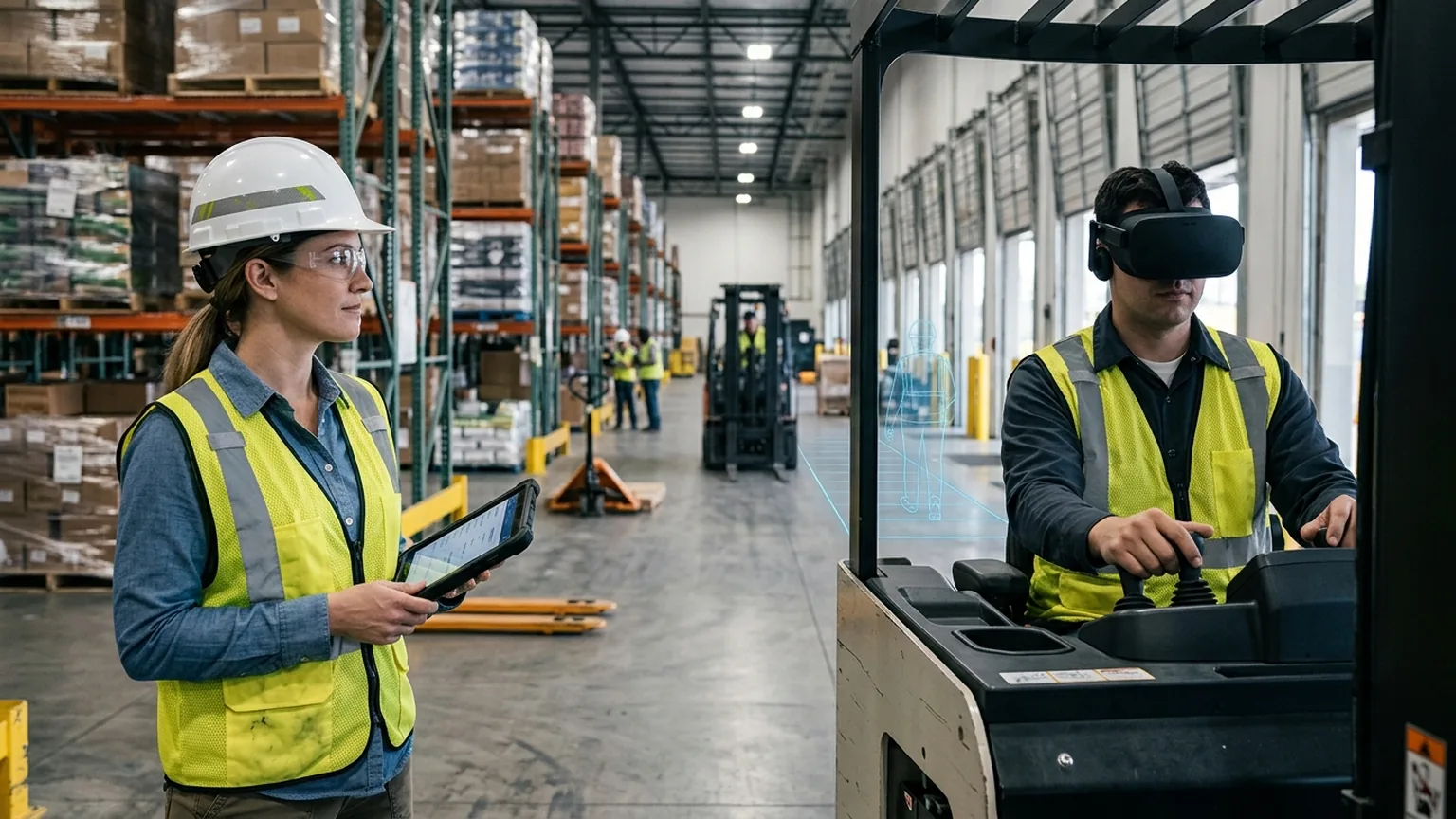
The companies above deliver the certifications, refreshers, and compliance tracking every Dallas operation needs. The Prime VR represents the layer most of that training is missing: custom virtual reality programs where Dallas workers practice forklift operation, dock and pedestrian safety, lockout/tagout, and emergency response in realistic simulations of your actual warehouse, with performance measured step by step.
High-volume logistics is an ideal fit for immersive training, because the same procedures repeat across hundreds of operators and constant new hires. A new operator can practice a crowded-dock scenario dozens of times in VR with zero real-world risk, and every decision is recorded so a manager can see who is genuinely ready before they touch a real machine. Because the program is built around your specific facility and owned outright, there are no per-seat fees, and it can be reused for every new hire and every shift, which is where the economics get compelling for a large distribution network.
Learn more about VR safety and operations training, how it applies to warehouse safety, or manufacturing safety.
The bilingual reality of the Dallas workforce
A large share of the Dallas-Fort Worth warehousing and construction workforce speaks Spanish as a first language, and safety training that is only delivered in English carries a hidden risk. An operator can pass a written test in a second language and still miss a nuance that matters when a dock gets busy. That is why providers such as OccuPros and OSHA Training Services deliver bilingual courses, and why serious employers insist on it. Bilingual delivery is a comprehension issue and a documentation issue at once, and any modern approach, including a custom immersive program, should be authorable in both languages so the experience and the assessment are equivalent for every operator.
The cost of getting it wrong
The financial exposure is real and rising. As of the 2025 inflation adjustment, OSHA can penalize a serious violation up to 16,550 dollars per instance and a willful or repeated violation up to 165,514 dollars per instance, with failure-to-abate penalties accruing daily. For a large Dallas distribution operation, an inadequate forklift program can generate multiple citations at once. Those figures do not include the indirect costs of a forklift incident: workers compensation, downtime, damaged product and racking, higher insurance, and lost customer confidence. Training is one of the least expensive forms of protection available, but only if it actually changes how operators behave on the floor.
How to choose a Dallas safety training partner
Start with your operation. If you run warehousing and distribution, prioritize forklift and material-handling specialists that can evaluate operators in your actual facility and deliver across shifts. Confirm bilingual delivery if your crews need it, and confirm the provider can help you manage the administrative burden of keeping a large operator pool current through three-year cycles and turnover. And if your problem is that operators are certified but incidents keep happening, that is the signal you need practice, not more paperwork.
Many Dallas operations end up with a blend: local providers for the required certifications and evaluations, plus an immersive layer for the highest-consequence procedures and for compressing new-operator ramp time. The certifications keep you compliant. The practice keeps your people safe and gives you an objective record to show during an audit or a customer prequalification. In a market as large and competitive as Dallas-Fort Worth, that combination of documented compliance and demonstrable competency is increasingly what separates the operations that win and keep national logistics contracts from the ones that lose them after a preventable incident.
What a VR pilot looks like for a Dallas operation
A custom immersive program starts with your facility, not a headset. A typical build runs in four phases. Discovery maps the specific hazards and procedures you want operators to practice, drawing on your incident history, dock layout, and the people who run the floor. Design turns those into interactive scenarios with defined success criteria. Build develops and tests the environment against your real warehouse, from a crowded dock to a specific lockout/tagout on a conveyor. Deploy handles hardware, learning management system integration, and train-the-trainer so your team runs it without an outside vendor.
For a Dallas operation, a sensible starting point is a single high-frequency, high-risk scenario, often a crowded-dock or pedestrian-interaction procedure, delivered as a pilot before expanding. That keeps the investment contained while proving whether measured practice moves your leading indicators, from near-miss reports to new-operator ramp time. Because the finished program is owned rather than licensed per seat, the economics improve every time you onboard another operator or open another facility.
Frequently Asked Questions
Who are the best safety training companies in Dallas-Fort Worth?+
The leading providers serving Dallas-Fort Worth include OccuPros, Forklift Safety, Shoppa's Material Handling, Dallas Forklift Service, Elite Material Handling, OSHA Training Services and the National Safety Council. Between them they deliver forklift and powered-industrial-truck certification, dock and warehouse safety, OSHA 10 and 30, and hazard communication, on-site and in Spanish. The right choice depends on whether your gap is warehousing, manufacturing, or general construction. For teams that must actually perform procedures under real conditions rather than only pass a course, immersive VR safety training from The Prime VR is an emerging complement.
How much does safety training cost in Dallas?+
Pricing in Dallas follows national ranges. Forklift certification runs a low per-seat fee, OSHA 10 or 30 cards run roughly 80 to 250 dollars per seat, and on-site group delivery is priced per class. Custom immersive VR safety training, built around your real Dallas warehouses, docks and worksites and owned rather than licensed per seat, typically runs from 25,000 to 500,000 dollars depending on scope.
Why is Dallas a logistics safety market?+
Dallas-Fort Worth is one of the largest inland logistics and distribution hubs in the country, with a dense concentration of warehouses, fulfillment centers, and freight operations, plus a heavy base of corporate headquarters and manufacturing. That means the recurring high-consequence hazards are forklift and powered-industrial-truck operation, dock and pedestrian safety, and the struck-by and caught-in risks that come with moving product at volume. The provider landscape reflects that, with unusual local depth in forklift and material-handling training.
What forklift and warehouse safety training does OSHA require?+
Powered industrial truck operators must be trained and evaluated under OSHA 29 CFR 1910.178, which requires formal instruction, practical training, and an evaluation of each operator in the workplace, with re-evaluation at least every three years. Warehousing operations also fall under lockout/tagout under 29 CFR 1910.147, hazard communication under 29 CFR 1910.1200, and general-duty obligations around dock and pedestrian safety. Training is not a one-time event, it is a recurring requirement that large Dallas distribution operations must manage continuously.
What is VR safety training and how does it fit Dallas logistics operations?+
Immersive VR safety training puts workers in realistic simulations where they practice real procedures such as forklift operation, dock and pedestrian safety, lockout/tagout, and emergency response, and the system measures how they perform step by step. It complements an OSHA course by turning knowledge into repeatable, measured practice, built around your actual Dallas warehouse or plant and owned rather than licensed per seat.
Do Dallas providers offer bilingual training?+
Yes. A large share of the Dallas-Fort Worth warehousing and construction workforce is Spanish-speaking, and providers such as OccuPros and OSHA Training Services deliver bilingual courses. Bilingual delivery matters for genuine comprehension of safety procedures and for defensible documentation if an incident is investigated. Any modern approach, including a custom VR program, should be authorable in both languages so the experience and the assessment are equivalent for every worker.
How do high-volume Dallas warehouses keep forklift training current?+
The challenge in a large distribution operation is not the initial certification, it is keeping hundreds of operators current across three-year re-evaluation cycles and constant turnover. Many operators look for repeatable, trackable methods rather than one-off classroom sessions, because a spreadsheet of expiration dates is only as good as the underlying competency. This is where a custom, owned VR program can help, giving new operators repeatable practice and giving managers an objective record of who is genuinely ready to operate.
Can VR training prove competency for audits and customer prequalification?+
Yes. A custom VR program records each operator's decisions, response times, and completion, and can pass that data to your learning management system. For Dallas logistics providers preparing for an OSHA audit or a customer prequalification, that objective per-worker record helps demonstrate that operators can actually perform safely in a crowded dock, not just that they passed a written test.
Want Dallas operators to practice the dock before it counts?
We build custom VR training around your real warehouse and operation. Tell us your setup and we will scope it.