
Forklift Battery Charging VR Training: Hydrogen, Acid and Topping Up (DSEAR 2002 and COSHH)
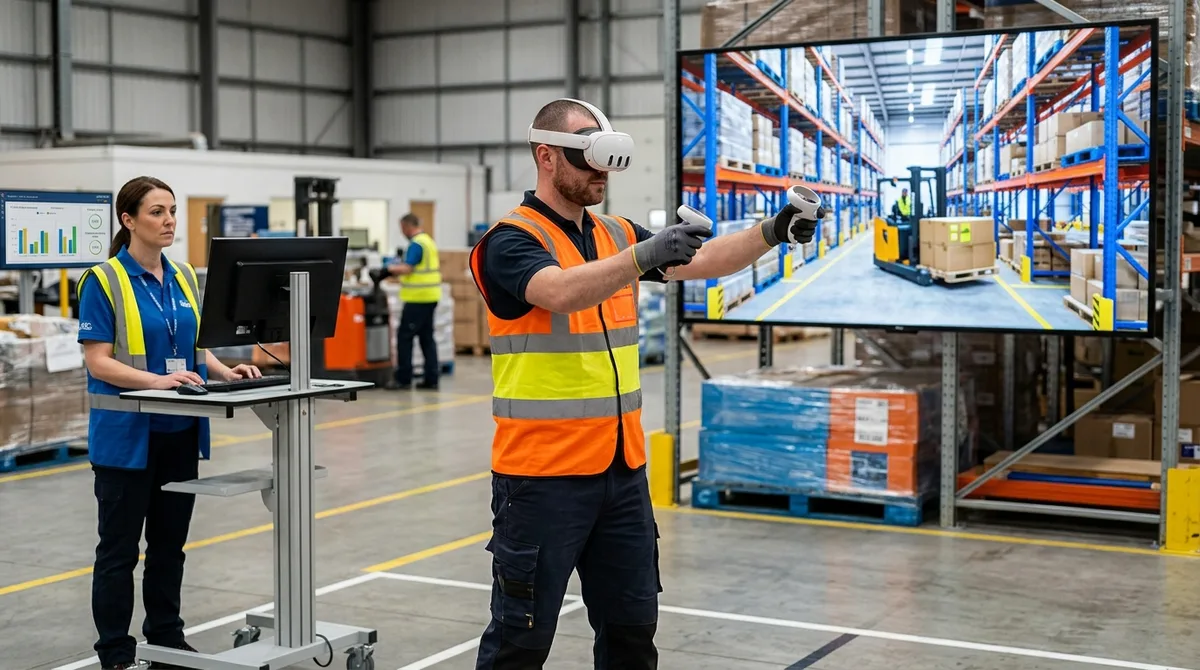
VR battery charging scenario on DSEAR 2002 and COSHH 2002: hydrogen ventilation, no ignition sources, acid handling, eye wash and charger connection order.
QUICK ANSWER
Lead-acid forklift batteries give off hydrogen while charging and contain sulphuric acid. DSEAR 2002 covers the explosion risk and COSHH 2002 covers the acid. A VR charging bay trains operators on connection order, ventilation and acid splashes.
What the Rule Requires
DSEAR 2002 and COSHH 2002: employers must assess and control risks from dangerous substances, including hydrogen produced during battery charging, by controlling ignition sources and providing ventilation. COSHH requires exposure to hazardous substances such as battery acid to be prevented or adequately controlled, with information, instruction and training.
The scenario has a charging area where someone has parked a pallet of cardboard, an operator disconnects a charger while it is still on, the eye wash station is blocked and a battery needs topping up.
Hazards in This Scenario
- Hydrogen explosion from sparks
- Acid burns to eyes and skin
- Lifting heavy batteries
- Blocked emergency equipment
The Procedure the Scenario Rehearses
- Keep the charging area ventilated and clear
- Switch off the charger before connecting or disconnecting
- No smoking or naked flames
- Wear goggles and gloves when topping up
- Top up after charging with the right water
- Keep the eye wash clear and know how to use it
Mistakes the Scenario Is Built to Catch
- Disconnecting a live charger
- Storing combustibles in the area
- Topping up without goggles
- Blocking the eye wash
Competence Assessment Matrix
| Decision point | What the assessor sees | Pass standard |
|---|---|---|
| Area | Combustibles removed | No cardboard or pallets near chargers |
| Charger | Off before disconnect | Switched off first, no sparks at the plug |
| PPE | Topping up | Goggles and gloves |
| Eye wash | Access | Cleared |
What VR Covers
- Spark and acid hazards shown safely
- Order of steps
- Emergency eye wash practice
- Records per operator
What VR Does Not Replace
- Ventilation design
- Battery maintenance by competent people
- First aid response
Scope of a One-Scenario Pilot
A pilot builds this scenario as a single module, in Unity or Unreal Engine depending on the visual fidelity the task needs and the headsets on site. It runs on standalone headsets, logs every learner decision, and exports a per-person record for your training file. It is measured against your current method with a test cohort before anything is scaled.
Frequently Asked Questions
Why is battery charging a fire risk?
Lead-acid batteries release hydrogen while charging, which can ignite.
When should batteries be topped up?
Usually after charging, following the manufacturer instructions.
Does this cover lithium-ion batteries?
The scenario can be adapted to lithium-ion trucks.
Want this scenario built around your site?
We review your current procedure and tell you which parts can be rehearsed in VR and which still need hands-on practice.
Map Your Highest-Risk ScenarioFurther reading
- Forklift Operator VR Training: Basic, Specific Job and Familiarisation Training (HSE L117 and PUWER)
- Warehouse Pedestrian Segregation VR Training (Workplace Regulations 1992, Regulation 17)
- Forklift Pre-Use Check VR Training for UK Operators (PUWER 1998 and LOLER 1998)
- Loading Bay VR Training: Vehicle Creep, Drive-Aways and Trailer Restraints (Workplace Transport, HSG136)
- Logistics warehouse VR training
- All VR training scenarios: United Kingdom
- VR pilot readiness checklist
- How VR training programs are priced