
Warehouse Pedestrian Segregation VR Training (Workplace Regulations 1992, Regulation 17)
VR scenario on regulation 17 of the Workplace (Health, Safety and Welfare) Regulations 1992: separate routes, crossings, blind corners and pedestrian behaviour around forklifts.
QUICK ANSWER
Regulation 17 of the Workplace Regulations 1992 requires workplaces to be organised so pedestrians and vehicles can circulate safely. In a warehouse that means marked walkways, crossings and barriers. A VR scenario trains both operators and pickers, because most incidents involve someone on foot.
What the Rule Requires
Workplace (Health, Safety and Welfare) Regulations 1992, regulation 17: every workplace must be organised so that pedestrians and vehicles can circulate in a safe manner. Traffic routes must be suitable for the persons or vehicles using them, sufficient in number, in suitable positions and of sufficient size, and must be suitably indicated where necessary. HSE guidance HSG136 explains segregation, crossings and barriers.
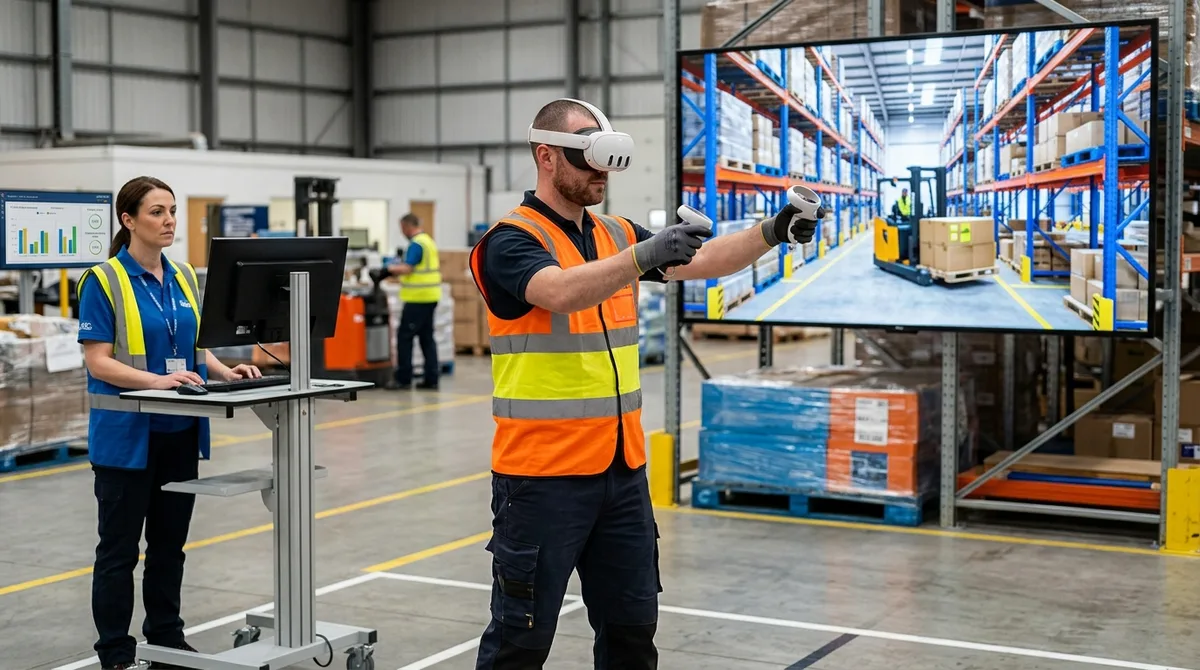
The scenario is a chilled distribution centre at shift change. A picker cuts across an aisle to save time, a walkway is blocked by a pallet, a forklift comes round a blind corner and a visitor is walking without hi-vis.
Hazards in This Scenario
- Pedestrians struck by forklifts
- Blocked walkways forcing people into traffic
- Blind corners and doorways
- Visitors who do not know the rules
The Procedure the Scenario Rehearses
- Use marked walkways and crossings
- Keep walkways clear
- Stop and look at crossings and corners
- Make eye contact with drivers
- Wear hi-vis where required
- Report near misses
Mistakes the Scenario Is Built to Catch
- Taking shortcuts across aisles
- Leaving pallets on walkways
- Entering a working aisle while a truck is in it
- Escorting visitors without briefing
Competence Assessment Matrix
| Decision point | What the assessor sees | Pass standard |
|---|---|---|
| Routes | Walkway use | Uses walkways |
| Crossings | Behaviour | Stops and looks |
| Blockage | Response | Clears or reports |
| Contact | With drivers | Eye contact first |
What VR Covers
- Both driver and pedestrian views
- Busy shift change conditions
- Near misses shown safely
- Records per person
What VR Does Not Replace
- Physical barriers and floor marking
- A workplace transport risk assessment
- Supervision
Scope of a One-Scenario Pilot
A pilot builds this scenario as a single module, in Unity or Unreal Engine depending on the visual fidelity the task needs and the headsets on site. It runs on standalone headsets, logs every learner decision, and exports a per-person record for your training file. It is measured against your current method with a test cohort before anything is scaled.
Frequently Asked Questions
What does UK law require for pedestrians in warehouses?
Safe circulation for pedestrians and vehicles under regulation 17 of the Workplace Regulations.
Is HSG136 law?
It is HSE guidance on workplace transport safety. Following it helps meet legal duties.
Who should take this scenario?
Forklift operators, pickers, supervisors and regular visitors.
Want this scenario built around your site?
We review your current procedure and tell you which parts can be rehearsed in VR and which still need hands-on practice.
Map Your Highest-Risk ScenarioFurther reading
- Forklift Operator VR Training: Basic, Specific Job and Familiarisation Training (HSE L117 and PUWER)
- Forklift Pre-Use Check VR Training for UK Operators (PUWER 1998 and LOLER 1998)
- Loading Bay VR Training: Vehicle Creep, Drive-Aways and Trailer Restraints (Workplace Transport, HSG136)
- Pallet Racking Damage Inspection VR Training (HSE HSG76 and Management Regulations)
- Logistics warehouse VR training
- All VR training scenarios: United Kingdom
- VR pilot readiness checklist
- How VR training programs are priced