
Logistics and Warehouse VR Training for High-Turnover Teams
Warehousing and logistics run on speed, safety, and a workforce that turns over fast. VR training gets new workers productive and safe sooner, without slowing the operation.
QUICK ANSWER
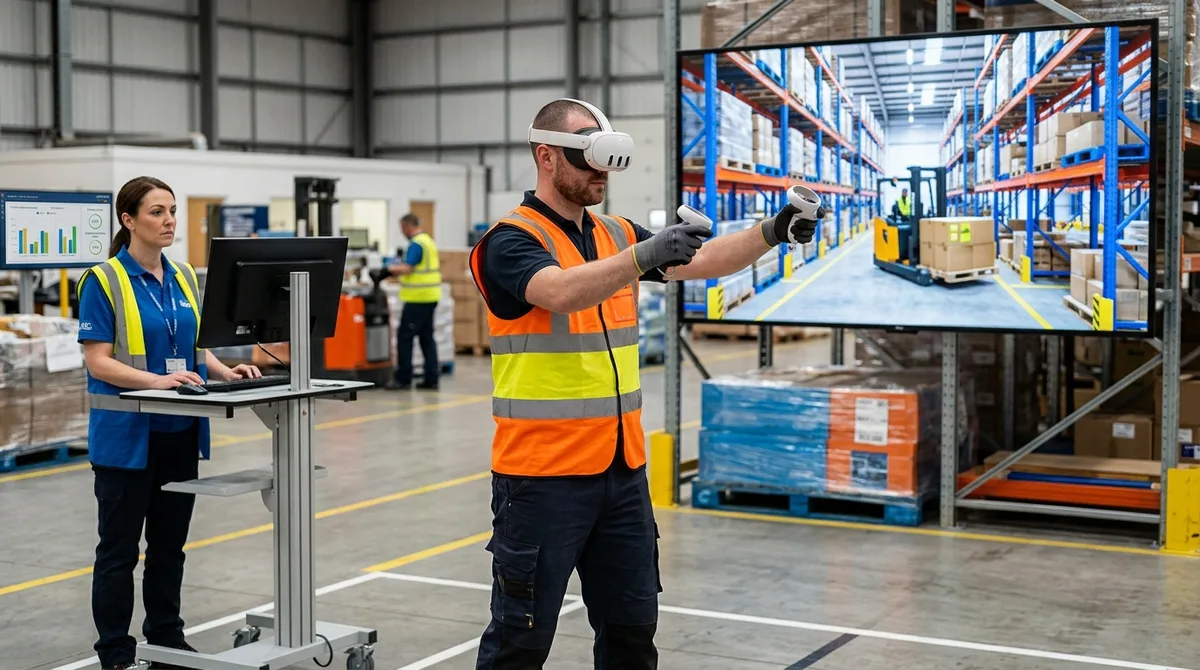
Logistics and warehouse VR training lets workers practice picking and packing workflows, equipment operation, dock and pedestrian safety, and emergency procedures in a realistic simulation before their first shift. It cuts ramp time for a high-turnover workforce, reduces incidents by building spatial safety judgment, and delivers identical training at every facility, without pulling productive floor space or supervisors offline.
Why Logistics Needs Faster, Safer Training
Warehousing and logistics face two structural training problems: high turnover that means constant onboarding, and a fast-moving floor where the cost of an incident, or a slow new worker, is immediate. Traditional training either pulls supervisors and floor space offline or throws new workers onto the floor underprepared. VR offers a third path: workers reach competence in a realistic simulation of the facility before their first shift, so they arrive faster and safer.
Ramp time and turnover
In high-turnover logistics operations, every day of ramp time is multiplied across constant new hires. VR that gets workers productive sooner compounds quickly, and the same content trains every new hire identically at every site.
Logistics VR Training Applications
- Picking and packing workflows. Practicing the actual pick path, scanning, and packing process before the first live shift.
- Equipment operation. Forklift, pallet jack, and conveyor safety and operation in a virtual replica.
- Dock and pedestrian safety. The pedestrian-forklift interactions and dock hazards that cause warehouse injuries.
- Emergency procedures. Fire, spill, and evacuation response rehearsed safely.
Consistency Across a Distributed Network
Large logistics operations run many facilities, and training quality usually varies by site and supervisor. VR delivers the identical scenario and assessment at every location, so a worker in one distribution center is trained to the same standard as one across the country. That consistency, plus per-worker competence data, is hard to achieve any other way. The approach extends our forklift simulator and warehouse safety training to the full logistics workflow.
What We See in VR Training Projects
From warehouse and logistics deployments, the consistent findings:
- Ramp time is where the ROI is. In high-turnover operations, shaving days off time-to-productivity compounds across every hire.
- Pedestrian-forklift safety is the highest-value safety target. Those interactions cause many warehouse injuries and are ideal to rehearse safely.
- Consistency across sites is a real differentiator. Identical training at every facility is something distributed networks struggle to achieve without VR.
Frequently Asked Questions
What is logistics and warehouse VR training? +
It is the use of VR simulation to let warehouse and logistics workers practice picking and packing, equipment operation, dock and pedestrian safety, and emergency procedures in a realistic facility simulation before their first shift.
How does VR training reduce warehouse ramp time? +
Workers reach competence on the actual workflows and equipment in a simulation before stepping onto the floor, so they arrive productive instead of learning live. In high-turnover operations, that time saving compounds across constant new hires.
Does it improve warehouse safety? +
Yes. It builds the spatial judgment behind safe pedestrian-forklift interaction, dock safety, and equipment operation, the factors behind many warehouse injuries, by letting workers rehearse them safely before facing them on a live floor.
How does VR help multi-site logistics operations? +
It delivers the identical scenario and assessment at every facility, so workers across a distributed network are trained to the same standard, with per-worker competence data, which is hard to achieve with site-by-site supervisor-led training.
Can it match our specific facility and workflow? +
Yes. Custom simulations can recreate the specific facility layout, equipment, and pick workflows workers use, which maximizes how well the practiced skills transfer to the real operation.
Training a high-turnover warehouse workforce?
Tell us your facility and workflows. We will show you how VR cuts ramp time and reduces incidents.