
XR Training: The Enterprise Guide to Extended Reality Learning
XR is the umbrella term for the immersive technologies reshaping corporate training. Understanding where VR, AR, and MR each fit is the first step to choosing the right tool for a given skill gap.
QUICK ANSWER
XR (extended reality) is the umbrella term for VR, AR, and MR. XR training applies these technologies to build workforce skills: VR for full-immersion practice and safe failure, AR for in-context guidance on real equipment, and MR for blending the two. The right choice depends on the task. Use VR when workers must practice in a replica environment, and AR when they need guidance overlaid on the real job.
The XR Spectrum: VR, AR, and MR
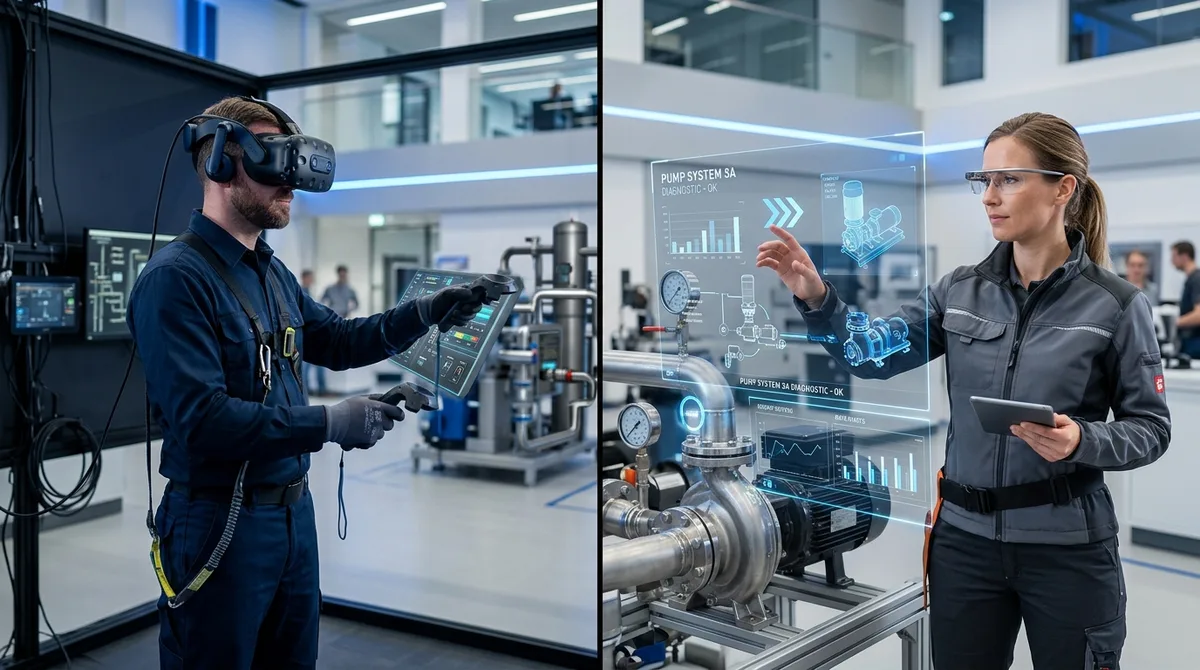
Extended reality, or XR, is not a single technology. It is a spectrum. At one end, virtual reality replaces the real world entirely with a headset, immersing the worker in a simulated environment. At the other, augmented reality keeps the real world visible and overlays digital information on top of it. Mixed reality blends the two, anchoring interactive digital objects into the real space.
For training, these differences are not academic. They determine which skills each technology can build. VR is for practicing a task in a safe replica. AR is for guiding a task as it happens on real equipment. Choosing the wrong one is the most common XR training mistake.
Where Each XR Technology Wins
VR wins when the task is dangerous, expensive, or impossible to practice live: a confined-space entry, a high-voltage isolation, a once-a-year emergency. Workers repeat the procedure in a replica until it is automatic, with zero real risk.
AR wins when the worker is already in front of the real equipment and needs guidance: step-by-step assembly instructions overlaid on the machine, or a remote expert annotating their view. AR supports performance in the moment rather than building it beforehand.
4x faster
VR-trained learners complete training up to 4x faster than classroom peers and are 275% more confident applying skills (PwC). For procedural and safety skills, the immersion that XR provides is what produces that speed and confidence.
How to Choose XR for a Training Gap
Start from the task, not the technology. Ask whether workers need to build a skill before the job (VR) or be guided during the job (AR). Most enterprise skill-building, especially safety and equipment operation, lands on VR because it provides repeatable practice and safe failure. Our AR vs VR training breakdown covers the decision in detail.
- Choose VR for safe practice of dangerous, costly, or rare procedures.
- Choose AR for in-context guidance and remote expert support on live equipment.
- Choose MR when workers must interact with digital objects anchored in the real workspace.
What We See in VR Training Projects
Across XR training deployments, the lessons that recur:
- Buyers fixate on the technology, not the task. The teams that start from the skill gap pick the right XR tool; the teams that start from the hardware often pick the wrong one.
- VR carries most enterprise skill-building. AR is powerful but narrower, suited to in-the-moment guidance rather than building competence beforehand.
- The data layer matters more than the immersion. Whatever the XR flavor, programs that measure performance get renewed.
Frequently Asked Questions
What is XR training? +
XR training uses extended reality, the umbrella term for virtual reality, augmented reality, and mixed reality, to build workforce skills through immersive practice and guidance. VR immerses workers in a simulated environment, AR overlays guidance on the real world, and MR blends both.
What is the difference between XR, VR, and AR? +
XR is the umbrella term. VR replaces the real environment entirely with a headset. AR keeps the real world visible and overlays digital information on it. MR blends the two by anchoring interactive digital objects into the real space.
Is XR training better than traditional training? +
For procedural, safety, and interpersonal skills, yes. Immersive XR practice produces faster learning and higher confidence than passive video or classroom instruction, with research showing learners up to 275% more confident and training up to 4x faster.
Should we use VR or AR for our training? +
Use VR when workers need to practice a task safely before doing it for real, especially dangerous, expensive, or rare procedures. Use AR when workers are at the real equipment and need guidance overlaid in the moment. Most enterprise skill-building lands on VR.
How much does XR training cost? +
It depends on the technology and whether content is off-the-shelf or custom. Off-the-shelf libraries start in the low five figures per year, while custom-built XR simulations modeled on a specific workplace range higher, justified by faster training and provable competence.
Not sure whether VR, AR, or MR fits your training?
Tell us the skill your workforce needs to build. We will recommend the right XR approach for the task, not the trend.