
AR vs VR Training: Which Immersive Technology Delivers Better Results for Your Team?
AR and VR are not competing technologies in enterprise training. They solve different problems. Choosing between them requires understanding the specific training challenge, not comparing hardware specs or demo quality.
QUICK ANSWER
AR training works best when workers need real-time guidance overlaid on physical objects during actual job execution: equipment maintenance, field service, surgical guidance. VR training works best when the training scenario must be fully simulated: high-risk safety practice, behavioral skills, empathy training, or any situation where real-world practice would be dangerous or logistically impossible. PwC data shows VR-trained learners are 275% more confident applying skills and complete training 4x faster. Most enterprise programs benefit from both: VR to rehearse, AR to guide the first real-world executions.
How AR Training Works and Where It Excels
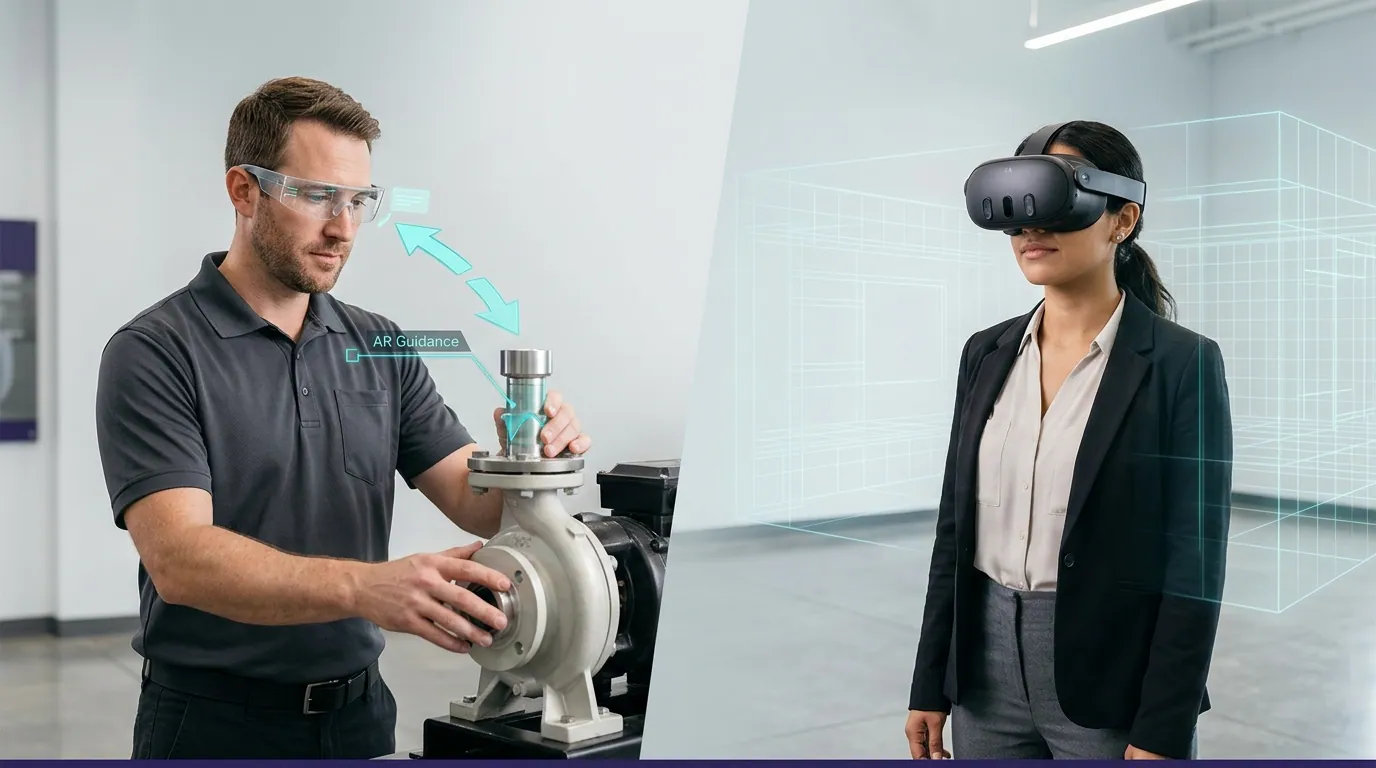
Augmented reality training overlays digital content onto the worker's real physical environment. The worker sees, hears, and physically interacts with actual equipment and tools while digital instructions, annotations, 3D arrows, and step checklists appear in their field of view through an AR headset or tablet camera.
The primary advantage of AR training is that it provides guidance during actual task execution. A field technician repairing an HVAC unit sees step-by-step instructions overlaid on the real components. A surgeon sees anatomical annotations overlaid on actual tissue. A factory worker receives digital guidance on the exact physical machine they are operating.
AR training excels for:
- Complex equipment maintenance and repair procedures
- Step-by-step assembly guidance with physical component identification
- Field service technician support and upskilling
- Medical and surgical procedure guidance
- Quality inspection with defect identification overlays
The limitation of AR training is that it requires the physical object to be present. You cannot use AR to simulate a chemical spill, practice a leadership conversation, or train for an emergency evacuation. For scenarios where the training environment must be created, not annotated, VR is the appropriate technology.
How VR Training Works and Where It Excels
Virtual reality training replaces the worker's physical environment entirely with a simulated world. The worker is fully immersed in a scenario: a virtual chemical plant, a simulated retail floor, a recreated operating room. There is no physical environment present. Every element of the training scenario, including the equipment, the hazards, the people, and the consequences of decisions, is digital.
The primary advantage of VR training is that it creates the training scenario rather than requiring it to exist in the real world. An enterprise VR training program can put a worker inside a virtual confined space, a simulated fire emergency, or a difficult executive conversation without any real-world risk. The worker practices the response, makes decisions, and experiences the consequences of those decisions in a fully controlled environment.
VR training excels for:
- VR safety training: high-risk scenarios that cannot be practiced safely in reality
- Behavioral skills and leadership development: difficult conversations, crisis response, negotiation
- Empathy training: placing workers in the perspective of a customer, patient, or colleague
- Procedural practice before workers approach real high-value or high-risk equipment
- VR sales training: simulated client interactions, objection handling, closing practice
3.75x
VR learners are 3.75x more emotionally connected to training content than classroom learners. Emotional connection correlates directly with retention and on-the-job application. AR training produces high task accuracy; VR training produces high emotional anchoring (PwC, 2022)
AR vs VR Training: Head-to-Head Comparison
This table is designed to support an actual procurement decision. Every row reflects a factor that affects training program design, budget, deployment, and outcome.
| Factor | AR Training | VR Training |
|---|---|---|
| Hardware cost per device | $1,500 - $3,500 | $400 - $800 |
| Content development cost | $20K - $100K | $35K - $250K |
| Physical environment required | Yes, real equipment needed | No, fully simulated |
| Immersion level | Partial (real world + digital overlay) | Full (complete environment replacement) |
| Emotional connection | Moderate (task-focused) | High (3.75x vs classroom, PwC) |
| Risk simulation capability | Low (real environment limits this) | High (any scenario possible) |
| Deployment environment | On the job, at the equipment | Training room, any location |
| LMS integration | xAPI / SCORM (step-level data) | xAPI / SCORM (decision + score data) |
| Setup complexity | High (3D object mapping required) | Low (standalone headset, no setup) |
| Best use case | Maintenance, field service, surgery | Safety, behavior, procedural rehearsal |
| ROI strongest when | Reducing physical task errors | Preventing incidents and building performance |
Industry-by-Industry: When to Choose AR vs VR
The right technology choice differs by industry and specific training objective. This breakdown covers the most common enterprise deployment patterns:
Manufacturing
VR first: Lockout/tagout, confined space entry, emergency response, and new hire procedural training before equipment access. AR after: Complex machine changeover guidance for experienced workers on new equipment configurations. The National Safety Council reports manufacturing accounts for a significant share of the $171 billion in annual U.S. workplace injury costs.
Healthcare
VR first: Patient communication, empathy training, high-stakes clinical decisions, and emergency response protocols. AR during: Surgical guidance, medication administration verification, and procedure step-checking in the clinical environment. VR-trained surgeons complete procedures 29% faster with 6x fewer errors than traditionally trained peers (Journal of Surgical Education).
Retail and Hospitality
VR primarily: Customer service scenarios, difficult customer interactions, de-escalation training, and brand standards immersion. AR has limited applicability in these environments because the training scenarios are behavioral and social rather than object-specific. STRIVR's Walmart program reduced module training time by 96% and increased assessment scores by 70% using VR.
Field Service and Utilities
VR first: Safety scenario rehearsal, hazard identification, and emergency response before field deployment. AR on the job: Equipment-specific repair procedures, cable routing, and system configuration guidance in the field where the technician needs real-time instruction on the actual physical infrastructure. This two-stage approach combines the confidence-building of VR simulation with the precision guidance of AR execution.
25%
Boeing reduced wire harness assembly time by 25% using VR training for procedural rehearsal before workers approached real aircraft components. The result demonstrates that VR simulation transfers directly to physical task performance (Boeing, assembly training study)
What We See in AR vs VR Training Decisions
In working with enterprise clients evaluating immersive training technology, the pattern we observe most consistently is this:
- Most organizations need VR, not AR, for their first immersive program. The training challenges that generate the strongest ROI case for immersive technology are safety simulation and behavioral skill development. Both require scenario creation, not real-world annotation. AR becomes relevant in the second phase, after VR has proven the business case and the organization has built internal comfort with headset-based training.
- AR hardware costs are underestimated at the procurement stage. Enterprise AR headsets from Microsoft HoloLens 2 and Magic Leap 2 run $2,000 to $3,500 per device, with significant MDM and content management requirements. Organizations frequently budget for VR hardware costs and are surprised when AR requires a substantially larger device investment for the same headset count.
- The "use both" strategy is correct but should be sequenced, not simultaneous. Programs that try to deploy AR and VR simultaneously before either technology has proven ROI in the organization tend to dilute focus and produce weak results from both. Build the VR foundation, prove the outcomes, then add AR guidance where the use case warrants it.
- Content update cost is higher for AR than VR. When a physical piece of equipment changes, AR content tied to 3D object recognition of that equipment must be updated or rebuilt. VR content can often be updated with fewer constraints because the virtual environment is not bound to a specific physical object's geometry. For organizations with frequent equipment updates, factor content maintenance cost into the total cost of ownership comparison. Review the VR training cost guide for full lifecycle cost analysis.
Frequently Asked Questions
What is the difference between AR and VR training? +
AR (augmented reality) training overlays digital information onto the real physical environment through a headset or tablet screen. VR (virtual reality) training replaces the physical environment entirely with an immersive simulated world. AR is best for hands-on procedural guidance where workers need to see their real tools and equipment while receiving digital instructions. VR is best for high-risk scenario simulation, empathy training, and procedural rehearsal before workers approach real equipment.
Is AR training or VR training more cost-effective? +
AR training programs typically have higher per-device hardware costs ($1,500 to $3,500 for enterprise AR headsets vs. $400 to $800 for VR headsets) but lower content development costs for procedural guidance overlays. Custom VR programs range from $35,000 to $200,000 per scenario set. Custom AR guidance programs range from $20,000 to $100,000. Total cost-effectiveness depends on use case: AR produces stronger ROI for real-world procedural guidance; VR produces stronger ROI for scenario simulation and high-stakes behavioral training.
Which industries benefit most from AR training vs VR training? +
AR training delivers strongest results in field service, equipment maintenance, and surgical guidance where workers need real-time instruction overlaid on physical objects. VR training delivers strongest results in safety simulation, leadership development, sales training, and high-risk procedural practice where the training environment must be safe and fully controlled. Many enterprise programs use both: VR to build the foundational skill, AR to provide on-the-job guidance during the first real-world executions.
Can AR and VR training both integrate with LMS platforms? +
Yes, both AR and VR training platforms support xAPI and SCORM integration with major LMS systems including Cornerstone, SuccessFactors, Workday Learning, and Docebo. xAPI captures the most detailed performance data for both modalities: AR programs log which guidance steps were accessed, how long each step took, and whether the worker completed the procedure in sequence. VR programs log decisions made, errors triggered, and scenario completion scores. Both formats provide stronger compliance documentation than video-based training.
What does AR vs VR training cost for enterprise deployment? +
AR enterprise programs run $20,000 to $120,000 for custom development depending on the number of procedures, complexity of 3D object recognition required, and language requirements. VR enterprise programs run $35,000 to $250,000 for custom scenario development. Hardware adds $1,500 to $3,500 per AR device vs. $400 to $800 per VR headset. Multi-site deployment reduces per-facility costs for both technologies. Most programs recover investment within 12 to 24 months through reduced training time, lower error rates, and incident prevention.
Not sure whether AR or VR is right for your training challenge?
Tell us your specific training objective and we will recommend the right immersive technology approach for your workforce and budget.