
Industrial VR Training for Manufacturing: Cut Downtime and Incidents
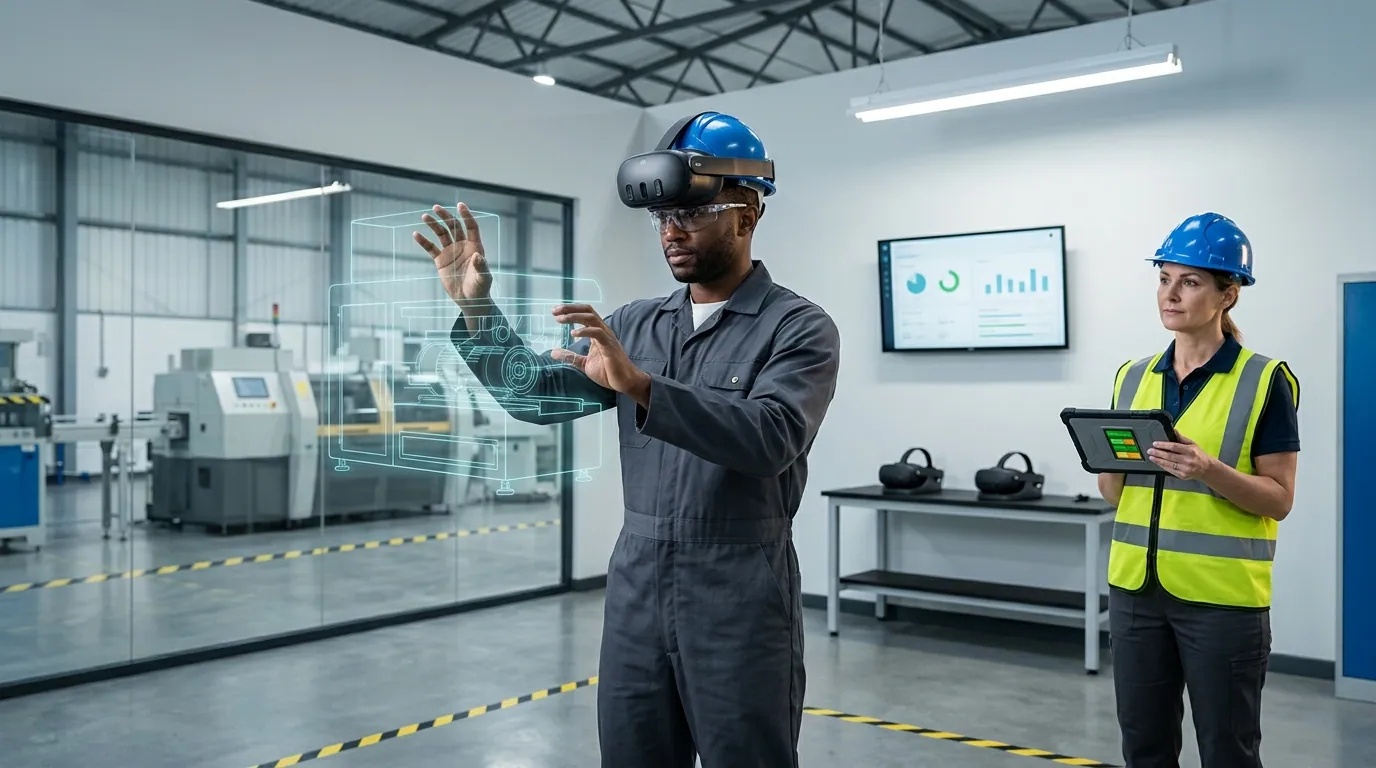
Industrial VR training for manufacturing gives workers repeatable, measured practice on virtual replicas of real equipment before they touch a single machine on the floor. Manufacturing accounts for 15% of all U.S. workplace fatalities. Most of those incidents involve workers who completed their required safety training. The gap is not knowledge, it is that no training method before VR actually let workers practice the procedure on a replica of the equipment they were going to operate.
QUICK ANSWER
VR training for manufacturing plants replaces static safety videos and inconsistent on-the-job training with repeatable, measured simulation. Workers practice lockout/tagout sequences, machine guarding procedures, and hazard identification on virtual replicas of actual equipment before touching real machinery. The National Safety Council reports manufacturing accounts for 15% of all U.S. workplace fatalities. PwC data shows VR-trained employees complete procedures 4x faster than classroom peers. Custom manufacturing VR programs range from $35,000 to $250,000 depending on equipment complexity, facility count, and LMS integration requirements.
Why Standard Safety Training Fails in Manufacturing
A lockout/tagout procedure on a multi-energy-source CNC machine involves 12 to 18 individual steps. Each step must be completed in the correct sequence, on the correct energy source, with the correct isolation method. A video can show those steps. A classroom trainer can describe them. Neither format requires the worker to actually perform them, and neither reveals whether the worker can execute the sequence correctly under the time pressure and environmental conditions of a real production floor.
On-the-job training with a supervisor solves the practice problem but introduces a different one: the worker practices with real stakes, on real equipment, with a supervisor who may or may not be consistent in what they teach. The training experience varies by shift, by supervisor, by equipment condition on the day of training. Some workers get 20 minutes of hands-on time. Others get five.
The result is a workforce where every worker has a completion certificate and a wide variance in actual procedural competency. That variance is where incidents happen. VR closes the variance by giving every worker the same equipment, the same procedure, the same number of repetitions, and the same performance measurement, before they touch the actual machine.
$58K
Average cost per serious workplace injury in manufacturing including direct and indirect costs, training investment pays back on the first incident prevented (NSC, 2023)
What VR Trains Better Than Classroom Methods in Manufacturing
Equipment-specific procedural training is where VR delivers results that no other format can replicate at scale. A virtual replica of a specific press, conveyor system, or chemical processing unit allows workers to interact with the exact controls, the exact sequence requirements, and the exact hazard points of the equipment they will actually operate, before the first time they approach it on the floor.
Beyond lockout/tagout, VR manufacturing training programs consistently deliver measurable improvements in:
- Hazard recognition: Workers identify machine guarding gaps, chemical label requirements, and ergonomic risks in simulated environments where missing a hazard triggers an educational consequence, not an injury.
- Machine changeover procedures: Complex, multi-step changeovers with significant downtime cost benefits from the same repetition-building VR provides for safety procedures. Workers who have practiced a changeover in VR complete it faster and with fewer errors on the floor.
- Emergency response: Chemical release, equipment failure, and fire response scenarios place workers in the exact high-stress situations where training must activate automatically, not require conscious recall.
- Quality inspection protocols: Inspection steps that require specific observation sequences and defect recognition can be trained in VR using simulated product samples with known defects, giving every inspector the same baseline calibration before they begin production work.
| Training Method | Procedure Practice | Error Consequence | Compliance Documentation |
|---|---|---|---|
| Video / eLearning | Watch only | None | Completion record only |
| Classroom / verbal | Described, not practiced | None | Sign-off sheet |
| OJT with supervisor | Once, with real stakes | Incident or near-miss | Variable |
| VR Simulation | 10-15 reps before equipment touch | Simulated consequence | Full xAPI log per step |
ROI of VR Training in Manufacturing Operations
The ROI calculation for manufacturing VR training has three components: incident cost reduction, new-hire ramp time compression, and multi-site deployment efficiency. Each of these produces measurable returns that most manufacturers can quantify against their own operational data.
Incident cost reduction is the most direct. The National Safety Council puts the average cost of a serious workplace injury, including direct medical costs, workers' compensation, productivity loss, and the indirect costs of investigation, retraining, and production disruption, at $58,000. A VR training program that prevents one serious incident per year at a single facility pays back the program investment without any other ROI contribution.
Ramp time compression is the second lever. PwC data shows VR-trained workers complete procedural tasks 4x faster than classroom-trained peers. For manufacturing operations with high turnover or seasonal workforce scaling, the ability to bring a new hire to baseline procedural competency faster, without relying on a supervisor to be available for consistent OJT, directly reduces production gap costs during onboarding periods.
Multi-site deployment amplifies both. Once a VR scenario is built for a specific piece of equipment or procedure, it deploys identically across every facility that uses that equipment. A manufacturer with eight plants can train the same LOTO procedure the same way at all eight locations, with the same documentation standards, at a fraction of the per-facility cost of building independent OJT programs at each site.
4x
VR-trained manufacturing workers complete procedural tasks 4x faster than classroom-trained peers, critical for reducing production downtime during onboarding (PwC, 2022)
What We See in Manufacturing VR Training Projects
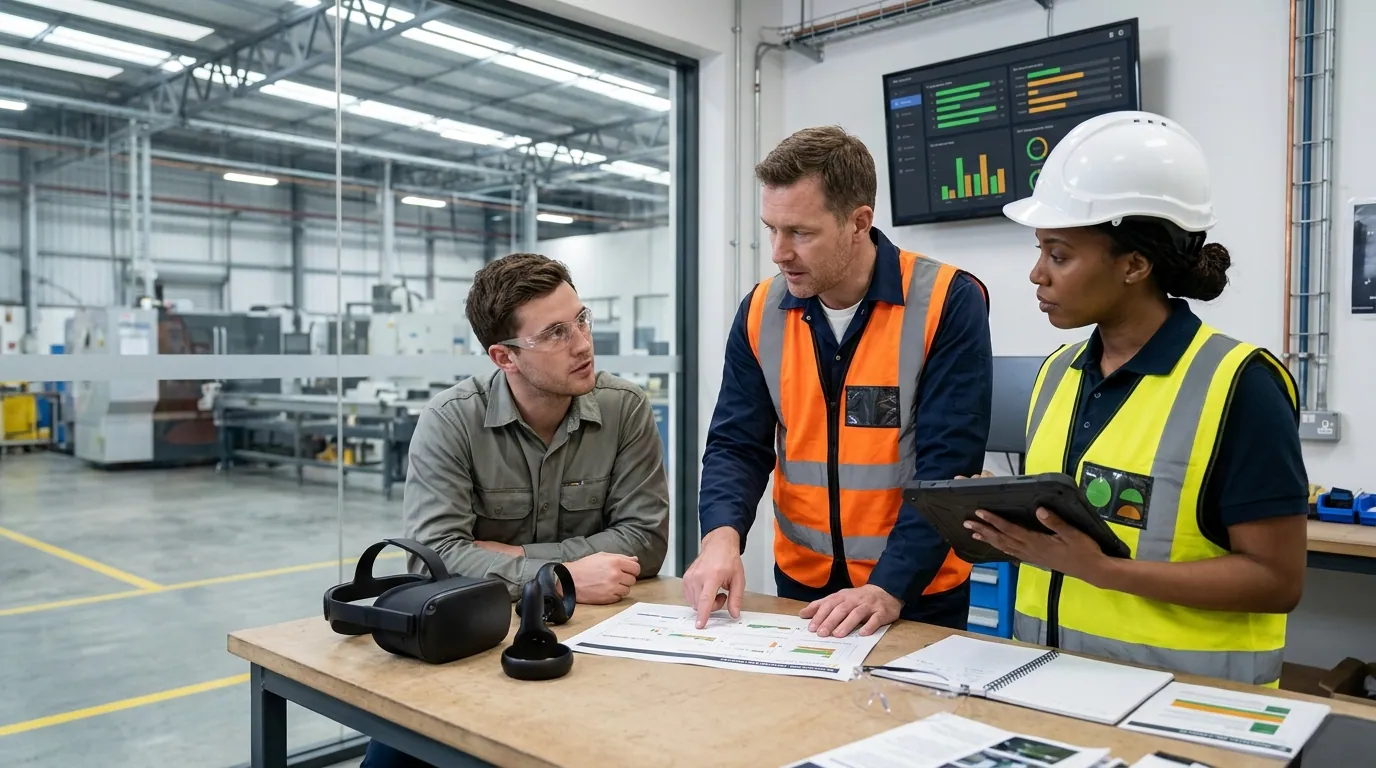
In manufacturing VR programs we develop, several consistent patterns shape what works and what does not:
- Equipment replica fidelity determines transfer effectiveness. A VR scenario built on a generic industrial machine produces generic procedural learning. A scenario built on a 3D model of the exact press, lathe, or conveyor system on your floor, with the correct control positions, energy sources, and guarding configuration, produces procedural memory that transfers directly to the real equipment. The fidelity investment is not about visual quality. It is about cognitive transfer.
- Shift workers train faster than expected when sessions are under 20 minutes. Fatigue and production pressure make long training sessions ineffective for shift-based workforces. Manufacturing VR programs broken into 15-20 minute modules, completable at shift change, during breaks, or in a dedicated training bay, consistently achieve higher completion rates and better retention than longer classroom formats.
- Error data from the first session reveals training gaps that management did not know existed. In almost every manufacturing VR deployment, the performance data from the first scenario session reveals that a significant portion of the workforce cannot complete the correct procedure sequence without prompts. This is not a workforce capability problem, it is evidence that prior training never measured whether workers could actually perform the sequence, only that they watched it being described.
- Multilingual capability solves a workforce reality most manufacturers face daily. Manufacturing workforces are frequently multilingual. A VR program that delivers the same LOTO scenario in English, Spanish, and other languages, without requiring bilingual supervisors to deliver the training, dramatically improves training reach and creates consistent compliance documentation across the entire workforce.
Frequently Asked Questions
What is industrial VR training? +
Industrial VR training is immersive, headset-based training that lets manufacturing and industrial workers practice equipment operation, safety procedures, and emergency response on a virtual replica of their real machinery before touching the physical equipment. Unlike video or classroom training, industrial VR training measures every decision and procedure step, building procedural memory that transfers directly to the plant floor. The Prime VR builds custom industrial VR training programs modeled on each client's exact equipment, energy sources, and guarding configuration, with LMS integration that documents competency for OSHA compliance.
What manufacturing procedures translate best to VR training? +
High-consequence, step-dependent procedures produce the strongest outcomes in VR: lockout/tagout sequences, confined space entry, machine changeover procedures, overhead crane operation, chemical handling, and quality inspection protocols. These are procedures where a missed step has serious consequences but are rarely practiced under realistic conditions. VR allows workers to practice the correct sequence 10-15 times before touching actual equipment, building procedural memory that transfers to the floor.
Can VR training work on a manufacturing plant floor? +
Yes. Standalone VR headsets like the Meta Quest 3 require no PC, no fixed station, and no internet connection during the session. A training bay in the corner of a facility, a repurposed break room, or a dedicated training station in an existing office all work. For large facilities with shift-based workforces, a rolling deployment model, where a training station moves between shifts and departments, is the most practical approach.
How does VR manufacturing training connect to OSHA compliance documentation? +
Custom VR programs built with xAPI integration log every session, every procedure step completed, every error made, and every score achieved to your LMS. This creates a timestamped competency record for each worker, exactly the documentation OSHA requires for specific standards like 1910.147 (lockout/tagout), 1910.119 (process safety management), and 1910.146 (confined space). The record is more detailed than a sign-off sheet and survives inspection scrutiny.
What does a VR training program for a manufacturing facility cost? +
Manufacturing VR programs range from $35,000 to $250,000+ depending on equipment complexity (simulating a CNC machine vs. a simple assembly station), number of scenarios, multilingual requirements, and LMS integration. For multi-facility operations, the per-facility cost drops significantly as scenarios are reused across sites. Most single-facility programs achieve cost recovery within 18 months through reduced incident costs and faster new-hire ramp time.
Ready to reduce manufacturing incidents with training that builds actual procedural memory?
Tell us your facility type, your top OSHA recordable categories, and your workforce size. We will design a program around your specific production environment.