
How Virtual Reality Sales Training Helps Teams Practice Objections
Reps do not lose deals because they never heard the objection. They lose them because they had not practiced the objection enough to respond cleanly under pressure. Virtual reality sales training turns objection handling from a skill reps develop on live prospects into one they master before the conversation that counts.
QUICK ANSWER
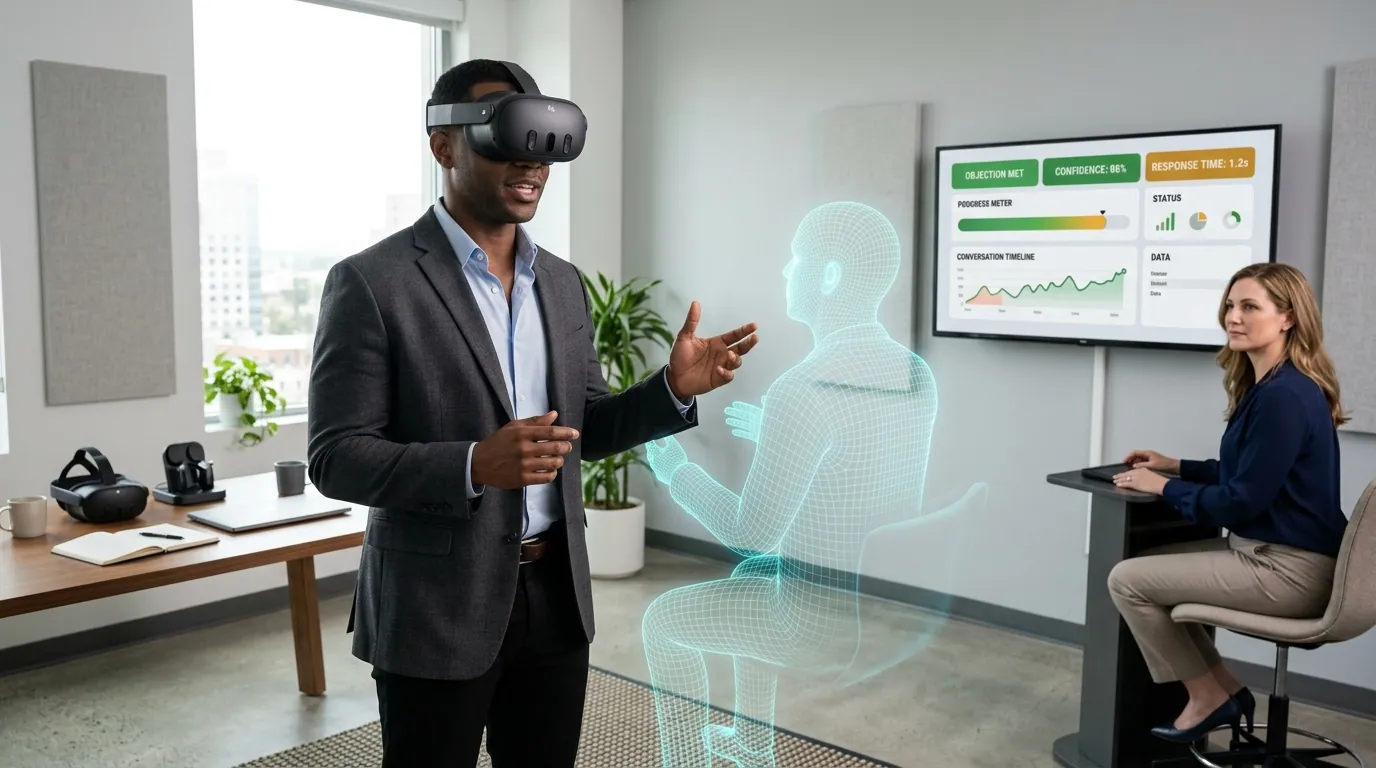
Virtual reality sales training helps teams practice objections by placing reps in realistic conversations with customer personas that push back consistently, allowing unlimited repetitions of the same objection until the rep handles it cleanly. Unlike manager role-play, VR personas behave the same way every time, so reps can isolate which technique actually works, and the system scores every attempt. According to PwC, VR learners are up to 275% more confident applying skills and complete training up to 4x faster than classroom learners. Custom programs range from $35,000 to $150,000.
The Objection-Handling Training Gap
Objection handling is the part of selling that separates closers from order takers, and it is the hardest part to train. A rep can memorize the right response to "your price is too high" and still freeze when a real buyer delivers it with skepticism and a deadline. The skill lives in the real-time response, not the script, and the only thing that builds it is repetition against a believable opponent.
Traditional training cannot supply that repetition. Sales courses teach frameworks the rep forgets the moment they are under pressure. Manager role-play is rare, inconsistent, and softened by a manager who coaches mid-sentence or plays the customer differently each time. So most reps develop objection-handling ability the expensive way, on live prospects, where every fumbled response is lost revenue.
275%
VR learners are up to 275% more confident applying what they learned compared to classroom learners, the single biggest factor in objection handling under pressure (PwC, 2022).
How VR Personas Make Objection Practice Real
A virtual reality sales scenario gives the rep a customer persona that holds its position, reacts to the rep's approach, and escalates or eases based on how the rep responds. The persona is not reading a fixed script; it behaves consistently according to its profile. That consistency is the breakthrough. A rep can run the same price objection against the same difficult buyer ten times in a row, trying a different approach each time, and see precisely which one changes the outcome.
That is impossible with a human role-play partner, who plays the customer differently every time and tires after the third round. The persona never tires, never breaks character, and never coaches. It lets the rep fail safely, adjust, and try again until the response becomes automatic, the same repetition principle behind all of our VR sales training work.
| Objection Practice Via | Repetitions | Opponent Consistency | Skill Isolation |
|---|---|---|---|
| Live prospects | Costly, unrepeatable | Every buyer differs | None |
| Manager role-play | Few | Inconsistent | Low |
| Scripts / course | No live practice | N/A | None |
| VR Simulation | Unlimited | Identical each run | High, data-backed |
From Subjective Coaching to Measured Improvement
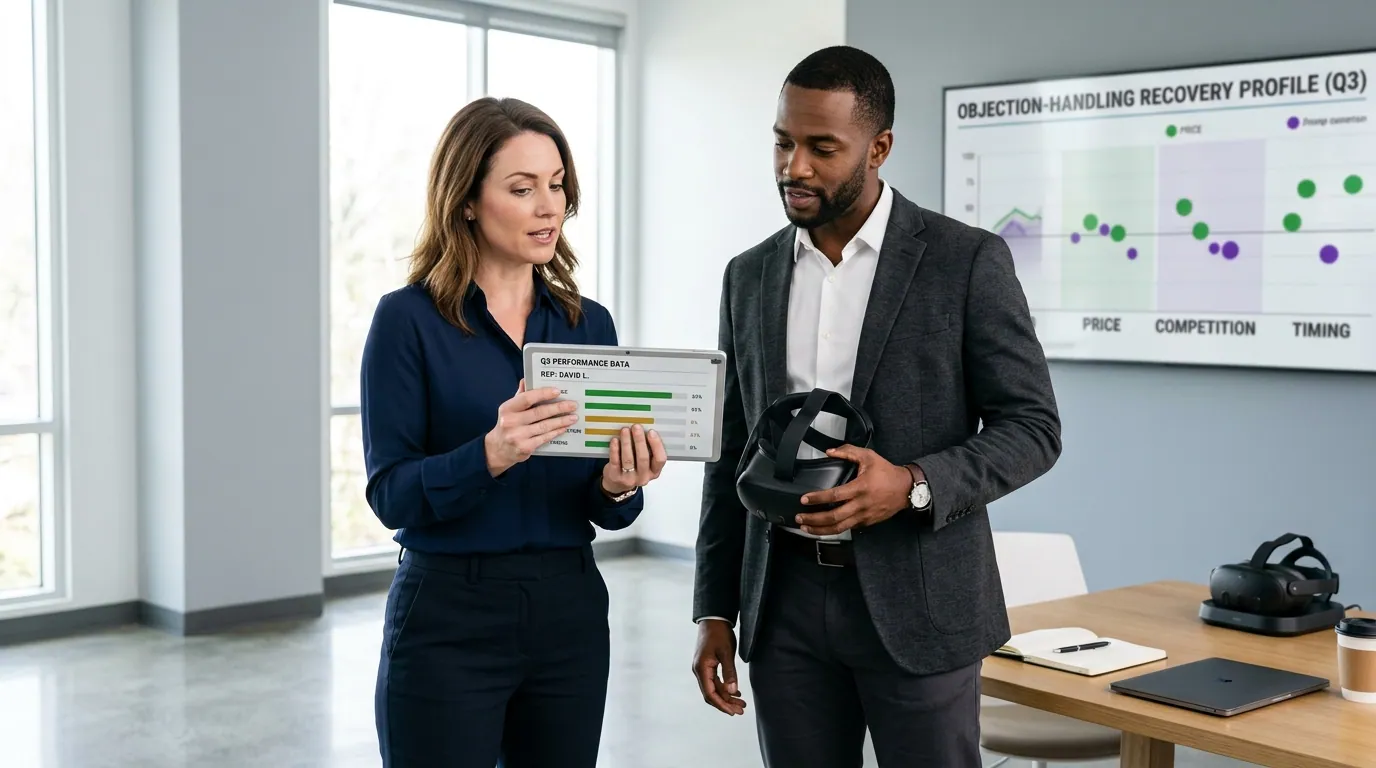
The data layer is what turns VR objection practice into a management tool. Every scenario logs which objections the rep faced, how they responded, where the conversation stalled, and whether they recovered. Across sessions, this builds a performance profile that shows exactly which objection types each rep handles well and which they struggle with.
That changes coaching entirely. Instead of "work on your closing," a manager can say "you lost three of five conversations at the payment objection; here is the technique to practice." The skill gap is specific, visible, and fixable, and the rep can drill exactly that objection until the data shows improvement. For teams comparing this approach to content-delivery platforms, our piece on VR training vs LMS explains where each fits.
4x
VR learners complete training up to 4x faster than classroom learners, so reps reach confident objection handling in fewer sessions (PwC, 2022).
What We See in Sales Objection VR Programs
- Persona behavior beats visual fidelity. A buyer that pushes back believably and adapts to the rep's tactics produces better practice than a photorealistic avatar reading a script.
- Reps practice more when failure is private. Removing the social cost of fumbling in front of a manager dramatically increases how many reps actually run the hard scenarios repeatedly.
- The data surfaces team-wide patterns. When most reps stall at the same objection, that is a messaging or enablement gap, not an individual one, and the aggregate data makes it visible.
- Branching matters for advanced teams. Scenarios where the persona's reaction changes based on the rep's wording teach nuance that single-path scripts never can.
Frequently Asked Questions
Why is objection handling so hard to train with traditional methods? +
Objection handling is a real-time, high-pressure skill that only improves with repetition against a believable opponent. Traditional methods fail to provide that: courses teach scripts the rep forgets under pressure, and manager role-play is infrequent and inconsistent. The rep ends up developing objection-handling skill on live prospects, learning at the cost of real revenue. Virtual reality sales training solves the core problem by giving reps unlimited reps against personas that push back the way real buyers do.
How does VR make objection practice realistic? +
VR sales training uses customer personas that hold their position, react to the rep approach, and escalate or soften based on how the rep responds, rather than reading a fixed script. A rep can run the same price objection against the same difficult buyer repeatedly, trying different approaches until they find what works. Because the persona behaves consistently, the rep can isolate exactly which technique improves the outcome, which is impossible with a manager who plays the customer differently every time.
Can VR sales training measure how well a rep handles objections? +
Yes. Every VR objection scenario logs measurable data: which objections the rep faced, how they responded, how long the conversation took, where it stalled, and whether the rep recovered. Over multiple sessions this produces a performance profile per rep that shows exactly which objection types they handle well and which they struggle with, turning vague coaching into a specific, fixable skill gap.
What types of teams use virtual reality sales training for objections? +
Any team where objection handling determines revenue benefits: automotive dealerships, retail and big-ticket sales, B2B field sales, financial services, and multi-location sales organizations that need consistent technique across every rep. The common thread is a defined sales conversation with predictable objection patterns that can be modeled precisely and practiced repeatedly.
What does a virtual reality sales training program cost? +
Custom virtual reality sales training programs range from $35,000 for a focused objection-handling module to $150,000 or more for multiple personas, branching conversations, and multi-location deployment with analytics. Because scenarios are reused across reps and sites, per-rep cost falls sharply at scale, and the program is owned rather than licensed per seat each year.
Want your reps to master objections before they cost you the close?
Tell us your toughest recurring objections. We will build personas that make your team practice them until the response is automatic.