
VR Sales Training for Automotive Dealerships
The hardest part of training an automotive sales rep is not teaching the product. It is giving them enough reps with difficult customers that the showroom floor stops being a place where they learn at the customer's expense. VR makes those reps unlimited, consistent, and measurable.
QUICK ANSWER
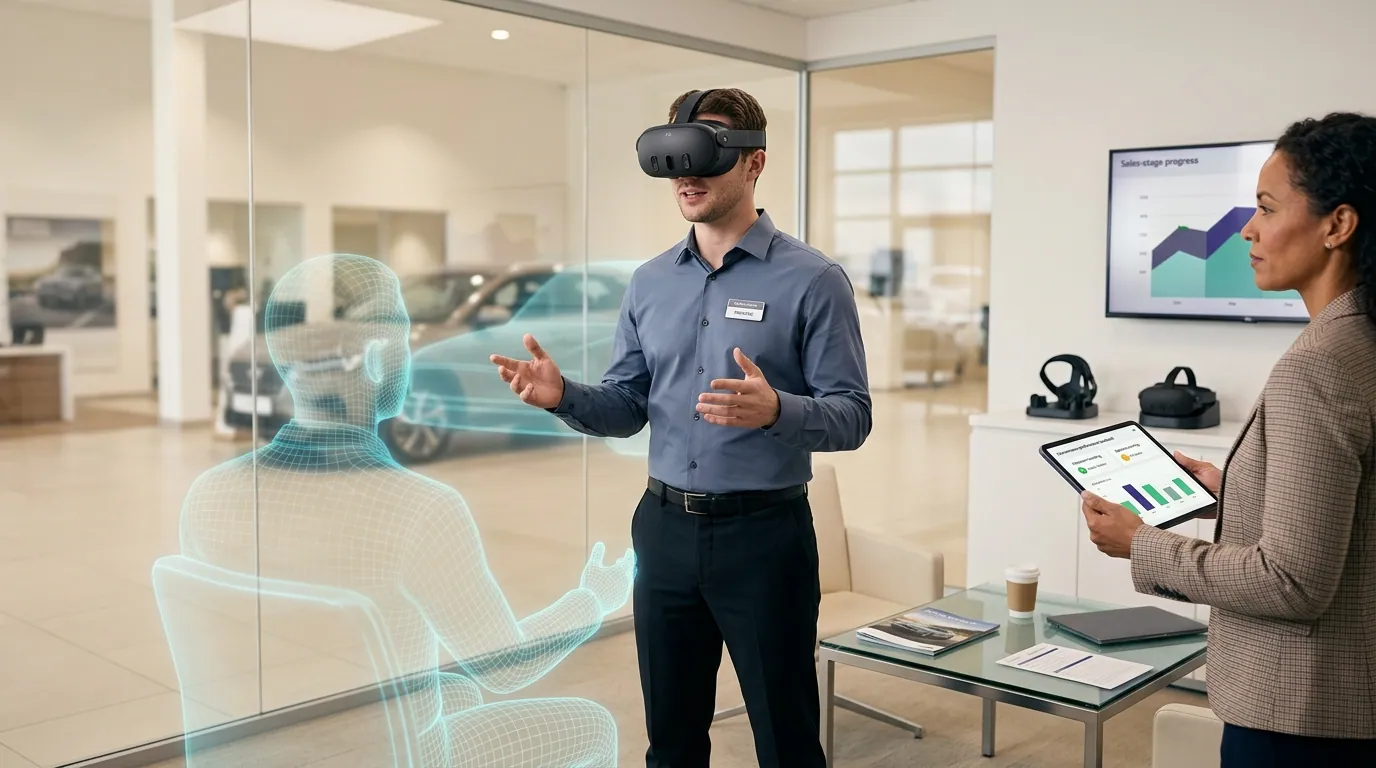
VR sales training for automotive dealerships lets reps practice the full sales conversation, including trade-in pushback, payment objections, and F&I disclosures, against realistic customer personas before facing a real buyer. Unlike manager role-play, VR provides unlimited consistent repetitions and captures measurable performance data on how each rep handled each objection. According to PwC, VR learners are up to 275% more confident applying skills after training and complete scenarios up to 4x faster than classroom learners. Custom dealership programs range from $35,000 to $150,000.
Why Dealerships Struggle to Train Sales Reps
Automotive sales is high turnover and high stakes. A new rep is often on the floor within days, learning the toughest parts of the job, objection handling and negotiation, in front of live customers who can walk at any moment. Every fumbled trade-in conversation or mishandled payment objection is a real deal at risk and a real margin lost.
The traditional answer is manager role-play, but it does not scale. A sales manager has limited time, plays the customer inconsistently, and tends to coach mid-conversation rather than let the rep struggle through it the way a real buyer would. One rep gets three role-plays; another gets none. The practice a rep needs most is exactly the practice the dealership can least consistently provide.
275%
VR learners are up to 275% more confident applying what they learned after training compared to classroom learners (PwC, 2022).
What Reps Practice in a VR Dealership Scenario
A VR automotive sales program puts the rep inside the conversations that actually happen on the floor, against customer personas that hold their ground. Because the scenarios are built around the real dealership process, the practice transfers directly rather than staying abstract. Typical scenarios include:
- Trade-in valuation pushback: The customer insists their vehicle is worth more than the appraisal. The rep practices holding the number while keeping the deal alive.
- Monthly-payment objection: The buyer fixates on payment instead of price. The rep rehearses reframing the conversation without becoming defensive.
- F&I product menu and disclosures: Finance staff practice the full menu presentation and required compliance disclosures, with the simulation flagging any omission.
- The walk-out save: The customer stands to leave. The rep practices the specific language that re-opens the conversation.
Each scenario can be run repeatedly against the same persona until the rep handles it cleanly, building the kind of measured competence that our broader VR sales training programs are designed to produce.
| Training Method | Reps Available | Consistency | Performance Data |
|---|---|---|---|
| Live floor learning | Real deals at risk | None | Lost-deal guesswork |
| Manager role-play | Few, time-limited | Varies by manager | Subjective |
| Video / course | Watch only | Uniform but passive | Completion only |
| VR Simulation | Unlimited | Identical persona | Per-objection scoring |
A Real Automotive Demo in Development
We are currently building a VR sales training demo for automotive specifically because this vertical maps so cleanly to what simulation does best: repeatable practice of a defined, high-stakes conversation with measurable outcomes. The automotive sales process is structured enough to model precisely, and the cost of an undertrained rep, in lost deals and compressed margin, is high enough that dealerships feel the gap every month.
That hands-on development work shapes how we design these programs. The scenarios that transfer best are the ones built around a dealership's actual desking process and real objection language, not generic sales theory.
4x
VR learners complete training scenarios up to 4x faster than classroom learners, getting new reps to floor-ready competence sooner (PwC, 2022).
What We See in Automotive Sales VR Projects
- Persona realism matters more than graphics. A customer persona that pushes back believably, holds an objection, and reacts to the rep's approach produces far better practice than a photorealistic but scripted avatar.
- F&I compliance is the fastest ROI. Dealerships often start with finance disclosure scenarios because the compliance exposure is concrete and the documented practice has immediate legal value.
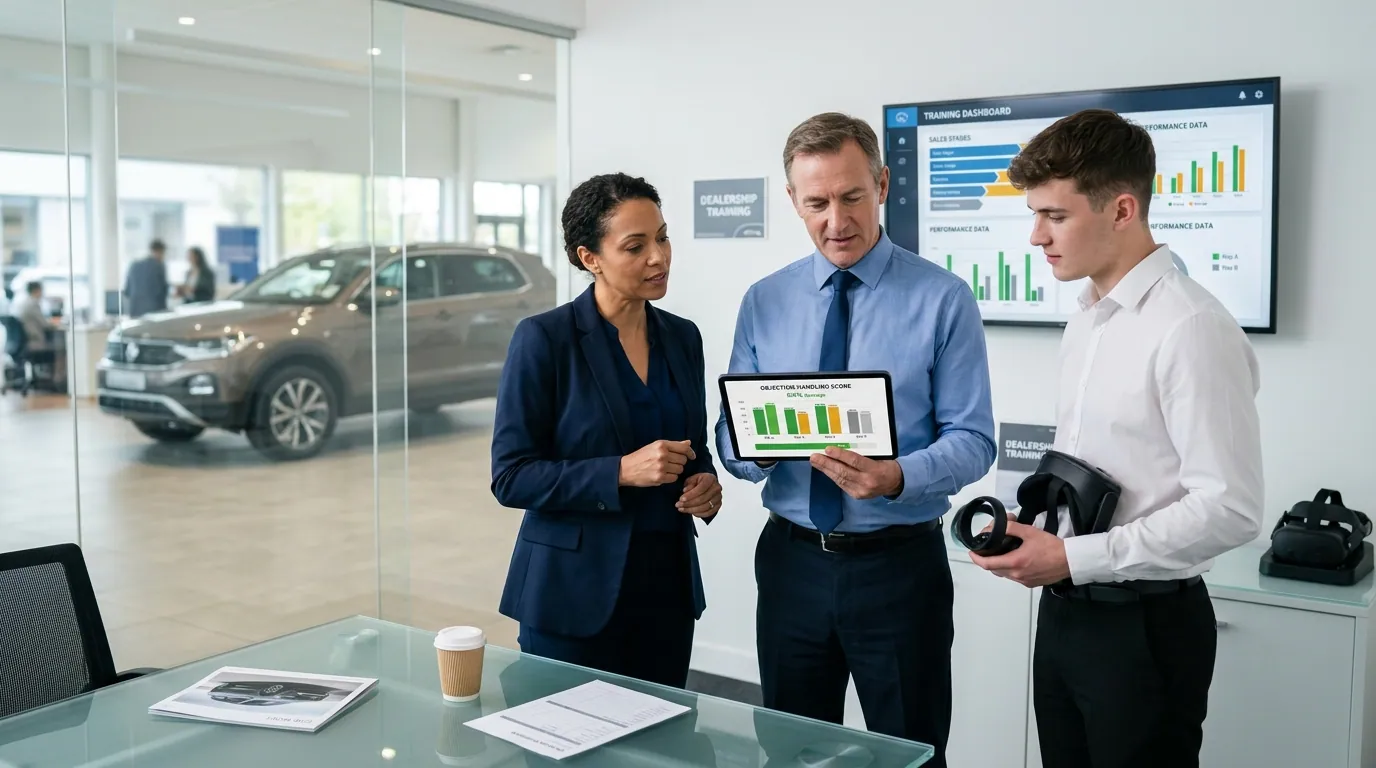
- Data changes coaching. When a manager can see exactly which objection a rep mishandles across ten reps, coaching shifts from general feedback to a specific, fixable skill.
- Multi-rooftop groups scale fastest. One scenario set deploys across every store with consistent standards, which is where the owned-asset model decisively beats per-seat course licensing.
Frequently Asked Questions
What can automotive sales reps practice in VR that they cannot in role-play? +
VR sales training gives automotive reps unlimited, consistent practice with realistic customer personas that never get tired, never break character, and never coach. A rep can run the same price objection 15 times against the same difficult buyer profile, something a manager doing role-play cannot replicate. VR also captures performance data: which objections the rep handled, how long they took, and where the conversation stalled. Role-play produces a subjective impression; VR produces a measurable record.
Does VR sales training work for F&I and compliance disclosures? +
Yes, and it is one of the strongest use cases. Finance and insurance conversations carry compliance requirements where a missed or misstated disclosure creates legal exposure. VR lets F&I staff rehearse the full menu presentation and required disclosures repeatedly, with the simulation flagging omissions. The result is consistent, documented practice of the exact language compliance requires, before the rep sits across from a real customer.
How is VR automotive sales training different from generic sales training? +
Generic sales training teaches frameworks. VR automotive sales training places the rep inside the specific conversations a dealership rep actually has: the trade-in valuation pushback, the monthly-payment objection, the four-square negotiation, the F&I product menu. Because the scenarios are built around the real dealership sales process, the practice transfers directly to the showroom floor rather than staying abstract.
How long does it take to build a VR automotive sales training program? +
A focused VR automotive sales program covering a defined set of scenarios typically takes 12 to 20 weeks from discovery to deployment, depending on the number of customer personas, objection branches, and whether F&I and compliance modules are included. Multi-rooftop dealer groups that want the same program deployed across locations add integration and analytics time but reuse the core scenarios across every store.
What does VR sales training for a dealership cost? +
Custom VR sales training programs for automotive dealerships generally range from $35,000 for a single-scenario module to $150,000 or more for a multi-scenario program with several customer personas, F&I modules, and multi-rooftop deployment. For dealer groups, per-store cost drops sharply because scenarios are reused across locations, and the program is owned rather than licensed per seat.
Want your reps practicing the hard conversations before they cost you deals?
Tell us your sales process and your toughest objections. We will design a VR program around the conversations your floor actually has.