
Utility and Lineman VR Training for High-Voltage Work
High-voltage work punishes error instantly. VR training lets linemen and utility crews build the judgment that keeps them alive, before they ever approach an energized line.
QUICK ANSWER
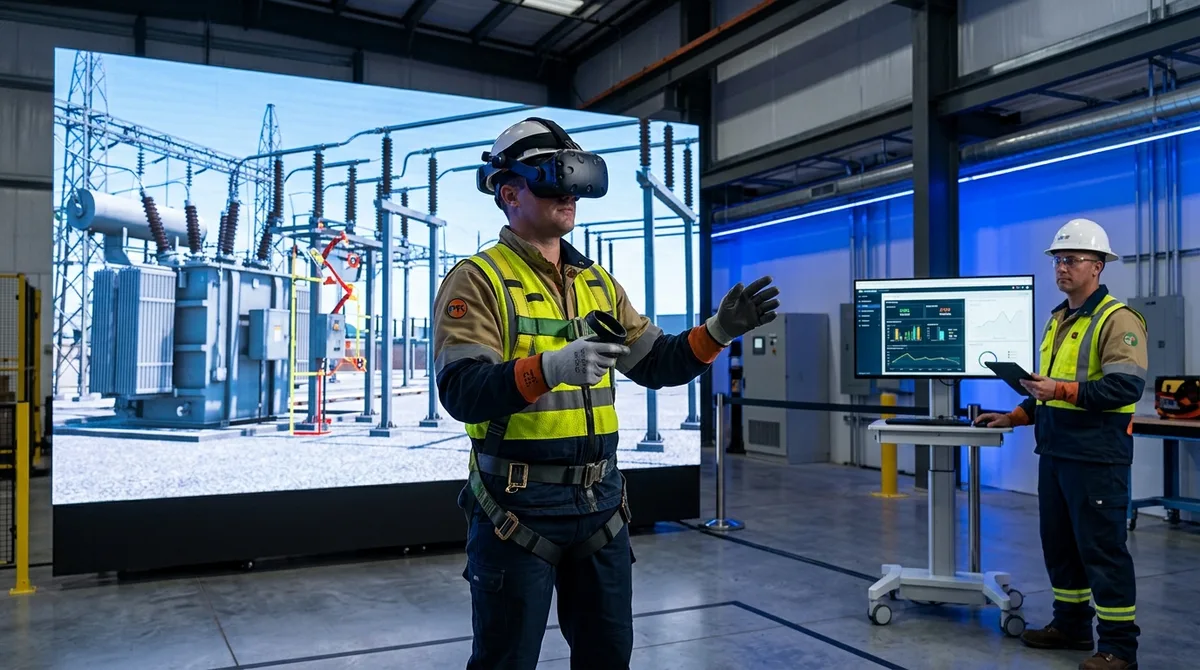
Utility and lineman VR training recreates high-voltage environments so field crews can practice approach boundaries, PPE selection, switching procedures, and emergency response without exposure to energized equipment. It builds the judgment and procedure discipline that high-voltage work demands, lets crews rehearse rare emergencies safely, and documents per-worker competence for a high-consequence, regulated trade.
Why High-Voltage Training Needs VR
There is no safe way to let a trainee make a high-voltage mistake on real equipment. Yet the judgment that prevents those mistakes, recognizing approach boundaries, selecting the right PPE, sequencing a switching operation, is built through practice. VR resolves the contradiction. Linemen practice the exact procedures and decisions in a realistic simulation where an error is a lesson, not an arc flash.
Practice the unpracticeable
Energized-work errors are fatal, so they cannot be used as teaching moments on real equipment. VR is the only way to let a lineman experience the consequence of a wrong approach or sequence safely.
Utility VR Training Applications
- Approach boundaries and PPE. Judging restricted and prohibited approach distances and selecting correct arc-rated PPE.
- Switching and isolation. Practicing correct switching sequences and energy isolation before doing them live.
- Emergency response. Reacting to contact, arc events, and rescue scenarios, rehearsed safely and repeatedly.
- Equipment and substation familiarization. New crews learning the environment before working in it.
A Regulated, High-Consequence Trade
Utility work is governed by strict safety standards, and documented competence matters for both safety and liability. VR provides per-worker performance records of demonstrated procedure competence before live work, strengthening the safety case. The approach parallels existing arc flash and electrical safety VR training and broader safety and operations programs.
What We See in VR Training Projects
From electrical and high-voltage simulation training, the consistent findings:
- The fatal scenarios are the ones to simulate. Approach errors and arc events cannot be taught live; VR is the safe path to that judgment.
- Procedure discipline is built by repetition. Switching sequences become reliable through safe practice, not a single classroom walkthrough.
- Documentation supports the safety and liability case. Demonstrated competence before live work matters to regulators and insurers.
Switching and Grounding Sequences
Sequence errors are dangerous. VR allows repeated practice of switching orders and grounding steps.
Match scenarios to company procedures.
Storm and Emergency Response
Crews can rehearse outage response under pressure, including communication and hazard checks.
Include escalation procedures.
Apprentice Progression
Apprentices build confidence before climbing or working near energized equipment. Supervisors track progress.
Complement field mentoring.
The Problem the Sector Has
Line work combines energized conductors, elevated work, heavy equipment and weather exposure, and the consequences of an error are frequently fatal rather than injurious.
Realistic practice on energized systems is not possible, and training yards, while valuable, cannot reproduce every configuration or condition a crew will meet.
That constraint is the reason immersive training has a specific role here rather than being a general training preference.
Scenarios Worth Building
Switching sequences, isolation and grounding, approach boundary awareness, aerial device operation and storm restoration decision making are the recurring cases where immersive rehearsal makes sense.
Hazard recognition on pole and structure configurations, including conditions that only appear occasionally, is well suited to a medium that can present them repeatedly.
Content that is procedural documentation or classroom theory belongs elsewhere, and putting it in headset raises cost without raising capability.
Accuracy and Local Configuration
Utility construction standards, equipment and switching practices differ between operators, and generic content has limited transfer value.
Building accurate scenarios requires standards documentation, technical review by the utility own experts and revision as construction practice changes.
A scenario that teaches a sequence which differs from the operator actual procedure creates a hazard rather than reducing one.
Deployment and Facilitation
Delivery normally occurs in training centers or service centers rather than in the field, with implications for crew scheduling and for storm season availability.
Facilitated debrief after a scenario is where the learning consolidates, and unfacilitated running produces familiarity with the simulation instead.
Immersive work complements rather than replaces training yard practice, since physical technique and equipment handling require the equipment itself.
Measurement and Regulation
Programs should be evaluated on hazard recognition, switching accuracy in assessment, near miss and incident records and observed field behavior rather than on completion.
Whether immersive delivery satisfies a specific qualification or training requirement is a question for the regulator and the utility qualification framework rather than for a vendor.
Applicable safety regulations, utility qualification requirements and employer procedures govern this, and current requirements should be confirmed with the relevant authority.
Committing to It Honestly
The case for this investment rests on scenarios that cannot otherwise be practiced, and stating that plainly produces better program design than broad claims do.
Baselining hazard recognition and assessment performance before deployment is what allows any later claim about effect to be made honestly.
Common Mistakes and How to Avoid Them
Common errors include using generic content that conflicts with the operator standards, failing to update scenarios as construction practice changes, omitting facilitated debrief, treating immersive work as a replacement for yard practice and deploying without a baseline.
Supervisors can help by making it acceptable to pause and ask. A culture where questions are treated as competence rather than weakness produces fewer errors in line work training.
How Employers Evaluate Readiness
Utilities assess this through hazard recognition and switching assessment results, near miss and incident records, qualification and training completion against requirements and observed crew behavior in the field.
Keeping Skills Current
Standards, equipment, switching practice and regulations change. Reviewing scenario content against current construction and operating standards prevents rehearsing a sequence the utility no longer uses.
Planning and Preparation
Preparation includes confirming which qualification and training requirements apply, supplying accurate construction and switching standards, arranging technical review by internal experts, planning crew scheduling around storm season and baselining assessment performance.
Documentation That Holds Up
Training and qualification records against applicable requirements, scenario version history tied to standards revisions, assessment results and near miss and incident reports are what support the program and what an investigation examines first.
Frequently Asked Questions
What is utility or lineman VR training? +
It is the use of VR simulation to let utility field crews and linemen practice high-voltage procedures, approach boundaries, PPE selection, switching, and emergency response in a realistic environment without exposure to energized equipment.
Why use VR for high-voltage training? +
Because high-voltage errors are fatal and cannot be used as teaching moments on real equipment. VR lets linemen experience the consequences of wrong approaches or sequences safely, building the judgment that keeps them alive.
What can linemen practice in VR? +
Approach-boundary judgment and PPE selection, switching and isolation sequences, emergency and rescue response, and substation and equipment familiarization, all practiced safely and repeatedly.
Does VR utility training support compliance? +
Yes. It produces per-worker records of demonstrated procedure competence before live work, which strengthens the safety and liability case in a strictly regulated, high-consequence trade.
How does this relate to arc flash training? +
Arc flash and electrical safety are a core part of utility VR training. The same simulation approach lets workers practice approach boundaries, PPE, and energized-work judgment that prevent arc flash incidents.
Can VR replace pole climbing practice? +
No, it prepares learners and supplements hands on training.
What does VR add for apprentices? +
Safe repetition of procedures and hazard recognition before field exposure.
Training linemen or utility field crews?
Tell us your equipment and procedures. We will show you how VR can build safer crews without energized risk.