
Retail Employee Training Simulation: Reduce Ramp Time
Retail employee training simulation lets associates practice the difficult moments, customer complaints, loss prevention decisions, and store procedures before the first shift on a live floor. See how large retailers are using VR to cut ramp time and reduce the cost of high turnover.

Hugo Ramirez
Quick Answer
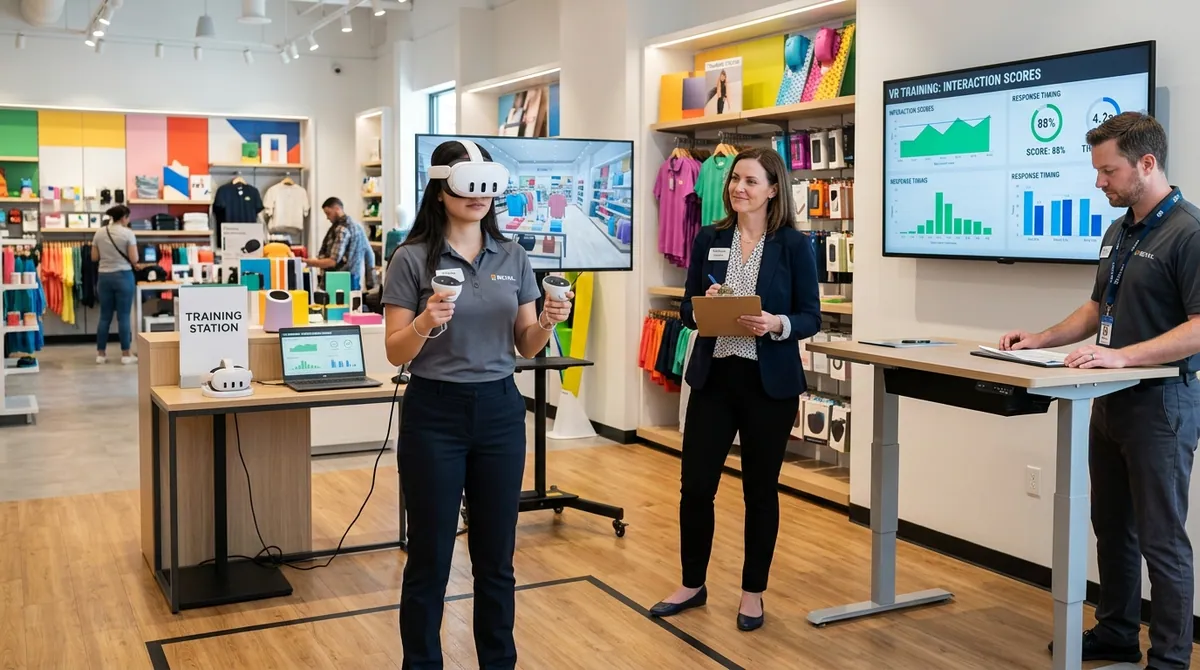
Retail employee training simulation uses VR to let associates practice customer interactions, loss prevention responses, and store procedures before their first live shift. Walmart trained over 1 million employees on VR and reported improved assessment scores. For high-turnover retailers, reducing time-to-productivity from 45 to 30 days across 200 annual new hires saves over $400,000 in annual productivity loss.
Why Retail Training Is Expensive to Do Well
The U.S. retail sector employs approximately 15 million people with annual turnover rates exceeding 60% in hourly roles. That means millions of new hires per year learning how to handle difficult customers, operate POS systems, manage shrink, and follow safety procedures, most of them on the live floor with real customers watching.
The cost of learning on the job in retail is direct: a new associate who handles a customer complaint poorly loses that customer. One who misidentifies a loss prevention situation creates liability. The traditional solution is manager shadowing and on-floor coaching, which requires experienced managers to spend hours per new hire that could be used on operations.
1M+
Walmart employees trained with VR across 4,700 stores, with improved assessment scores reported
60%
Annual turnover rate in hourly retail roles, making repeatable onboarding training a major cost driver
Retail VR vs Traditional Training: What Changes
| Training Type | Traditional Retail | VR Simulation |
|---|---|---|
| Complaint handling | Manager models once, associate learns on real customers | 10+ practice runs on simulated customers before first shift |
| Loss prevention | Video module, policy handout | Simulated shoplifting scenario with decision branching |
| Store orientation | Guided walk with manager (1 to 2 hours) | Self-paced VR store tour (30 min), repeatable |
| Manager coaching time | 4 to 8 hours per new hire in first week | 1 to 2 hours (debrief only, simulation handles practice) |
| Consistency across locations | Varies by manager and store culture | Identical scenario, identical assessment, every location |
What We See in Retail VR Deployments
- High-turnover retailers with 200 or more annual new hires see the strongest ROI because program cost amortizes across a large and recurring cohort
- Seasonal hiring surges are a key use case: VR allows a 50-person seasonal cohort to complete consistent onboarding without requiring proportional manager time
- Multi-location retailers use VR to enforce brand standards during onboarding: every associate in every store practices the same customer interaction model
- Programs that combine a 20-minute VR practice session with a 30-minute live debrief produce better first-shift performance than either format alone
Retail VR Training: Procurement Checklist for L&D and Operations Teams
Before issuing an RFP or engaging vendors, retail L&D and operations teams should be able to answer these questions. Unclear answers at the procurement stage cause scope creep, budget overruns, and programs that sit on a shelf.
- What specific behaviors are you trying to change? "Better customer service" is not a training objective. "Associates de-escalate a complaint within 90 seconds without supervisor assistance" is. VR scenarios must be built against specific behavioral targets.
- What is your annual new hire volume per location? Headset ROI depends on throughput. A single location hiring 12 associates per year cannot justify a dedicated headset fleet. A district with 200 annual hires can.
- What LMS do you currently use? If your LMS supports xAPI (Cornerstone, SAP SuccessFactors, Workday Learning), VR completion and performance data flows automatically. If not, you will need a manual reporting process or an LRS (Learning Record Store) layer.
- Do you need content updates? Retail training content changes frequently: new product lines, policy updates, seasonal promotions. Confirm the vendor's content update process and cost before signing. Fixed-price development with expensive change orders is a common trap.
- Who owns the hardware? Some vendors provide headsets as part of the program cost. Others deliver software only. Headset ownership affects support, replacement, and refresh cycle costs over the program lifetime.
When VR Is Not the Right Fit for Retail Training
Not every retail training challenge is a VR problem. Applying VR to the wrong content type wastes budget and erodes stakeholder confidence in the technology.
- Pure information transfer: Product knowledge, store hours, benefits enrollment, these are knowledge facts that read well on a tablet or phone. VR adds cost without adding value for informational content that does not require practiced behavior.
- Low-volume single-location retailers: A single store with 8 associates per year cannot justify the program investment. VR economics require sufficient throughput to amortize development cost, typically 50 or more trained employees per year at minimum.
- Physical task training: Stocking shelves, operating specific equipment, and following planogram procedures benefit from hands-on practice with actual equipment, not VR simulation. Physical procedural training belongs on the floor with a supervisor, not in a headset.
- When the real problem is a process failure: If associates consistently handle complaints poorly because they lack authority to resolve them, not because they lack communication skills, VR training will not fix the underlying process problem. Diagnose before you prescribe.
Frequently Asked Questions
What retail training scenarios work well in VR simulation? +
The highest-value retail VR scenarios are customer service interactions (handling complaints, upselling, de-escalation), loss prevention and shoplifting response, new hire store orientation and safety procedures, cash handling and POS operations, and manager performance conversations. Scenarios requiring practice under pressure are better suited to simulation than scenarios that are primarily informational.
How does Walmart use VR training? +
Walmart deployed VR training to over 4,700 stores and trained more than 1 million employees on topics including customer service, new technology rollouts, and manager leadership scenarios. Walmart reported improved assessment scores and faster content delivery compared to traditional classroom methods. Their program used Oculus Go headsets before transitioning to newer platforms.
Can VR retail training work for high-turnover environments? +
Yes. High-turnover environments are actually strong candidates for VR training because the cost of repeated onboarding is large and measurable. A VR onboarding module that reduces time-to-productivity from 45 days to 30 days for 200 new hires per year at $18/hour saves approximately $432,000 in annual productivity loss, which typically exceeds program cost in year one.
How many headsets does a retail chain need to run VR training? +
The headset-to-employee ratio depends on your training volume and session length. A 20-minute onboarding module with 10 headsets can train approximately 24 employees per hour. For a 200-employee annual cohort spread across two weeks of staggered hiring, 6 to 8 headsets typically provide sufficient throughput without queuing.
Does retail VR training integrate with our ATS or HRIS? +
Yes. Custom VR training programs export data via xAPI to any LMS that supports the standard, and most major HRIS and ATS platforms (Workday, ADP, BambooHR, iCIMS) can receive training completion and competency data through LMS integrations. The integration layer is typically configured during the deployment phase.
Scaling retail training across locations?
Schedule a discovery call to discuss your annual hire volume, locations, and training content priorities.