
VR Soft Skills Training: Why Immersive Practice Outperforms Role-Play
Soft skills are called soft because they are difficult to teach, not because they are unimportant. The gap between knowing the right response in a difficult conversation and actually delivering it under real pressure is where most soft skills training fails. VR closes that gap by creating the pressure.
QUICK ANSWER
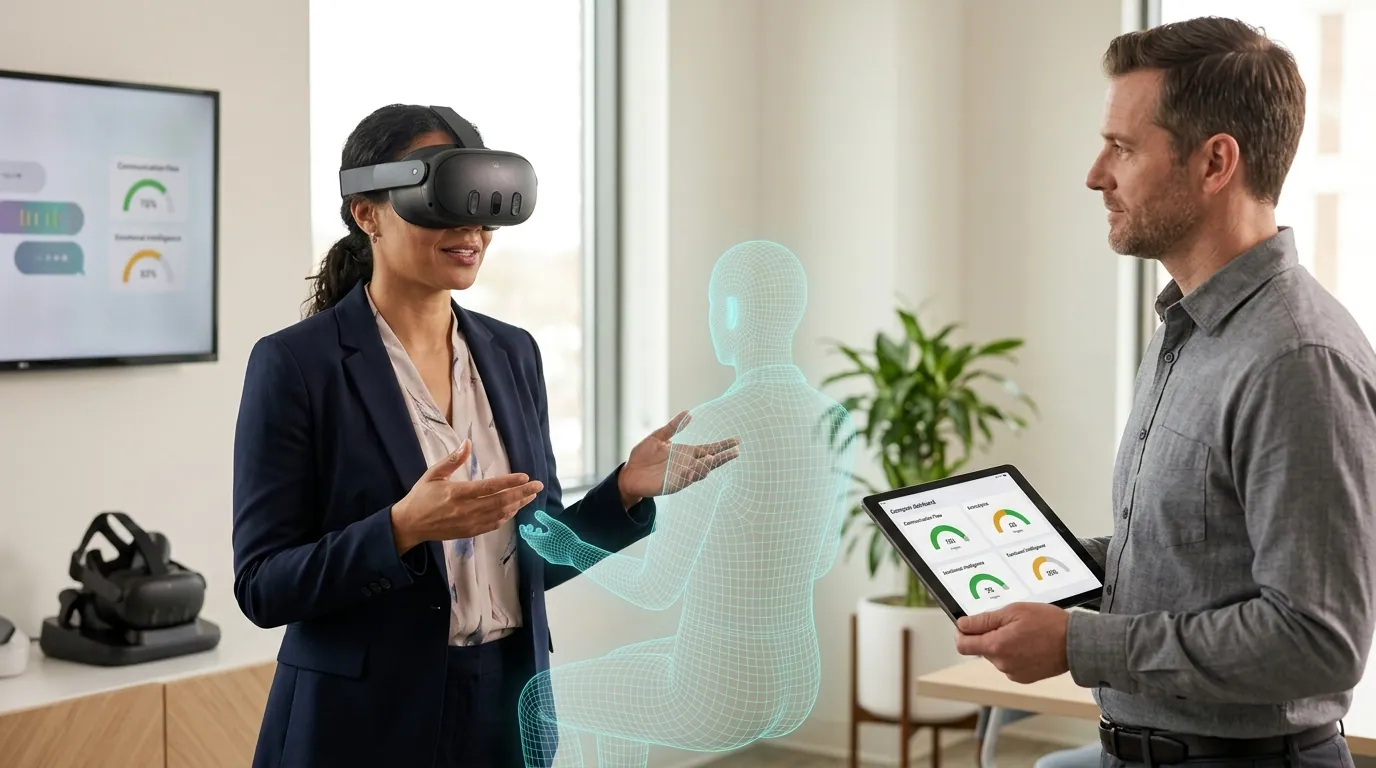
VR soft skills training puts learners inside the exact high-stakes conversations and interpersonal situations where soft skill deficits cause the most damage, difficult performance reviews, conflict resolution, cross-cultural communication, and crisis leadership. PwC's 2022 study found VR-trained learners are 3.75x more emotionally connected to training content than classroom peers and 275% more confident applying skills on the job. Unlike role-play with a colleague, VR delivers consistent scenario pressure, immediate decision feedback, and no social anxiety about performing poorly in front of peers.
Why Soft Skills Are Hard to Train
A manager can understand intellectually that they should remain calm during a difficult performance conversation, listen actively before responding, and focus on behavior rather than personality. That understanding rarely survives the first moment the conversation becomes emotionally charged. Under stress, people revert to habitual response patterns, not to the communication framework they studied in a workshop six months ago.
The problem is not that training programs teach the wrong things. It is that knowing the right response and being able to execute it under real interpersonal pressure are completely different cognitive and emotional tasks. Reading about conflict de-escalation, watching a training video about it, or discussing it in a classroom all develop the first capability. None of them develop the second.
Practicing under pressure develops the second. That is why experienced managers are generally better at difficult conversations than new managers with equivalent training, not because they received better content, but because they have practiced the response pattern more times under real conditions. The question for learning and development is whether organizations can accelerate that pattern-building without waiting for years of real-world experience, and without requiring every learning moment to come with real-world consequences.
3.75x
VR-trained employees are 3.75x more emotionally connected to training content than classroom learners, emotional engagement is the mechanism through which soft skill practice produces behavioral change (PwC, 2022)
What Makes VR Different From Role-Play for Soft Skills
Role-play is the traditional answer to the practice problem in soft skills training. It has the right instinct, practice matters, but four structural limitations prevent it from producing the learning outcomes organizations need at scale.
First, social anxiety. Most learners are more anxious about performing poorly in front of a colleague or trainer than they are about the simulated situation itself. That anxiety distorts their behavior, they play it safe, avoid the challenging response, perform for the observer rather than practicing authentically. VR removes the social observer entirely. The learner is alone in the scenario with no performance audience.
Second, inconsistency. A role-play scenario depends on the partner's improvisation, their interpretation of the situation, and their energy level on that day. Two employees in the same training program may have completely different practice experiences. VR delivers the same scenario, the same character, the same emotional trigger, the same decision point, to every learner, every time.
Third, feedback quality. In role-play, feedback is subjective, delivered by a peer or trainer who observed behavior from the outside, and often filtered through social politeness. In VR, feedback is immediate, scored against defined behavioral criteria, and delivered without social friction.
Fourth, repeatability. Role-play is limited by partner availability, trainer time, and the logistical reality that most organizations cannot schedule enough practice reps to build genuine competency. VR scenarios are available on demand, can be repeated as many times as the learner needs, and produce a fresh scenario experience every time.
| Training Method | Scenario Pressure | Feedback | Repeatability |
|---|---|---|---|
| Classroom lecture | None | General | Low |
| Role-play with colleague | Low / social discomfort | Peer subjective | Limited by partner availability |
| Coaching session | Moderate | Expert, 1:1 | Cost-limited |
| VR simulation | High / physiological response | Immediate, scored | Unlimited reps, consistent |
Soft Skills VR Use Cases Across Organizations
Leadership development is the highest-volume use case for soft skills VR across enterprise organizations. New manager programs consistently identify the same gaps: managers know the theory of giving feedback, conducting performance reviews, and navigating conflict, but freeze or default to avoidance when they encounter the real situation. VR programs built around these specific conversations let new managers practice the response pattern before they are leading a real team.
Sales conversation training is the second major use case. Objection handling, price negotiation, and closing conversations all share the structure that makes VR effective: a high-stakes interaction where the learner's real-time response determines the outcome, and where confidence under pressure is as important as the content of what they say. VR gives sales teams the ability to practice specific objection types, budget objections, competitor comparisons, procurement delays, as many times as they need before entering a real deal conversation.
Customer service de-escalation is where the ROI of soft skills VR is most immediately visible. Organizations that train frontline employees through de-escalation scenarios, placing them in interactions with angry or distressed customers, see measurable reductions in escalation rates and customer satisfaction improvement. The practice works because the VR scenario activates a realistic stress response. A customer service rep who has de-escalated 20 virtual angry customers before their first difficult real call has a practiced response pattern to draw from.
Cross-cultural communication training is an emerging use case with growing demand in multinational organizations. VR scenarios that place employees in professional interactions with colleagues or clients from different cultural backgrounds, with different communication norms, different expectations around directness, different relationship-building conventions, build the awareness and behavioral flexibility that classroom training about cultural differences cannot produce.
275%
VR-trained employees are 275% more confident applying interpersonal skills on the job versus classroom-trained peers, the confidence gap that determines whether training produces real behavior change (PwC, 2022)
What We See in VR Soft Skills Training Projects
In soft skills VR programs we develop, the patterns that determine whether training produces real behavioral change are consistent across industries and role types:
- Learners who claim they already know how to handle this perform worst in the first scenario. The most consistent finding across soft skills VR deployments is that experienced employees, managers who have managed teams for years, salespeople who have been closing deals for a decade, underperform newer employees in the first scenario session. Experience creates the belief that the response is already known. VR reveals the gap between believing you can handle something and demonstrating that you can under simulated pressure.
- Scenario realism determines engagement and transfer. A scenario featuring unconvincing character voices, unrealistic reactions, or a situation that no actual employee would recognize as genuine produces low engagement and poor transfer. The most effective soft skills VR scenarios are built from real situations that subject matter experts or employees recognize immediately as authentic, the specific type of performance conversation that actually happens in their organization, with the exact emotional dynamic that makes it difficult.
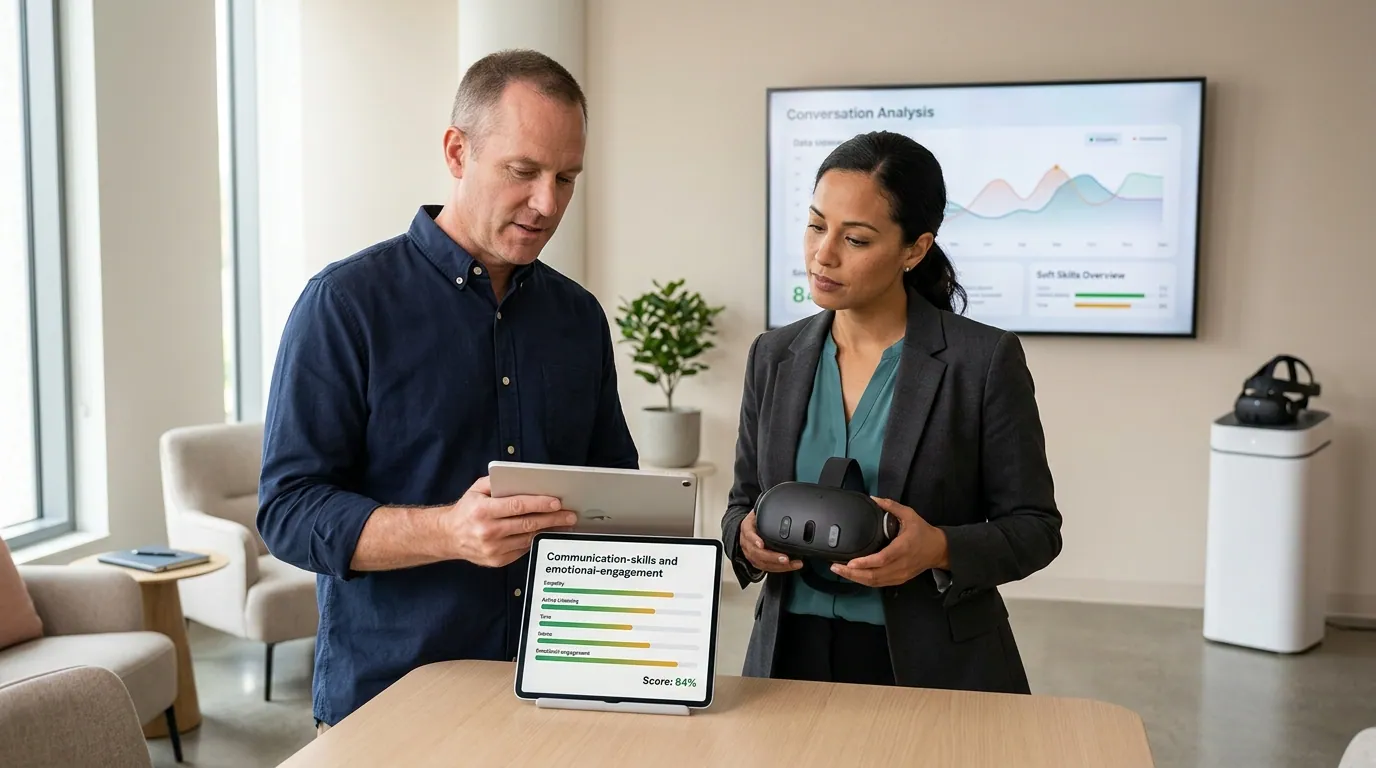
- Post-session debrief data is what produces reflection, the VR is the practice, the debrief is the learning. The VR scenario creates the experience. The debrief that follows, showing the learner their decision log, explaining why specific choices aligned or misaligned with the target behavior, and connecting the scenario to real situations they will face, is where the behavioral insight is formed. Programs that skip the debrief produce practice without learning. The two must work together.
- Organizations that deploy VR soft skills as pre-work before coaching see better coaching session quality. When employees arrive at coaching conversations having already practiced the scenario in VR, they bring specific questions, identified weaknesses, and a baseline experience to discuss. Coaches report that sessions with VR-prepared participants are more productive, more honest, and produce faster development than sessions where the coaching conversation is also the first practice experience.
Frequently Asked Questions
What soft skills work best in VR training? +
Interpersonal scenarios with meaningful decision points produce the strongest outcomes: difficult conversations (performance reviews, terminations, conflict de-escalation), leadership under pressure (crisis response, team conflict, cross-functional negotiation), sales and objection handling, customer service de-escalation, diversity and inclusion conversations, and cross-cultural communication. The common thread: situations where the learner's emotional response matters as much as the cognitive decision. VR activates a physiological stress response that role-play with a colleague rarely achieves, and that stress activation is what makes the practice transfer to the real situation.
How do you measure outcomes in VR soft skills training? +
Custom VR soft skills programs measure: decision quality (did the learner choose the response that aligns with the intended behavior), timing (how quickly they responded under pressure), scenario completion rate, and retry behavior (how many times a learner repeats a scenario before achieving a competency score). Post-deployment surveys and manager observation provide secondary validation. Some programs incorporate biometric proxies via headset sensors to measure stress response and engagement during the scenario, providing a more granular measure of emotional engagement than self-report.
Can VR soft skills training replace manager coaching? +
No, but it dramatically improves the ROI of coaching. VR handles the high-volume baseline, every employee practices the standard scenario, builds confidence, and arrives at coaching conversations with experience rather than anxiety. Manager coaching time then focuses on nuanced, context-specific feedback rather than basic scenario practice. Organizations that combine VR baseline training with scheduled coaching sessions see faster skill development than those that rely on coaching alone.
What does a VR soft skills training program cost? +
Soft skills VR programs range from $25,000 for a focused single-scenario module (one difficult conversation type, one leadership challenge) to $120,000+ for a multi-module soft skills curriculum covering leadership, communication, and customer interaction. For organizations training 500+ managers annually, the per-learner cost drops significantly below the cost of equivalent coaching hours or off-site leadership programs.
Ready to build soft skills through practice instead of lecture?
Tell us the specific conversations and situations where your team struggles most. We will design scenarios around your actual leadership and communication challenges.