
VR Leadership Training: How Executives Practice Difficult Decisions Before They Cost the Business
Leadership programs teach the framework. The real test is applying it under pressure, when the room is tense, the stakes are high, and the right words do not come automatically. VR gives leaders a place to practice that conversation before it matters.
QUICK ANSWER
VR leadership training places executives in simulated high-stakes scenarios: difficult performance conversations, crisis decisions, board interactions, and team conflict. Unlike classroom programs that build awareness, VR builds practiced response. PwC found VR learners were 275% more confident applying skills and 3.75x more emotionally connected to the training than classroom methods. Leadership programs cost $50,000 to $200,000 and are most effective for organizations where senior leader behavior directly impacts retention, culture, and strategic execution. The most common entry point: a single scenario type where current leader behavior has a documented business cost.
The Problem with Traditional Leadership Development
Leadership development spending in the U.S. exceeds $14 billion annually. Organizations invest in workshops, coaching, 360-degree feedback, and executive education programs. Yet leadership failure remains one of the most expensive problems in business: failed or underperforming leaders cost organizations an estimated 6 to 27 times the leader's annual salary in turnover, team disengagement, and strategic misexecution.
The gap is not awareness. Leaders who have attended three leadership workshops know that psychological safety matters, that feedback should be specific, and that crisis communication requires clarity. The gap is execution under pressure. When the conversation is uncomfortable, when the decision is ambiguous, when the team is watching, the practiced response does not come automatically unless it has been practiced.
3.75x
VR learners were 3.75x more emotionally connected to training content than classroom learners (PwC, 2020). For leadership development, emotional engagement during practice determines whether the behavioral change transfers to real interactions.
What VR Adds to Leadership Development
VR leadership programs close the gap between knowing and doing through three mechanisms that classroom programs cannot replicate:
Pressure without consequences
A leader can practice delivering a termination conversation, mishandle it, receive feedback, and practice it again. The simulated employee reacts realistically: getting defensive, asking unexpected questions, becoming emotional. The leader builds the practiced response without the legal, relational, and reputational consequences of doing it wrong in real life.
Emotional realism that role-play cannot match
Role-playing with a peer or coach is self-consciously artificial. Everyone in the room knows it is not real, which limits the emotional engagement. VR creates enough perceptual realism to trigger genuine physiological and emotional responses. Leaders practice emotional regulation as well as communication because the scenario feels real enough to make the body respond accordingly.
Scored, repeatable feedback
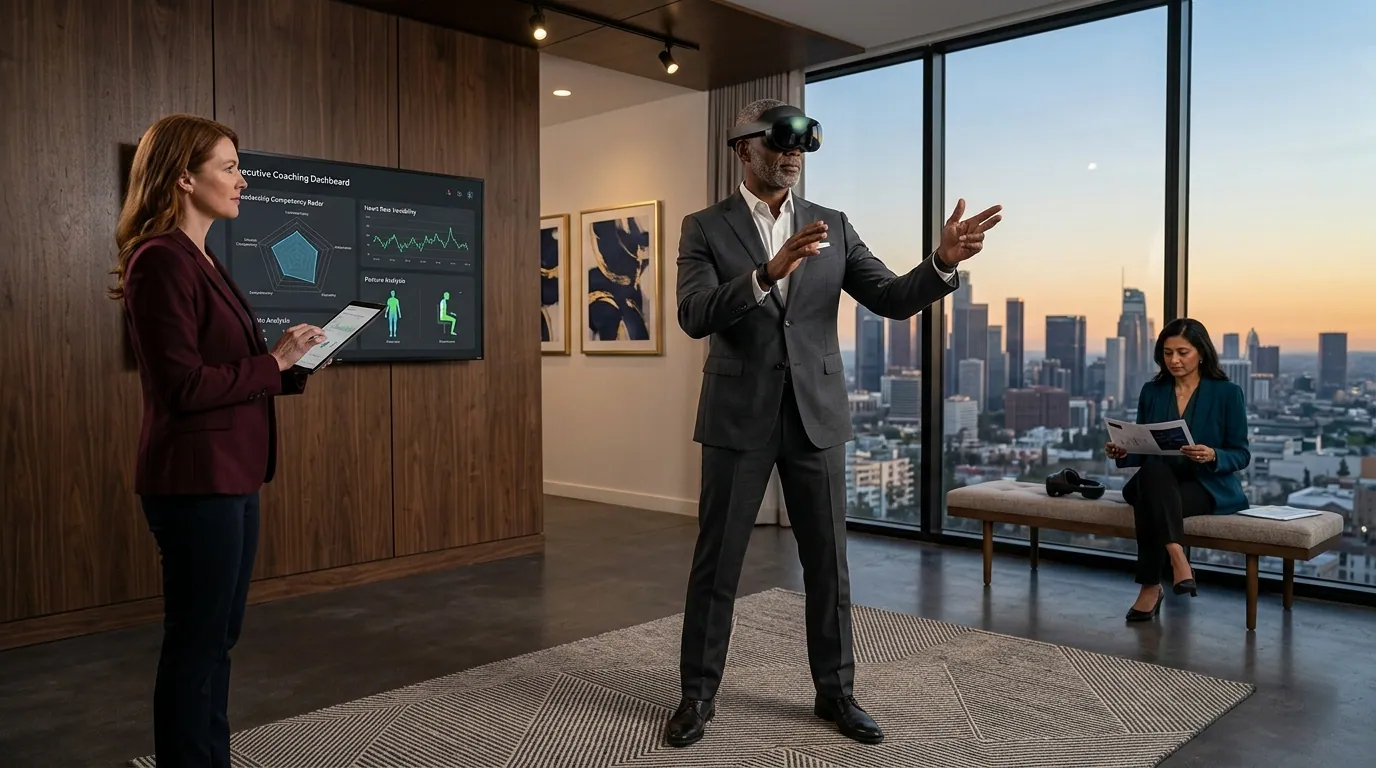
Every VR leadership session produces data: response time, word choice patterns, emotional tone indicators, decision branch selections, and outcome scores. This data gives executive coaches specific behavioral evidence to work with instead of relying on the leader's self-report of how they handled a situation.
VR Leadership Training vs. Traditional Methods
| Method | What It Builds | What It Misses |
|---|---|---|
| Workshop / seminar | Framework awareness, peer connection | Practiced behavioral response under pressure |
| Executive coaching | Self-awareness, reflection, pattern recognition | Repetitive practice of new behavior |
| 360-degree feedback | Understanding how others perceive behavior | Practice changing the behavior being perceived |
| Role-play with coach | Basic conversation rehearsal | Emotional realism, scoring, repeatability |
| VR leadership training | Practiced response under realistic pressure with scored feedback | Higher upfront cost, requires custom scenario development |

High-Impact Scenarios for Leadership VR Training
The best leadership VR scenarios are those where real-world execution has a documented business cost:
Difficult performance conversations
Delivering feedback to a high performer who is missing a critical standard. Managing a low performer who is well-liked by the team. Having a compensation conversation that the employee will not like. These are scenarios that leaders avoid, delay, or handle poorly because they have never practiced them.
Crisis communication under uncertainty
Addressing a team after a major business setback. Communicating a strategic pivot that some employees will resist. Managing a reputational issue in a public forum. Leaders who have practiced crisis communication in simulation respond more clearly and calmly than those who face it for the first time in reality.
Cross-functional conflict resolution
Navigating disagreement between two senior leaders who both report to the same executive. Mediating a resource conflict between business units. These high-stakes peer conversations require practiced neutrality, active listening, and decision authority that are difficult to simulate in a workshop.
Board and investor communication
Presenting a strategy change to a skeptical board. Responding to a line of difficult questions about financial performance. New executives in particular benefit from practicing these interactions, where composure, clarity, and authority under scrutiny determine how the room interprets the message.
275%
Leaders trained with VR were 275% more confident applying skills compared to those trained in classroom programs. For leadership development, that confidence translates directly to clearer communication, faster decisions, and more effective execution under pressure (PwC, 2020)
What We See in Leadership VR Training Projects
From building custom leadership development VR programs, we consistently observe:
- The highest-performing leaders engage the most. Top executives tend to be the heaviest users of VR leadership practice. They recognize the value of deliberate practice in the same way elite athletes do. The same competitive instinct that drives business performance drives them to rehearse.
- Self-awareness gaps become visible immediately. Leaders who describe themselves as "direct communicators" frequently discover in VR that their directness reads as aggression. Leaders who consider themselves empathetic discover they avoid difficult truths. The simulation reveals the gap between self-perception and behavioral reality.
- The data changes coaching conversations. Executive coaches working alongside VR programs report that the session data makes coaching more efficient. Instead of spending time establishing what happened in a real conversation, they work from scored behavioral data on exactly what the leader said, how they said it, and what decision they made.
- Program ROI is tied to specific leadership costs. The clearest business cases come from organizations that can quantify a specific leadership failure cost: a senior leader whose team turnover costs $400,000 per year, or a management cohort where 60% of performance improvement plans are improperly delivered. VR leadership training programs focused on those specific costs produce measurable ROI.
How Leadership VR Training Fits Your Existing Programs
VR leadership training is not a replacement for executive coaching, 360-degree feedback, or leadership workshops. It is the practice layer that those programs currently lack. The workshop identifies the skill gap. The coach builds the awareness. VR provides the practice repetitions that convert awareness into behavioral change.
For organizations already investing in enterprise VR training for frontline roles, leadership VR programs extend the same infrastructure to the highest-leverage population in the organization. For the cost breakdown and development timeline, see our VR training cost guide.
What is VR leadership training? +
VR leadership training places leaders in simulated high-stakes scenarios: delivering difficult feedback, managing a crisis, navigating a board conversation, or making a real-time decision under pressure. Unlike classroom leadership programs that discuss frameworks, VR makes leaders practice applying them. Every session is scored on decision quality, communication clarity, emotional regulation, and outcome alignment.
How is VR leadership training different from executive coaching? +
Executive coaching builds awareness and reflection over time. VR leadership training builds practiced behavioral response through repeated simulation. The two complement each other: coaching helps leaders understand their patterns; VR lets them practice changing them. PwC found VR learners were 275% more confident applying skills and 3.75x more emotionally connected to the content than classroom training, which is why the practice environment matters.
What leadership scenarios work best in VR? +
Difficult performance conversations (low performer, compensation, termination), crisis communication under uncertainty, managing team conflict between high-value employees, negotiating with a board or senior stakeholder, and cross-cultural communication for global leaders are the highest-impact scenarios. The common thread: high-stakes interactions where hesitation, word choice, and emotional regulation determine the outcome.
How much does VR leadership training cost? +
$50,000 to $200,000 for a custom leadership development VR program. Senior leadership programs with complex branching scenarios, emotional AI feedback, and multi-stakeholder dynamics are at the higher end of the range. Programs covering a single leadership scenario type (such as difficult conversations) start at $50,000 to $75,000. See our full pricing guide. for scope details.