
VR Franchise Training: How to Guarantee Consistent Execution Across Every Location
Your brand standard exists in a document. The question is whether it exists in every employee at every location who is delivering it to customers right now. VR franchise training closes the gap between the manual and the execution.
QUICK ANSWER
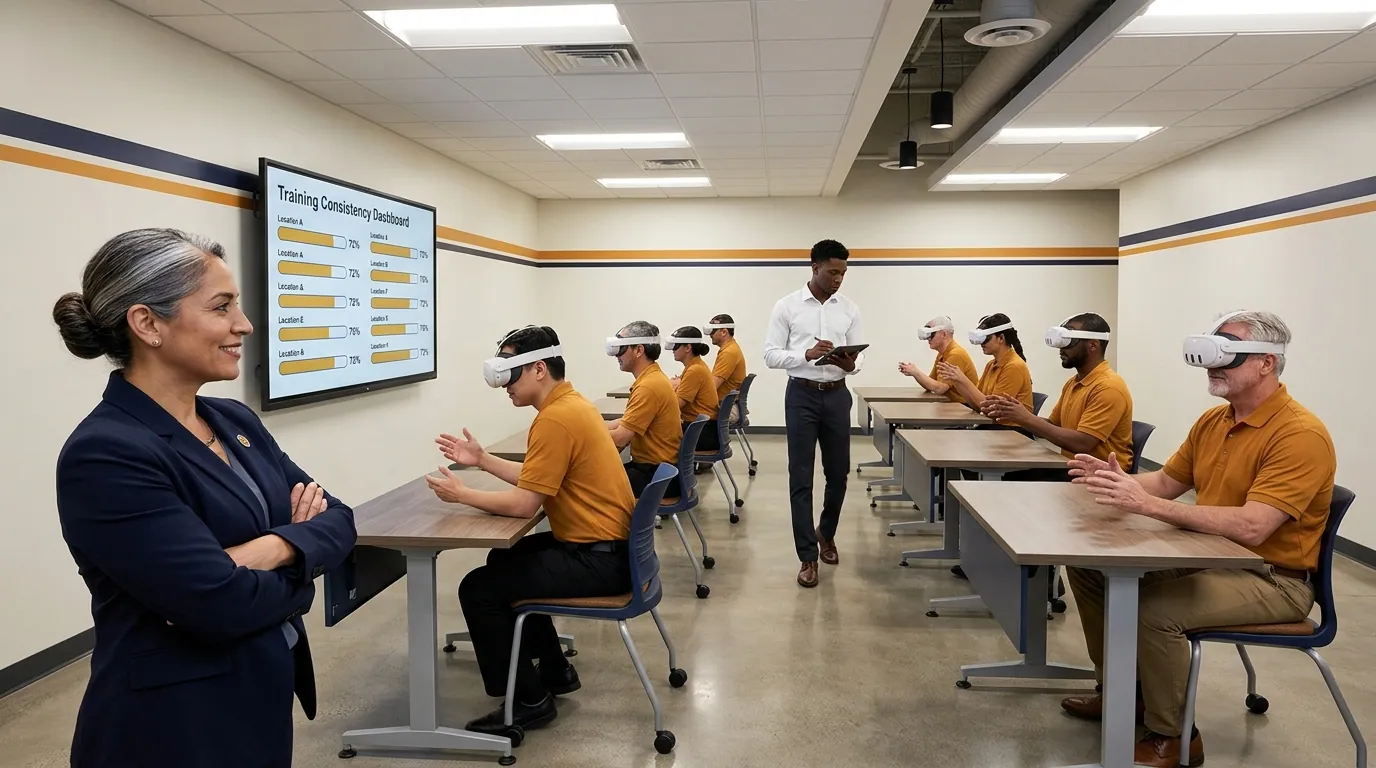
VR franchise training guarantees consistent execution by delivering identical scenarios, standards, and scoring to every employee at every location. Unlike train-the-trainer programs where quality degrades with each handoff, VR delivers the same experience in location 1 and location 500. PwC found VR learners were 275% more confident applying skills. Walmart trained over 1 million associates using VR to achieve consistent execution across 4,700 stores. Programs for franchise systems cost $50,000 to $200,000 and are most effective when targeting customer-facing procedures where brand consistency directly affects revenue.
The Franchise Consistency Problem
Franchise systems are built on a promise: the experience at location 47 is identical to the experience at location 1. That promise is delivered by employees who were trained by a local manager, who was trained by a regional trainer, who attended a corporate workshop three years ago. Every handoff in that chain introduces interpretation, variation, and drift.
The training manual says the same thing everywhere. The execution does not. And when a customer has a bad experience at location 47, they do not blame that franchisee. They blame the brand.
1M+ Associates
Walmart deployed VR training to over 1 million associates across 4,700 stores using STRIVR's platform, achieving consistent execution of specific procedures at every location. The same scalability applies to franchise networks of any size (STRIVR, 2023)
Why Train-the-Trainer Fails at Scale
Train-the-trainer is the standard franchise training model because it scales. But scale comes at the cost of consistency:
Quality degrades with every handoff
Corporate trains regional trainers. Regional trainers train local managers. Local managers train employees. By the time the standard reaches the frontline, it has been interpreted, simplified, and adapted at least three times. The employee is executing someone's interpretation of the standard, not the standard itself.
High turnover resets the problem constantly
Franchise businesses typically operate with 50% to 150% annual employee turnover. Every departing employee takes their training with them. Every new hire restarts the consistency clock, dependent on whoever has the time and inclination to train them properly that week.
No measurement of training quality
Traditional franchise training produces completion records. A new hire completed orientation. Their trainer signed off. Whether they can actually execute the brand standard is unknown until a customer interaction reveals otherwise.
How VR Solves the Consistency Problem
VR removes the trainer from the consistency equation. Every employee at every location practices the same scenario, against the same standard, and receives the same scored feedback:
| Training Element | Train-the-Trainer | VR Franchise Training |
|---|---|---|
| Training standard | Varies by trainer interpretation | Identical at every location |
| Quality over time | Degrades with each handoff | Consistent regardless of turnover |
| Readiness verification | Trainer judgment | Scored performance threshold |
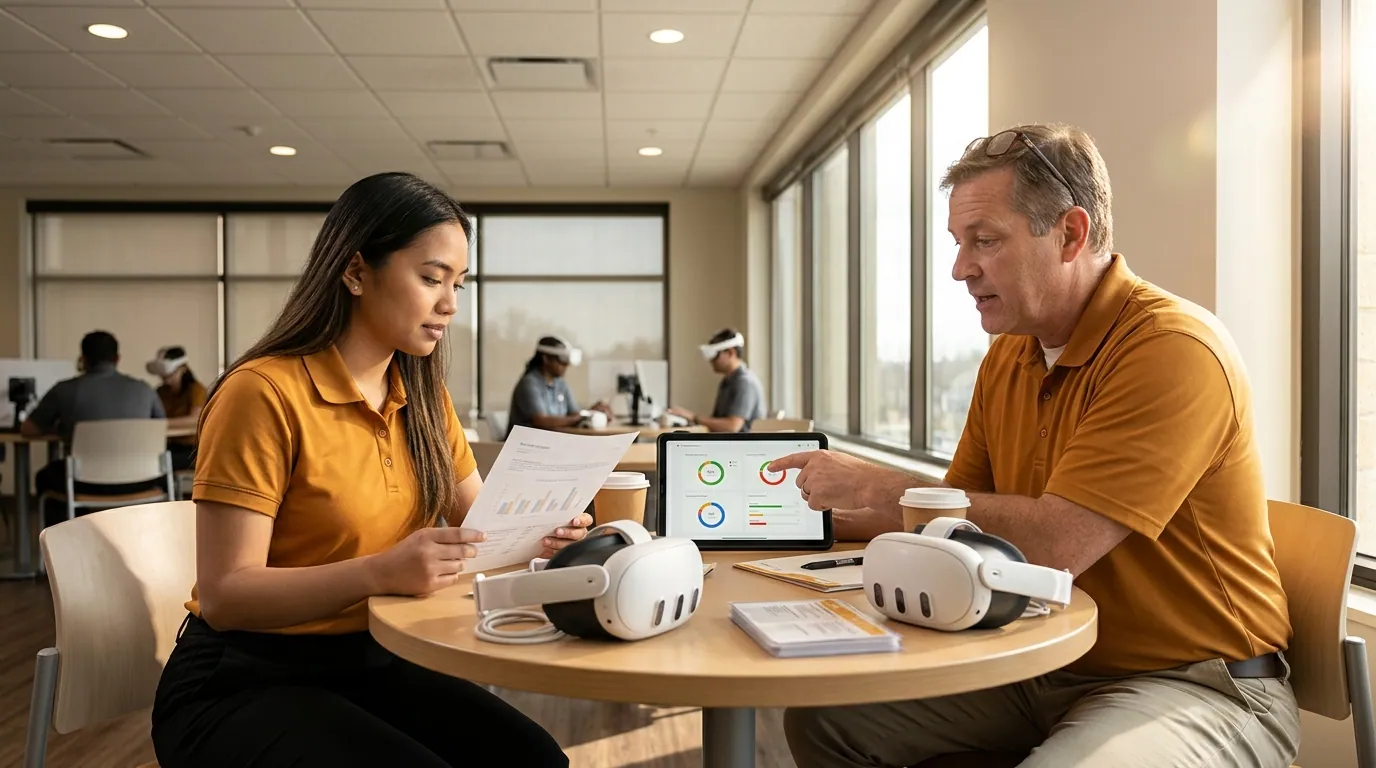
| Documentation | Completion sign-off | Performance record per employee per scenario |
| New hire training speed | Depends on trainer availability | 4x faster than classroom (PwC) |
| Scalability | Expensive per location | Same cost per hire at location 5 or location 500 |
High-Impact Scenarios for Franchise VR Training
Not every procedure needs VR. The highest-ROI franchise scenarios share one characteristic: inconsistent execution has a direct, measurable cost.
Customer service recovery
How an employee handles a complaint determines whether a dissatisfied customer becomes a returning customer or a negative review. VR lets employees practice complaint scenarios, service recovery language, and escalation decisions before facing a real unhappy customer.
Food safety and sanitation
A single food safety incident can close a location and damage the brand network-wide. VR training for safety and operations procedures gives employees practiced experience with sanitation protocols, temperature monitoring, and contamination response before any error costs the franchise its license.
Upsell and add-on conversations
For franchise systems where revenue per transaction varies significantly by employee, practiced upsell conversations translate directly to revenue. Employees who have rehearsed the offer in VR deliver it naturally. Those who have only read the script hesitate and skip it.
Manager shift management
Shift opening and closing procedures, staff conflict resolution, and rush-period prioritization decisions are high-stakes scenarios that new managers face with no prior practice. VR simulations let managers make those decisions, see consequences, and build judgment before their first solo shift.
3.75x
VR learners were 3.75x more emotionally connected to the training content than classroom learners. For franchise brand standards, emotional connection means employees internalize the standard rather than mechanically executing it (PwC, 2020)
What We See in Franchise VR Training Projects
From building custom franchise VR training programs, we consistently observe:
- The consistency gap is always larger than expected. When franchise operators measure performance scores across locations for the first time using VR data, they consistently discover wider variance than their in-person audits suggested. The VR data makes the problem visible.
- Franchisees become advocates, not resistors. Franchise owners who initially resist adding training requirements change their position when they see that VR reduces the time and cost of getting new hires to standard. The benefit is theirs, not just corporate's.
- High-turnover locations benefit most. Franchise locations with 100%+ annual turnover see the highest ROI because VR training scales with each new hire at no additional development cost. Once the program is built, training the 100th hire costs no more than training the first.
- Performance data improves franchisee coaching conversations. When regional managers visit locations with VR performance data in hand rather than observation checklists, coaching conversations shift from subjective to objective. Both parties see the same numbers.
Investment and Scale Economics
The economics of VR franchise training improve with network size. Development cost is fixed; deployment cost per employee is near zero after the program is built. A $100,000 program deployed to 50 locations training 20 employees each reaches 1,000 employees at $100 per person. Deployed to 200 locations, the same program costs $25 per person.
For detailed investment ranges by program scope, see our VR training cost guide. For a full overview of the development and deployment process, see how it works.
How does VR training improve franchise consistency? +
VR delivers identical training scenarios to every employee at every location, eliminating the quality variance that comes from local trainer interpretation. Every franchisee trains against the same standard, practices the same procedures, and is scored on the same rubric. PwC found VR-trained learners were 275% more confident applying skills, meaning franchise employees execute the brand standard rather than approximating it.
What franchise training scenarios work best in VR? +
Customer service interactions (handling complaints, upselling, service recovery), food safety and sanitation procedures, equipment operation, manager shift-opening and closing checklists, and emergency response protocols are the highest-impact scenarios for franchise VR training. Any procedure where execution consistency directly affects customer experience or brand reputation is a strong candidate.
How much does franchise VR training cost? +
$50,000 to $200,000 for a custom franchise training program. A foundational program covering 3-5 core scenarios for one role type costs $50,000 to $100,000. Enterprise franchise programs covering multiple roles, locations, and LMS integration run $100,000 to $200,000+. Per-location cost decreases as the network scales, making the investment more efficient for larger franchise systems.
Can VR training replace my existing franchise training manual? +
No, VR training adds a practice layer to your existing training system rather than replacing documentation. Franchisees still receive the training manual, policy guides, and compliance materials. VR replaces the part of training where employees are expected to learn by doing under live conditions, which is expensive and inconsistent. The manual explains what to do; VR makes them practice doing it.