
Pharmaceutical VR Training for Cleanroom and GMP Compliance
In pharmaceutical manufacturing, a procedural error can mean a contaminated batch or a compliance finding. VR training builds GMP and cleanroom discipline without ever entering the real cleanroom.
QUICK ANSWER
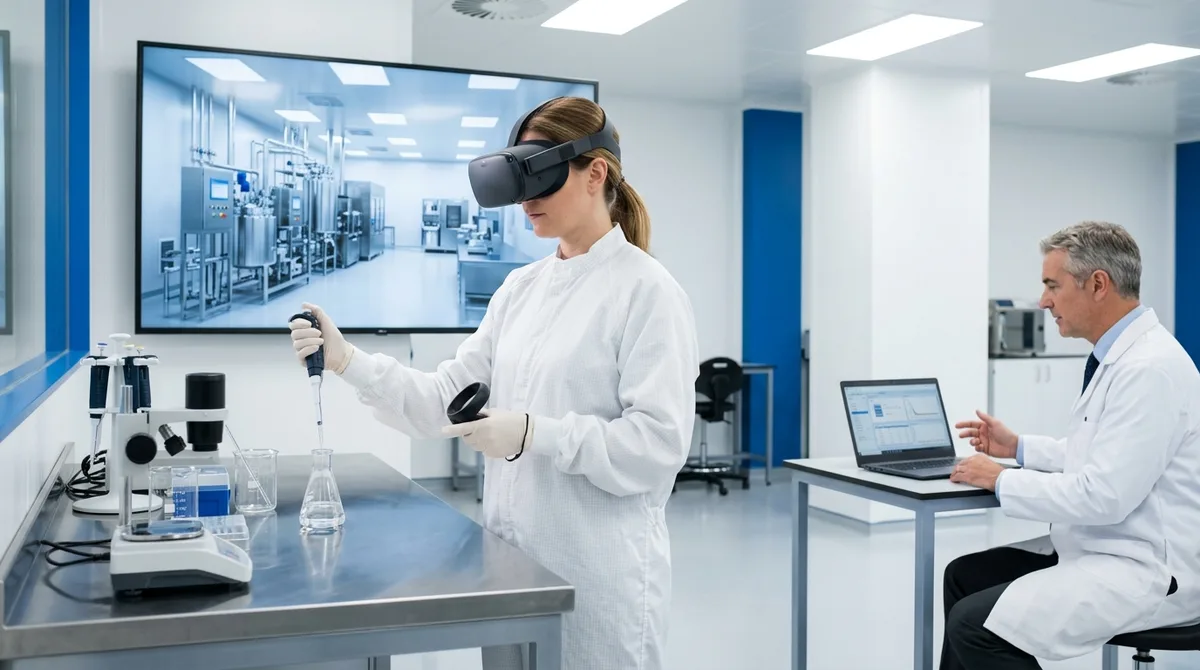
Pharmaceutical VR training recreates cleanrooms and production environments so workers can practice gowning, aseptic technique, GMP procedures, and contamination control without entering the real cleanroom or disrupting production. It builds the procedure discipline regulated pharma manufacturing demands, lets new workers train without contamination risk, and documents per-worker competence for GMP compliance.
Why Pharma Manufacturing Needs VR Training
Pharmaceutical manufacturing runs on procedure and contamination control. A worker who gowns incorrectly or breaks aseptic technique can contaminate a batch worth far more than any training program. Yet training in a real cleanroom is disruptive, expensive, and itself a contamination risk, especially for new workers learning by trial and error. VR lets workers practice the exact procedures in a virtual replica of the cleanroom, as often as needed, with zero contamination risk and zero production disruption.
Train without contamination risk
Every new worker learning in a real cleanroom is a contamination risk and a production disruption. VR removes both, letting workers reach competence before they ever enter the controlled environment.
Pharmaceutical VR Training Applications
- Cleanroom gowning. The precise gowning sequence practiced until flawless, the most common contamination failure point.
- Aseptic technique. Practicing movements and handling that maintain sterility.
- GMP procedures. Documented manufacturing procedures rehearsed for consistency and compliance.
- Contamination control and response. Recognizing and responding to contamination events.
GMP Compliance and Documentation
GMP requires documented evidence of trained, competent personnel. VR builds that competence through practice and documents it per worker, producing audit-ready records of demonstrated procedure competence. This supports inspections and reduces the deviation risk that comes from procedural inconsistency. The approach mirrors the documentation strength of VR compliance training generally and fits broader enterprise VR training.
What We See in VR Training Projects
From regulated-industry procedure training, the patterns that apply to pharma:
- Gowning is the highest-value target. It is the most common contamination failure and the easiest to perfect through repeated VR practice.
- Training without disruption is the operational win. Removing new-worker training from the live cleanroom protects both production and product.
- Documentation supports GMP inspections. Per-worker competence records meet what regulators expect better than attendance logs.
Cleanroom Behavior and Gowning
Learners practice gowning order and movement in controlled spaces. Errors have no product impact in VR.
Align with your SOPs.
Equipment Operation and Changeover
VR can rehearse equipment setup and cleaning procedures before touching real equipment.
Track step accuracy.
Training Records
Document participation and assessment results as your quality system requires. Validate use with your quality team.
Consult QA before rollout.
Why the Sector Is Demanding
Pharmaceutical manufacturing operates under regulatory expectations where the procedure, the documentation and the demonstrated competence of the operator all form part of what is inspected.
Errors carry consequences for patient safety, for batch value and for the company regulatory standing, which is why procedural discipline matters more here than almost anywhere else.
Training in this environment has to produce not only capability but evidence of capability, and those are different deliverables.
Where Immersive Delivery Fits
Aseptic technique, gowning sequence, cleanroom behavior and material transfer through airlocks are recurring cases where rehearsal outside the classified area has obvious value.
Equipment operation, changeover, cleaning validation steps and deviation response are further candidates because practicing them on live equipment consumes capacity and risks product.
Training people inside a classified area is itself disruptive and costly, and that constraint is much of the practical case for simulated rehearsal.
What It Does Not Replace
Gowning technique, physical handling and the tactile aspects of aseptic work require the actual garments, materials and environment.
Qualification for aseptic work involves practical assessment and monitoring that a simulation does not substitute for.
The defensible configuration is simulated rehearsal to build familiarity and sequence, followed by supervised practical work and formal qualification.
Validation and Controlled Content
Training content in this sector behaves like other controlled material, meaning version control, review, approval and change control apply to it.
Content that diverges from the current standard operating procedure creates a discrepancy between what operators were trained on and what the procedure requires.
Whether a computerised training system falls within validation expectations is a question for the quality function rather than for the vendor.
Records and Inspection
Training records supporting qualification must show who was trained, on which procedure version, when, by what method and with what assessment outcome.
Retention requirements apply, and records have to be retrievable during an inspection rather than reconstructable afterward.
Applicable regulations, quality system requirements and inspectorate expectations govern this, and current requirements should be confirmed with the quality function and the relevant authority.
Evaluating the Investment
Programs should be judged on deviation rates attributable to operator error, qualification times, media fill and environmental monitoring outcomes and inspection findings.
Common Mistakes and How to Avoid Them
Common errors include treating simulated rehearsal as a substitute for practical qualification, allowing content to diverge from the current procedure version, omitting change control on training material and deploying without a baseline for deviation rates.
Supervisors can help by making it acceptable to pause and ask. A culture where questions are treated as competence rather than weakness produces fewer errors in pharmaceutical manufacturing training.
How Employers Evaluate Readiness
Organizations assess this through deviation and human error rates, qualification and requalification timelines, media fill and environmental monitoring results, inspection findings and whether training records withstand review.
Keeping Skills Current
Procedures, equipment and regulatory expectations change. Linking training content to procedure version control prevents operators being qualified against a superseded revision.
Planning and Preparation
Preparation includes confirming validation and qualification expectations with the quality function, linking content to controlled procedure versions, defining what assessment supports qualification and baselining deviation and error rates.
Documentation That Holds Up
Training records tied to procedure versions with assessment outcomes, qualification and requalification documentation, content change control records and retention consistent with regulatory requirements are what an inspection examines first.
Frequently Asked Questions
What is pharmaceutical VR training? +
It is the use of VR simulation to let pharma manufacturing workers practice cleanroom gowning, aseptic technique, GMP procedures, and contamination control in a realistic virtual cleanroom, without entering the real controlled environment or disrupting production.
Why use VR in pharmaceutical manufacturing? +
Because training in a real cleanroom is disruptive, expensive, and itself a contamination risk. VR lets workers reach procedure competence in a virtual replica before they ever enter the controlled environment, protecting both production and product quality.
Does pharma VR training support GMP compliance? +
Yes. GMP requires documented evidence of trained, competent personnel. VR builds competence through practice and documents it per worker, producing audit-ready records that support inspections. Confirm program specifics against your GMP requirements with quality and regulatory teams.
What do workers practice in pharma VR? +
Cleanroom gowning sequences, aseptic technique, documented GMP manufacturing procedures, and contamination recognition and response, all practiced safely and repeatedly without contamination risk.
Can it replicate our specific cleanroom? +
Yes. Custom simulations can recreate the specific cleanroom layout, equipment, and procedures workers use, which maximizes how well the practiced technique transfers to the real environment.
Does VR training satisfy GMP requirements? +
It can support training programs, but your quality system must define how it is documented and assessed.
What tasks suit VR in pharma? +
Gowning, cleaning, equipment setup and deviation response.
Training pharma manufacturing or cleanroom staff?
Tell us your environment and procedures. We will show you how VR builds GMP competence without contamination risk.