
Mining Safety VR Training for High-Hazard Operations
Mining is one of the most hazardous industries, and its worst-case scenarios are impossible to practice live. VR safety training lets miners rehearse the situations that matter most, safely.
QUICK ANSWER
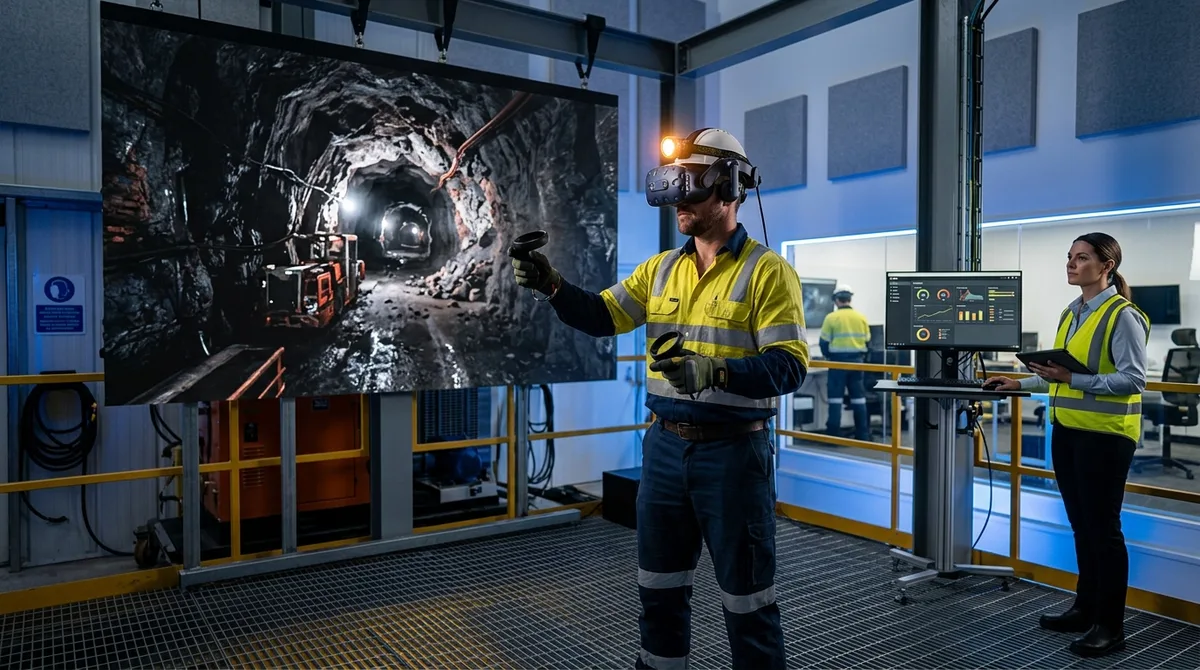
Mining safety VR training recreates underground and surface mine environments so workers can practice hazard recognition, emergency evacuation, equipment operation, and ground-control awareness without real exposure. It is most valuable for the high-consequence scenarios, fires, collapses, gas events, that cannot be staged live but that workers must respond to correctly. It builds competence and provides documented per-worker training records.
Why Mining Safety Needs Simulation
Mining hazards are severe and many of the most important lessons are the most dangerous to teach. You cannot stage a roof fall, a fire underground, or a gas event to train response. Yet miners must respond to exactly these correctly. VR simulation closes that gap by letting workers rehearse high-consequence scenarios in a realistic virtual mine, as often as needed, with zero exposure.
Rehearse the worst case
The scenarios that kill, fires, collapses, gas events, evacuations, are impossible to practice on a real site. Simulation is the only way to give miners repeated practice at responding correctly before it happens for real.
Mining VR Training Applications
- Hazard recognition. Spotting ground-control, ventilation, and equipment hazards before they cause harm.
- Emergency response and evacuation. Fire, collapse, and gas-event response and self-escape, rehearsed safely.
- Equipment operation. Heavy mining equipment practiced in a virtual replica before live operation.
- New-miner orientation. Familiarizing new workers with the mine environment and its hazards before they go underground.
Compliance and Documentation
Mining is heavily regulated, and operators must document training. VR captures per-worker performance, producing a record of demonstrated competence, not just attendance, which strengthens the compliance posture and supports audits. The simulation approach mirrors broader VR safety and operations training and confined space practice common in mining.
What We See in VR Training Projects
From high-hazard simulation training, the patterns that apply to mining:
- The unstageable scenarios are the strongest case. Where live practice is impossible, simulation is the only safe path to competence.
- Replica environments transfer best. A simulation of the specific mine and equipment outperforms generic content.
- Documentation matters in a regulated industry. Per-worker competence records support compliance and audits.
Frequently Asked Questions
What is mining safety VR training? +
It is the use of VR simulation to recreate underground and surface mine environments so workers can practice hazard recognition, emergency response, evacuation, and equipment operation without exposure to real mine hazards.
Why use VR for mining safety? +
Because the most important mining safety lessons, responding to fires, collapses, and gas events, are too dangerous to stage on a real site. VR lets miners rehearse those high-consequence scenarios safely and repeatedly until response is automatic.
What can miners practice in VR? +
Hazard recognition, emergency response and self-escape, equipment operation, and new-miner orientation to the mine environment, all in a realistic virtual replica with zero real exposure.
Does VR mining training support compliance? +
Yes. VR captures per-worker performance data, producing a documented record of demonstrated competence rather than just attendance, which strengthens compliance and supports audits in a heavily regulated industry.
Can the simulation match our specific mine? +
Yes. Custom simulations can recreate the specific mine layout, conditions, and equipment workers face, which maximizes how well the practiced skills transfer to the real environment.
Training miners on high-hazard procedures?
Tell us your site and the scenarios that matter most. We will show you how VR can build safer crews.