
Best Warehouse Training Programs (2026)
Warehouses run on safety, speed, and equipment competence, with high turnover and real injury risk. Good warehouse training covers OSHA safety, forklift and equipment certification, and fast onboarding to the specific operation. These are the recognized providers.
QUICK ANSWER
The best warehouse training options include Vector Solutions for safety and compliance, MSSC and IWLA for logistics certification, Naumann/Hobbs for forklift and equipment training, OSHAcademy for online safety, and equipment-maker programs like Raymond and Toyota for lift certification. The right mix pairs OSHA safety with equipment certification and operation-specific onboarding.
How to read this list
Warehouse training divides into OSHA safety, equipment and forklift certification, and operation-specific onboarding. Match the pick to your biggest risk and whether you need recognized certification or fast role onboarding.
The Programs
Vector Solutions
Best for: Warehouse safety and compliance
Offers a large library of role-based warehouse safety and compliance training supporting OSHA requirements.
MSSC
Best for: Certified logistics associate
The Manufacturing Skill Standards Council offers a nationally recognized Certified Logistics Associate and Technician credential.
IWLA
Best for: Warehousing and logistics certification
The International Warehouse Logistics Association provides certification and education for warehousing professionals.
Naumann/Hobbs
Best for: Forklift and equipment safety
Provides forklift and material-handling equipment safety training to meet OSHA operator requirements.
OSHAcademy
Best for: Online warehouse safety
Offers accessible online safety courses addressing common warehouse and storage hazards.
Raymond and Toyota Lift
Best for: Manufacturer forklift certification
Equipment-maker training programs that certify forklift and lift-truck operators on their machines.
THE IMMERSIVE OPTION
Where custom VR fits warehouse training
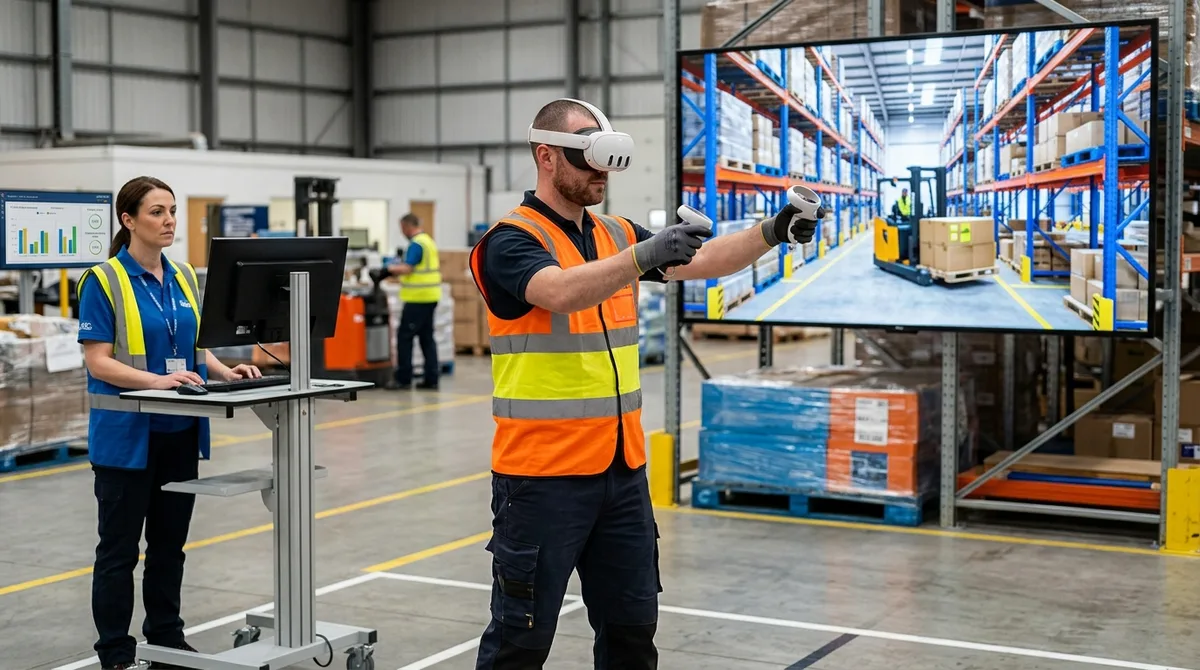
These programs cover safety knowledge and equipment certification. What they cannot do is let a worker practice the forklift maneuver, the pedestrian-hazard moment, and the pick-path safety at speed until it is reflex. That practice, without a real forklift or real risk, is where immersive simulation fits.
The Prime VR builds custom VR training on your exact warehouse layout and equipment, so workers practice forklift operation, pedestrian safety, and picking procedures in a realistic environment, with performance measured and exported to your LMS.
Equipment and Safety Content
Look for programs covering forklifts, pallet jacks, ergonomics and hazard recognition. Include evaluations required by regulations.
Verify compliance elements.
Practical Evaluation
Classroom training alone is not enough for powered equipment. A supervisor or trainer must evaluate operation.
Document the evaluation.
Onboarding Speed
Fast, clear training helps seasonal hires. Practice reduces incidents.
Track early performance.
Questions to Ask Providers
Ask about equipment coverage, evaluation methods, records and support for multiple shifts. Request references.
Pilot before buying.
Sustaining Safe Habits
Combine training with observation, coaching and refreshers. Track incidents and near misses.
Involve supervisors.
What Warehouse Training Has to Address
Warehouse operations combine powered equipment, manual handling, inventory accuracy and throughput pressure, and training has to serve all of them at once.
Turnover in the sector is high, which means a program has to work repeatedly for new staff rather than once for an established team.
Programs suited to this context are evaluated on how quickly a new worker becomes productive and safe, not only on content coverage.
Criteria Worth Applying
Useful criteria include whether the program addresses both regulatory requirements and operational performance, how it handles equipment specific certification and how quickly it can be delivered to a new hire.
Programs built for a different facility layout, equipment mix or product type will need adaptation, and how easily that is done is a practical differentiator.
Language accessibility matters in this workforce more than in most, and a program available in only one language excludes part of the intended audience.
Questions to Ask Providers
Ask how equipment operator evaluation is handled, since hands on evaluation on the specific equipment is generally required and cannot be delivered by content alone.
Ask what the program requires from the facility in trainer time, space and equipment availability, because those costs are frequently larger than the program fee.
Ask how records are maintained and what documentation the program produces, since that documentation is what matters during an inspection.
Delivery Formats
Classroom and written material handle regulatory knowledge efficiently and do not by themselves produce operating competence.
Hands on training with an experienced operator is the traditional method and its quality varies entirely with the individual assigned.
Simulation lets new staff practice equipment operation, hazard recognition and picking procedures without occupying live equipment or risking damage and injury.
Measuring Whether It Worked
Useful measures include time to productivity for new hires, picking accuracy, equipment damage incidents, injury rates and retention through the first months.
Comparing these before and after a program change is what distinguishes an improvement from seasonal variation.
Baselines captured before a program starts make that comparison possible, and they are commonly missing.
Regulatory Context
Powered industrial truck operation, hazard communication, emergency action and several other areas carry specific regulatory training requirements.
Requirements differ by jurisdiction and by equipment type, and employers should confirm what applies to their facility and workforce.
Evaluation and refresher intervals are part of those requirements, and treating initial training as sufficient is a common compliance gap.
Common Mistakes and How to Avoid Them
Common errors include selecting a program that omits hands on equipment evaluation, ignoring the facility time it demands, overlooking language accessibility and treating initial training as satisfying ongoing requirements.
Supervisors can help by making it acceptable to pause and ask. A culture where questions are treated as competence rather than weakness produces fewer errors in warehouse training.
How Employers Evaluate Readiness
Operations evaluate these programs on time to productivity, picking accuracy, equipment damage and injury rates, retention and whether documentation survives an inspection.
Keeping Skills Current
Equipment, layout, product mix and regulations change. Reviewing whether training content still matches the current operation prevents preparing staff for a facility that no longer exists.
Planning and Preparation
Preparation includes identifying the regulatory requirements that apply, mapping the roles and equipment involved, establishing performance baselines, confirming trainer availability and planning how records will be kept.
Documentation That Holds Up
Training and evaluation records by individual and equipment type, refresher dates and performance data are what demonstrate compliance and identify where a gap is producing incidents.
Related Guides
These cover adjacent ground with a different focus:
Frequently Asked Questions
What does warehouse training need to cover?+
OSHA safety and hazard awareness, forklift and equipment certification, and fast onboarding to the specific operation. High turnover and injury risk make safety and speed the priorities.
Is forklift certification required?+
Yes. OSHA requires that forklift operators be trained, evaluated, and certified on the type of equipment they use, with periodic re-evaluation. Many providers and equipment makers offer the certification.
How does VR fit warehouse training?+
VR lets workers practice forklift maneuvers and pedestrian-safety scenarios without a real machine or real risk, building reflexes that reduce the incidents that cluster in warehouses.
Does forklift training require hands on evaluation?+
Yes, OSHA requires practical training and evaluation of operators.
How can warehouses train seasonal staff?+
Use short, focused modules with practice and close supervision.
Train forklift and pick safety without the risk.
We build custom VR training on your warehouse layout and equipment.
VR scenario designs related to logistics courses
Proposed practice scenarios and checklist guides built around specific tasks. Each one lists what VR does not replace.
- Warehouse Standard Operating Procedures: Checklist
- Transport and Logistics Courses: VR Scenarios for Teams