
Best Logistics Training Companies (2026)
Logistics and supply chain training builds the planning, transportation, and operations knowledge that moves goods efficiently. The best providers offer recognized certifications and deep curriculum for professionals and teams. These are the leading organizations.
QUICK ANSWER
The best logistics and supply chain training providers include ASCM (APICS), Georgia Tech Professional Education, the Institute for Supply Management, IWLA, MSSC, and the Supply Chain Institute. They offer recognized certifications like CSCP, CLTD, and CPSM, and differ in whether they focus on planning, transportation, procurement, or operations.
How to read this list
Logistics training centers on recognized certifications for planning, transportation, and procurement, plus operator-level operations. Match the pick to the role you are developing and which certification your industry values most.
The Companies
ASCM (APICS)
Best for: Supply chain and logistics certification
The Association for Supply Chain Management offers the widely recognized CSCP, CPIM, and CLTD logistics and supply chain certifications.
Georgia Tech Professional Education
Best for: University-backed supply chain courses
One of the largest supply chain and logistics education institutes, offering courses and certificates for professionals.
Institute for Supply Management
Best for: Procurement and supply management
Offers the Certified Professional in Supply Management, a recognized procurement and supply-management credential.
IWLA
Best for: Warehousing and 3PL logistics
The International Warehouse Logistics Association provides education and certification for warehousing and third-party logistics.
MSSC
Best for: Certified logistics credentials
Offers nationally recognized Certified Logistics Associate and Technician credentials for frontline logistics workers.
Supply Chain Institute
Best for: Planning and operations education
A provider of education in demand planning, forecasting, logistics, and operational excellence.
THE IMMERSIVE OPTION
Where custom VR fits logistics training
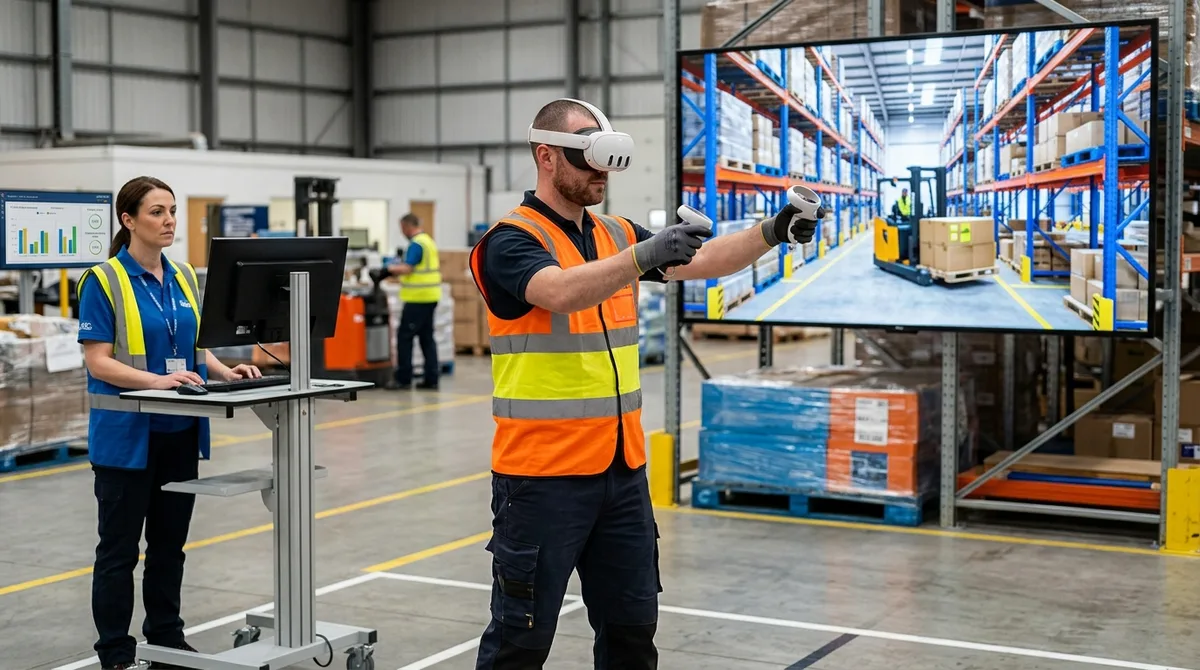
These organizations deliver strong certification and planning knowledge. What certification does not build is the hands-on, frontline operations competence, the dock, the forklift, the pick, the loading, done safely and at speed. That operational practice is where immersive simulation fits.
The Prime VR builds custom VR training on your exact logistics operation, so frontline workers practice dock, forklift, and loading procedures in a realistic environment, complementing the planning and certification side with measured hands-on skill.
Certifications and Skills
Logistics roles use certifications in areas like supply chain, warehouse safety and transportation. Choose ones employers recognize.
Check industry demand.
Hands On Practice
Simulation and practical exercises bridge theory and job performance. Look for these components.
Ask about labs.
Support and Outcomes
Placement help and alumni results show the value of a provider. Verify claims.
Questions to Ask Providers
Ask about content, equipment, assessment and support. Confirm they cover your operational needs.
Keeping Skills Fresh
Logistics changes with technology and regulations. Plan refreshers and cross training.
Track competencies.
What the Category Covers
Logistics training spans warehouse operations, transportation, inventory and supply chain planning, customs and trade compliance, and safety and equipment certification.
Providers rarely cover all of these well, and a provider strong in supply chain analysis may be weak in equipment operation and the reverse.
Defining which of these the organization actually needs is what makes a comparison meaningful rather than a survey of marketing material.
Criteria for Evaluating Providers
Ask whether the provider delivers instruction, certification preparation, equipment qualification or consulting, because these are different products often described in similar language.
Ask how content is kept current, since regulations, customs requirements and systems change frequently in this sector.
Ask whether training can be delivered on site, across shifts and in the languages the workforce actually uses.
Certification and Regulatory Content
Equipment operator qualification, hazardous materials handling, commercial driving requirements and customs compliance are governed by regulation rather than by provider standards.
Requirements differ by jurisdiction and by the specific operation, and employers should confirm what applies rather than relying on a provider description.
A provider preparing candidates for a regulated qualification should be able to state precisely which requirement its program satisfies.
Questions to Ask Before Committing
Ask what evidence exists that the training changed performance rather than only that it was delivered.
Ask how the provider handles assessment, and whether assessment is a knowledge test or a demonstration of the task.
Ask what happens when the operation changes, and whether content updates are included or charged separately.
Cost and Delivery Considerations
Compare total cost including participant time away from operations, which frequently exceeds the provider fee.
Consider whether delivery format suits a workforce that works shifts, is distributed across sites and may have limited computer access.
Consider trainer capability transfer, since building internal training capability is often more durable than a recurring external engagement.
Measuring Results
Useful measures include error and damage rates, safety incidents, productivity, turnover and the time a new employee takes to reach standard.
Simulation allows practice of equipment operation and process handling without disrupting operations or risking damage.
Applicable regulations, employer procedures and customer requirements govern operations, and organizations should verify current requirements for their jurisdiction and sector.
Common Mistakes and How to Avoid Them
Common mistakes when selecting include buying a broad program when the gap is specific, accepting that a course satisfies a regulatory requirement without verifying it, ignoring the cost of time away from operations and assessing knowledge instead of task performance.
Supervisors can help by making it acceptable to pause and ask. A culture where questions are treated as competence rather than weakness produces fewer errors in logistics training.
How Employers Evaluate Readiness
Organizations evaluate logistics training through error and damage rates, safety incidents, productivity, new employee time to standard and audit or inspection findings.
Keeping Skills Current
Regulations, systems and customer requirements change frequently in this sector. Confirming content is current prevents training a workforce on requirements that have been superseded.
Planning and Preparation
Preparation includes identifying the specific capability gap, confirming which qualifications are legally required, deciding what will be measured and planning delivery around shift patterns and operational demands.
Documentation That Holds Up
Training and qualification records, assessment results and operational performance data are what demonstrate competence to auditors and customers and allow the organization to judge whether the investment worked.
Frequently Asked Questions
What are the top logistics certifications?+
The ASCM certifications CSCP, CPIM, and CLTD, the Institute for Supply Management CPSM, and MSSC Certified Logistics credentials are among the most recognized in supply chain and logistics.
What is the difference between logistics training providers?+
Some focus on professional planning and procurement certification, university-backed programs offer broad curriculum, and others certify frontline operations roles. The right fit depends on the role and level.
How does VR complement logistics certification?+
Certification builds planning and management knowledge, while custom VR builds the hands-on frontline operations skill on your specific dock, equipment, and processes.
What logistics certifications are common?+
Options include APICS CSCP, CLTD and other credentials, depending on role.
How do I compare training providers?+
Look at curriculum, hands on practice, cost, support and outcomes.
Add hands-on practice to logistics certification.
We build custom VR training on your dock, equipment, and processes.