
Best Safety Training Companies in Shreveport (2026)
Shreveport and Bossier City sit atop the Haynesville Shale, one of the most productive natural gas plays in the country, alongside a diversified manufacturing base, Barksdale Air Force Base, and a gaming and hospitality economy. That mix gives the region an unusually varied safety training market, from SafeLand and H2S for gas fieldwork to lockout/tagout for manufacturing. This guide compares the safety training companies that actually serve Shreveport, what each is best for, and where immersive practice fits.
QUICK ANSWER
The best safety training companies serving Shreveport and Bossier City in 2026 include Brammer Training, SRP Environmental, OSHA Training Services, Southern University at Shreveport, HAZWOPER Center, Smart Safety Group and the National Safety Council. They deliver OSHA 10 and 30, HAZWOPER, HazCom, SafeLand and SafeGulf, H2S, and forklift certification on-site and online. For Shreveport employers whose workers must actually perform H2S response, confined space and lockout/tagout procedures under real conditions, not just pass a course, immersive VR safety training from The Prime VR is the emerging complement that turns knowledge into measured, hands-on practice.
Why Shreveport is a mixed safety market
Some cities have one dominant industry that shapes their safety training market. Shreveport has several. The Haynesville Shale makes natural gas fieldwork and midstream a major driver, requiring SafeLand and SafeGulf orientations and H2S training. A diversified manufacturing base needs lockout/tagout, machine guarding, and forklift certification. Barksdale Air Force Base and its supply chain add defense-adjacent and general-industry needs, and a substantial gaming and hospitality sector brings its own service-industry safety demands. No single provider is the right answer for all of them.
That diversity is why the local provider bench spans oilfield-orientation specialists, general OSHA outreach trainers, and a technical college feeding a workforce pipeline. The differentiator among them is not whether they can issue a card, it is whether the training genuinely matches the hazard a worker will face, and whether it prepares them to perform the procedure correctly when it counts.
The providers, and what each is best for
Brammer Training
Best for: HazCom, HAZWOPER, SafeLand and SafeGulf
A Shreveport and Bossier City provider delivering HazCom, HAZWOPER, SafeLand, and SafeGulf, a strong fit for the natural gas and oilfield service workforce that needs the industry-recognized orientations operators require.
SRP Environmental
Best for: HazCom, HAZWOPER and H2S
Serves the Shreveport and Bossier City area with hazard communication, HAZWOPER, and H2S training alongside environmental services, useful for employers that want training paired with environmental compliance support.
OSHA Training Services
Best for: OSHA 10 and 30 outreach
Provides expert-led OSHA 10 and 30-hour training in Shreveport for businesses and government organizations, a dependable baseline for general-industry and construction employers.
Southern University at Shreveport
Best for: Workforce safety certifications
The SUSLA workforce program offers OSHA 10, HAZWOPER, forklift, asbestos worker, and CPR and first aid certification, a fit for employers building a locally trained workforce pipeline.
HAZWOPER Center
Best for: On-site and online HAZWOPER
Delivers online and on-site HAZWOPER training that meets OSHA standards, convenient for dispersed natural gas and industrial crews across the region.
Smart Safety Group
Best for: Consulting plus training and OSHA support
A safety consultancy offering health and safety training alongside OSHA incident reporting and representation, useful when an employer wants training paired with program-level support.
National Safety Council
Best for: Nationally recognized workplace safety
A leading safety nonprofit offering widely recognized workplace safety, first aid, and defensive-driving training, a fit for Shreveport employers that want a national brand for general-industry programs.
Natural gas: the Haynesville hazard profile
The Haynesville is a deep, high-pressure natural gas play, and the fieldwork around it carries the hazards that define oil and gas safety anywhere: hydrogen sulfide where sour gas is present, confined space entry, hot work, and heavy equipment. Access to a location is gated by an industry-recognized orientation, most commonly SafeLand for onshore work or SafeGulf, plus H2S awareness. These are not OSHA cards, they are industry programs operators adopt to standardize who they let on site, layered on top of the OSHA standards that govern the actual work.
Because the Haynesville workforce is mobile and contract-based, a worker may hold current SafeLand, H2S, and confined space credentials and still be on an unfamiliar location within hours of arriving. That gap between holding a card and being genuinely ready for the specific site is exactly where realistic practice matters, because H2S response and confined space entry are procedures where hesitation or error can be fatal.
Manufacturing and defense: a different stack
Away from the gas fields, Shreveport's manufacturing employers work under OSHA general-industry standards, where the daily hazards are lockout/tagout under 29 CFR 1910.147, machine guarding, forklift and powered-industrial-truck operation under 29 CFR 1910.178, and hazard communication. These are procedural, repetitive hazards, the kind where habits form and where a worker can pass a class and still take a shortcut months later. The training that reduces injuries here is the training that builds and reinforces the right habits, not the training that simply issues a certificate.
Barksdale Air Force Base and its supply chain add a defense-adjacent layer, with a workforce that values standardized, repeatable, and measurable readiness, exactly the profile immersive practice is built for. The point across all of Shreveport's sectors is that the right training is specific: a gas contractor, a manufacturer, and a defense supplier need different programs, and matching the approach to the work is the first decision a buyer has to get right.
Gaming and hospitality: the region's other workforce
Shreveport and Bossier City are also a regional gaming and entertainment destination, with riverboat casinos, hotels, and event venues employing thousands of people. That workforce sits far from the gas fields in every sense, but it carries its own real and recurring safety needs: slip, trip, and fall hazards on busy floors, kitchen burns and cuts, food safety requirements, and the growing challenge of de-escalation for staff who deal with intoxicated or aggressive guests, especially late at night and during major events.
These service-sector hazards are often overlooked in a conversation dominated by industrial risk, but they drive a large share of injuries and turnover in the local hospitality economy. The training that helps here is behavioral and situational rather than technical. A dealer or server already knows the rules, the difference is whether they can stay calm and act correctly when a situation escalates in front of guests.
This is another place where immersive, scenario-based training is increasingly relevant even outside heavy industry. Giving hospitality staff a safe environment to rehearse the difficult moments, whether that is a kitchen emergency, a medical event on the floor, or a tense guest interaction, builds the same kind of reflex that keeps an industrial worker safe. The underlying principle is identical across all of Shreveport's very different industries: knowing what to do is not the same as being able to do it under pressure, and practice is what closes that gap.
The stakes: why completion is not competency
Across natural gas, manufacturing, and defense work, the same gap appears. Incidents are rarely caused by a lack of knowledge. They are caused by the gap between what a worker knows and what they do under pressure, on an unfamiliar site, against a schedule. A worker can hold a current SafeLand card, an H2S certificate, and a lockout/tagout qualification and still make a serious error when the situation is real and moving. Classroom training transfers the rules, but it does not build the reflexes that keep a crew safe when an alarm sounds or a machine is not fully isolated.
This is the gap every Shreveport safety leader recognizes. The providers above do essential work issuing the credentials the region's industries require. The point is that the credential is the floor, not the ceiling, and that for the highest-consequence procedures, realistic and repeatable practice is what turns a certified worker into a genuinely prepared one.
SPECIAL MENTION: IMMERSIVE TECHNOLOGY
The Prime VR, for VR safety training in Shreveport
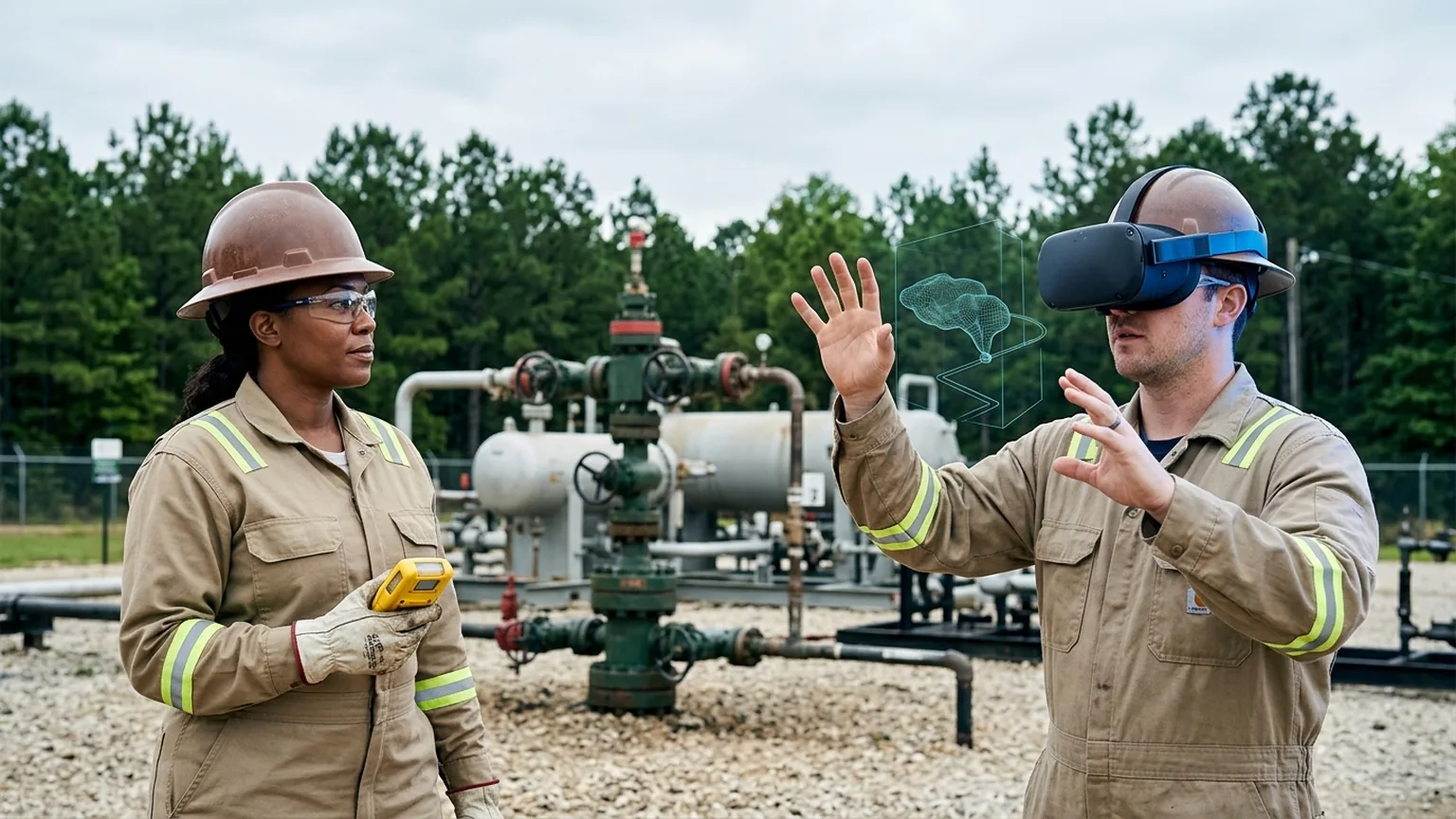
The companies above deliver the orientations, certifications, and compliance tracking every Shreveport employer needs. The Prime VR represents the layer most of that training is missing: custom virtual reality programs where workers practice H2S response, confined space entry, lockout/tagout, and emergency response in realistic simulations of your actual site or facility, with performance measured step by step.
Whether the work is a Haynesville gas location or a manufacturing plant floor, immersive practice earns its place wherever a procedure is high-consequence, repeatable, and needs to be standardized across a mobile or high-turnover workforce. A worker can rehearse an H2S evacuation or a lockout/tagout dozens of times in VR with zero real-world risk, and every decision is recorded so a safety manager can see who is genuinely ready. Because the program is built around your specific hazards and owned outright, there are no per-seat fees, and it can be reused for every new hire and every crew rotation.
Learn more about VR safety and operations training, how it applies to oil and gas safety, or manufacturing safety.
The bilingual reality of the Shreveport workforce
A share of the region's construction and field workforce speaks Spanish as a first language, and safety training that is only delivered in English carries a hidden risk. A worker can pass a written orientation in a second language and still miss a nuance that matters during a real entry or an H2S event. That is why serious operators insist on bilingual delivery and documentation, both for genuine comprehension and for defensibility if an incident is investigated. Any modern approach, including a custom immersive program, should be authorable in both languages so the experience and the assessment are equivalent for every worker on the crew.
The cost of getting it wrong
The financial exposure is real and rising. As of the 2025 inflation adjustment, OSHA can penalize a serious violation up to 16,550 dollars per instance and a willful or repeated violation up to 165,514 dollars per instance, with failure-to-abate penalties accruing daily. For a Shreveport gas contractor or manufacturer, an inadequate H2S or lockout/tagout program can generate multiple citations at once, and a serious gas-field incident carries consequences far beyond OSHA. Training is one of the least expensive forms of protection available, but only if it actually changes what a worker does under real conditions.
How to choose a Shreveport safety training partner
Start by naming your world. If you are a natural gas contractor, prioritize providers with genuine SafeLand, SafeGulf, and H2S depth and confirm they align with the operators whose locations you work. If you are a manufacturer, prioritize lockout/tagout, machine guarding, and forklift specialists who can evaluate workers in your actual facility. Confirm on-site and cross-shift delivery and bilingual options if your crews need them. And if your problem is that people complete the training but near-misses keep happening, that is the signal you need practice, not another card.
Many Shreveport employers end up with a blend: local providers for the required orientations and certifications, plus an immersive layer for the highest-consequence procedures and for bringing a mobile or high-turnover workforce up to genuine readiness. The credentials keep you compliant. The practice keeps your people safe and gives you an objective record to show during a prequalification or an audit, which across the region's demanding industries is a genuine business advantage. In a market as varied as Shreveport, where the same contractor pool may move between gas locations, plant floors, and construction sites, being able to prove real competency rather than just a stack of cards is increasingly what separates the crews operators keep from the ones they replace.
What a VR pilot looks like for a Shreveport employer
A custom immersive program starts with your hazards, not a headset. A typical build runs in four phases. Discovery maps the specific procedures you want workers to practice, drawing on your incident history, your site or facility, and the people who run the work. Design turns those into interactive scenarios with defined success criteria. Build develops and tests the environment against your real operation, from an H2S evacuation on a gas location to a lockout/tagout on a specific machine. Deploy handles hardware, learning management system integration, and train-the-trainer so your team runs it without an outside vendor.
For a Shreveport employer, a sensible starting point is a single high-consequence procedure tied to your dominant hazard, delivered as a pilot before expanding. That keeps the investment contained while proving whether measured practice moves your leading indicators, from near-miss reports to new-worker readiness. Because the finished program is owned rather than licensed per seat, the economics improve every time you onboard another crew or cycle another contractor through it, and the same platform can hold scenarios for more than one of your priority hazards as your overall safety program matures over time.
Frequently Asked Questions
Who are the best safety training companies in Shreveport?+
The leading providers serving Shreveport and Bossier City include Brammer Training, SRP Environmental, OSHA Training Services, Southern University at Shreveport, HAZWOPER Center, Smart Safety Group and the National Safety Council. Between them they deliver OSHA 10 and 30, HAZWOPER, HazCom, SafeLand and SafeGulf, H2S, and forklift certification, on-site and online. The right choice depends on whether your gap is natural gas fieldwork, manufacturing, or general industry. For teams that must actually perform high-risk procedures under real conditions rather than only pass a course, immersive VR safety training from The Prime VR is an emerging complement.
How much does safety training cost in Shreveport?+
Pricing in Shreveport follows regional and national ranges. SafeLand and SafeGulf orientations and OSHA cards run from a low per-seat fee to a few hundred dollars for OSHA 30, and HAZWOPER courses run several hundred dollars per seat. On-site group delivery is priced per class. Custom immersive VR safety training, built around your real Shreveport worksites and hazards such as natural gas fieldwork, confined space, and manufacturing lockout/tagout, and owned rather than licensed per seat, typically runs from 25,000 to 500,000 dollars depending on scope.
What industries drive safety training demand in Shreveport?+
Shreveport and Bossier City sit atop the Haynesville Shale, one of the most productive natural gas plays in the country, which drives fieldwork, midstream, and service demand for SafeLand, SafeGulf, and H2S training. The area also has a diversified manufacturing base and is home to Barksdale Air Force Base, adding general-industry and defense-adjacent training needs. That mix means the right provider depends on which part of the regional economy your operation sits in.
What safety training does natural gas work in the Haynesville require?+
Natural gas fieldwork and midstream operations typically require an industry-recognized orientation such as SafeLand or SafeGulf to access a site, plus H2S awareness where sour gas is present, and OSHA-based confined space entry under 29 CFR 1910.146, respiratory protection under 29 CFR 1910.134, and hot work permitting. HAZWOPER under 29 CFR 1910.120 applies to hazardous substance operations. Because operators set their own access requirements, Haynesville contractors often carry several current credentials at once.
What is VR safety training and how does it fit Shreveport employers?+
Immersive VR safety training puts workers in realistic simulations where they practice real procedures such as H2S response, confined space entry, lockout/tagout, and emergency response, and the system measures how they perform step by step. It complements a SafeLand, SafeGulf, or OSHA course by turning knowledge into repeatable, measured practice, built around your actual Shreveport worksite or facility and owned rather than licensed per seat.
Do Shreveport providers offer bilingual training?+
Yes. A share of the region's construction and field workforce is Spanish-speaking, and several providers deliver bilingual courses. Bilingual delivery matters for genuine comprehension of life-safety procedures and for defensible documentation if an incident is investigated. Any modern approach, including a custom VR program, should be authorable in both languages so the experience and the assessment are equivalent for every worker on the crew.
How does a diversified Shreveport economy affect training choices?+
Unlike a pure oilfield town, Shreveport blends natural gas fieldwork, manufacturing, defense, and gaming and hospitality, and each has a distinct hazard profile. A SafeLand orientation is essential for a gas contractor but irrelevant for a manufacturing plant that needs lockout/tagout and machine guarding, and neither fits a hospitality employer. The practical implication is to match the provider and the practice scenarios to your actual work rather than assume one trainer covers the whole regional economy.
Can VR training prove competency for operator prequalification?+
Yes. A custom VR program records each worker's decisions, response times, and completion, and can pass that data to your learning management system. For Shreveport natural gas and industrial contractors going through operator prequalification, that objective per-worker record helps demonstrate that a crew can actually perform an H2S response or a confined space entry, not just that they hold a card, which is increasingly what safety-conscious operators want to see.
Want Shreveport crews ready before it counts?
We build custom VR training around your real site and hazards. Tell us your setup and we will scope it.