
Best Safety Training Companies in San Diego (2026)
San Diego combines a major Navy and defense presence with ship repair and shipbuilding, one of the largest biotech clusters in the country, cross-border manufacturing, and a large tourism economy, all under California's stricter Cal/OSHA plan. That makes its safety training market unusually specialized, spanning shipyard maritime standards, biotech lab safety, and general industry. This guide compares the safety training companies that actually serve San Diego, what each is best for, and where immersive practice fits.
QUICK ANSWER
The best safety training companies serving San Diego in 2026 include Illustra Pro, ROI Safety Services, OSHA Training Services, Unishield and SoCal First Aid, Grossmont-Cuyamaca Community College, HAZWOPER Center and the National Safety Council. Because San Diego blends shipyards, biotech, and defense under Cal/OSHA, several specialize in maritime, HAZWOPER, and California-specific training. For San Diego employers whose workers must actually perform confined space, hot work, and lab safety procedures under real conditions, not just pass a course, immersive VR safety training from The Prime VR is the emerging complement that turns knowledge into measured, hands-on practice.
Why San Diego safety training is unusually specialized
Most metros have a dominant industry that shapes their safety training market. San Diego has three very different ones at once, each with its own regulatory world. The ship repair and shipbuilding sector that supports the Navy falls under OSHA maritime standards, a distinct body of rules from general industry. The biotech and life-sciences cluster runs on laboratory and biological safety standards that most industrial trainers never touch. And the region's manufacturing, construction, and logistics operate under California's Cal/OSHA framework, which is stricter than the federal baseline. No single provider is the right answer for all three.
That specialization is why the San Diego provider bench includes maritime-focused trainers, Cal/OSHA specialists, and college workforce programs feeding the pipeline. The first decision for any San Diego buyer is to be honest about which of these worlds their operation lives in, because a shipyard trainer is not the right partner for a research lab, and a forklift certifier is not the right partner for hot work aboard a vessel.
The providers, and what each is best for
Illustra Pro
Best for: Maritime and shipyard OSHA training
A San Diego provider with training designed specifically for maritime workers and shipyard employers, a strong fit for the region's Navy-adjacent ship repair and shipbuilding industry, which falls under specialized OSHA maritime standards.
ROI Safety Services
Best for: Cal/OSHA, forklift and aerial lift
Offers a complete range of California safety training including OSHA 10 and 30, forklift, and aerial lift certification, useful for San Diego employers that need programs built around Cal/OSHA rather than generic federal content.
OSHA Training Services
Best for: OSHA 10 and 30 and competent person
Provides on-site and online OSHA 10 and 30-hour training plus confined space and competent person certification for San Diego businesses and government organizations.
Unishield / SoCal First Aid
Best for: On-site HAZWOPER for Southern California
Delivers on-site 8, 24, and 40-hour HAZWOPER and safety training across Southern California, convenient for San Diego industrial and environmental crews that need instruction at their own site.
Grossmont-Cuyamaca Community College
Best for: HAZWOPER and workforce training
The GCCCD corporate college offers HAZWOPER refresher and workforce safety training, a fit for San Diego employers building a locally trained industrial and environmental workforce.
HAZWOPER Center
Best for: On-site and online HAZWOPER
Delivers online and on-site HAZWOPER training that meets OSHA standards, convenient for dispersed San Diego industrial and biotech crews.
National Safety Council
Best for: Nationally recognized workplace safety
A leading safety nonprofit offering widely recognized workplace safety, first aid, and defensive-driving training, a fit for San Diego employers that want a national brand for general-industry programs.
Shipyards: the maritime standard that sets San Diego apart
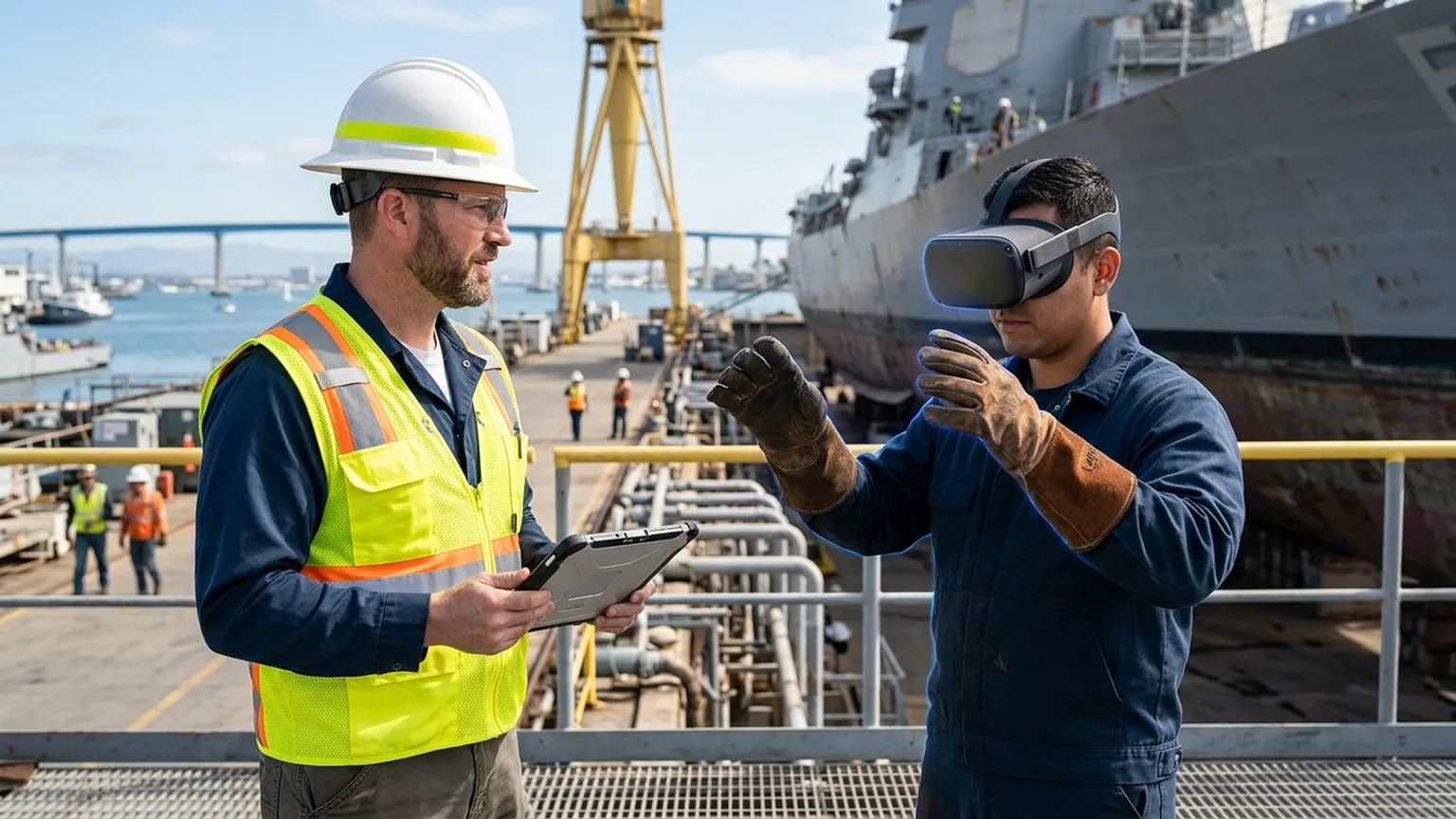
San Diego is one of the country's major Navy homeports, and the ship repair and shipbuilding industry around it is central to the local economy. That work is governed by OSHA's shipyard employment standards under 29 CFR Part 1915, a distinct framework from general industry. The hazards are severe and specific: confined and enclosed spaces aboard vessels where atmospheres can turn deadly, hot work and welding near flammable materials, falls and fall-into-water risks, and hazardous coatings and materials. Shipyard work requires competent-person oversight and specialized training that a general OSHA course does not cover.
The consequence is that a San Diego shipyard cannot simply send workers to a generic safety class. It needs training built around maritime standards and, ideally, around the specific vessels and procedures its crews work on. This is also where the case for realistic practice is strongest, because a confined space entry aboard a ship, or a hot work job in a tight compartment, is exactly the kind of high-consequence procedure where rehearsal saves lives and where a classroom cannot replicate the real conditions.
Biotech and life sciences: a laboratory safety world
San Diego's Torrey Pines corridor is one of the largest biotech and life-sciences clusters in the world, and lab safety is a discipline unto itself. It centers on the OSHA laboratory standard, 29 CFR 1910.1450, which requires a chemical hygiene plan and specific training, along with bloodborne pathogens under 29 CFR 1910.1030, hazardous drug handling, and biological safety practices. The hazards are chemical, biological, and procedural rather than mechanical, and the training has to reflect that.
For a biotech employer, the right partner understands lab and research safety, not warehouse forklift work. And because much of lab safety is about consistent, correct procedure under time and contamination pressure, it is another area where measured, repeatable practice adds value, giving new researchers and technicians a safe way to rehearse spill response, emergency procedures, and correct handling before it matters in a live lab.
Cal/OSHA: the California rules underneath it all
Whatever the sector, San Diego employers operate under Cal/OSHA and Title 8 of the California Code of Regulations. The most universal requirement is the Injury and Illness Prevention Program, the IIPP under Title 8 Section 3203, which California requires nearly all employers to maintain in writing with training as a core element. The Heat Illness Prevention standard under Section 3395 matters for outdoor shipyard, construction, and logistics work in the San Diego climate, and California adds its own requirements across many operations.
The practical implication is that San Diego employers cannot simply adopt a generic federal OSHA program and assume compliance. A provider who genuinely knows Cal/OSHA, and who can align training with California's stricter rules, is worth more than a national course that stops at the federal baseline. This is true across shipyards, labs, and factories alike.
Cross-border manufacturing and defense contractors
Two more parts of the San Diego economy shape its safety training needs. The first is cross-border manufacturing. The Otay Mesa corridor and the deep production ties to Tijuana mean a large advanced-manufacturing and warehousing base moves goods and, in many cases, workers across the border. That work brings general-industry hazards, machine and forklift safety, hazardous materials, and logistics, under Cal/OSHA, and it makes bilingual training not just useful but essential for the binational workforce.
The second is the defense contractor base that surrounds the Navy presence. Beyond the shipyards themselves, San Diego hosts a dense network of firms building and maintaining unmanned systems, electronics, and defense hardware, workforces that value standardized, documented, and repeatable readiness. That profile fits immersive practice well, because defense-adjacent manufacturing often involves high-consequence procedures that must be performed identically every time and proven to a customer or an auditor.
The common thread across shipyards, labs, cross-border plants, and defense contractors is that San Diego is not one safety market but several, each demanding specific training. The employers that handle it well are the ones that match the provider and the practice to the actual work, rather than buying a generic course and hoping it covers a compartment aboard a ship, a spill in a lab, and a machine on a production line all at once.
The stakes: why completion is not competency
Across San Diego's shipyards, labs, and factories, the same gap appears. Incidents are rarely caused by a lack of knowledge. They are caused by the gap between what a worker knows and what they do under pressure, in a confined compartment, a live lab, or on a busy floor. A worker can hold current maritime, Cal/OSHA, and lab-safety credentials and still make a serious error when a real situation unfolds. Classroom and online training transfer the rules, but they do not build the reflexes that keep a worker safe when an atmosphere reads dangerous or a spill spreads.
This is the gap every San Diego safety leader recognizes. The providers above do essential work issuing the credentials the region's specialized industries require. The point is that the credential is the floor, not the ceiling, and that for the highest-consequence procedures, realistic and repeatable practice is what turns a certified worker into a genuinely prepared one.
SPECIAL MENTION: IMMERSIVE TECHNOLOGY
The Prime VR, for VR safety training in San Diego
The companies above deliver the maritime, lab, and Cal/OSHA training every San Diego operation needs. The Prime VR represents the layer most of that training is missing: custom virtual reality programs where workers practice confined space entry aboard a vessel, hot work, lab spill and emergency response, and lockout/tagout in realistic simulations of your actual shipyard, lab, or facility, with performance measured step by step.
San Diego's specialized, high-consequence work is a natural fit for immersive practice, because the most dangerous procedures are also the hardest and riskiest to rehearse in the real environment. A shipyard worker can run a confined space entry dozens of times in VR with zero real-world risk, and a lab technician can practice a spill response before facing one for real, with every decision recorded so a safety manager can see who is genuinely ready. Because the program is built around your specific hazards and owned outright, there are no per-seat fees, and it can be reused for every new hire and every crew.
Learn more about VR safety and operations training, how it applies to confined space VR training, or manufacturing safety.
The bilingual reality of the San Diego workforce
A significant share of San Diego's construction, shipyard, and service workforce is Spanish-speaking, reinforced by the region's deep cross-border ties, and safety training delivered only in English carries a hidden risk. A worker can pass a written test in a second language and still miss a nuance that matters aboard a vessel or in a lab. That is why serious San Diego employers insist on bilingual delivery and documentation, both for comprehension and for defensibility if an incident is investigated. Any modern approach, including a custom immersive program, should be authorable in both languages so the experience and the assessment are equivalent for every worker on the crew.
The cost of getting it wrong
The financial exposure in California is significant, and Cal/OSHA penalties can be substantial for serious, willful, and repeat violations, with active enforcement in high-hazard sectors like shipyards and manufacturing. For a San Diego shipyard, biotech firm, or manufacturer, an inadequate program can generate multiple citations at once, and a serious shipyard or lab incident carries consequences far beyond OSHA. Those figures do not include the indirect costs of an incident: workers compensation, downtime, damaged assets, higher insurance, and reputational harm. Training is one of the least expensive forms of protection available, but only if it actually changes what a worker does under real conditions.
How to choose a San Diego safety training partner
Start with your world. If you are a shipyard, prioritize genuine maritime expertise and competent-person training under the 1915 standards. If you are a biotech firm, prioritize lab and biological safety depth. If you are a general-industry employer, prioritize Cal/OSHA knowledge and your IIPP and heat illness obligations. Across all of them, confirm bilingual delivery and on-site, cross-shift capability. And if your problem is that workers are certified but incidents still happen, that is the signal you need practice, not more paperwork.
Many San Diego employers end up with a blend: sector specialists for the required credentials and compliance, plus an immersive layer for the highest-consequence procedures and for compressing new-worker readiness. The credentials keep you compliant. The practice keeps your people safe and gives you an objective record to show during a Cal/OSHA inspection or a customer prequalification, which in San Diego's specialized and heavily regulated industries is a genuine advantage that customers and regulators increasingly expect.
What a VR pilot looks like for a San Diego operation
A custom immersive program starts with your hazards, not a headset. A typical build runs in four phases. Discovery maps the specific procedures you want workers to practice, drawing on your incident history, your vessels or labs or lines, and the people who run the work. Design turns those into interactive scenarios with defined success criteria. Build develops and tests the environment against your real operation, from a shipboard confined space entry to a lab spill response. Deploy handles hardware, learning management system integration, and train-the-trainer so your team runs it without an outside vendor.
For a San Diego operation, a sensible starting point is a single high-consequence procedure tied to your dominant hazard, delivered as a pilot before expanding. That keeps the investment contained while proving whether measured practice moves your leading indicators, from near-miss reports to new-worker readiness. Because the finished program is owned rather than licensed per seat, the economics improve every time you onboard another crew or cycle another worker through it.
Frequently Asked Questions
Who are the best safety training companies in San Diego?+
The leading providers serving San Diego include Illustra Pro, ROI Safety Services, OSHA Training Services, Unishield and SoCal First Aid, Grossmont-Cuyamaca Community College, HAZWOPER Center and the National Safety Council. Because San Diego blends shipyards, biotech, and defense under California's Cal/OSHA plan, several specialize in maritime, HAZWOPER, and Cal/OSHA-specific training. The right choice depends on whether your gap is shipyard, biotech, manufacturing, or general industry. For teams that must actually perform procedures under real conditions rather than only pass a course, immersive VR safety training from The Prime VR is an emerging complement.
How much does safety training cost in San Diego?+
Pricing in San Diego follows California and national ranges. OSHA 10 or 30 cards run roughly 80 to 250 dollars per seat, HAZWOPER courses run several hundred dollars per seat, and on-site group delivery is priced per class. Custom immersive VR safety training, built around your real San Diego shipyard, lab, or facility and owned rather than licensed per seat, typically runs from 25,000 to 500,000 dollars depending on scope.
How does Cal/OSHA affect San Diego employers?+
California runs its own state occupational safety plan, Cal/OSHA, enforced through Title 8 of the California Code of Regulations, and it is generally stricter than federal OSHA. San Diego employers must maintain a written Injury and Illness Prevention Program, the IIPP under Title 8 Section 3203, comply with the Heat Illness Prevention standard under Section 3395 for outdoor work, and follow California-specific rules across their operations. Training has to be built for California, which is why local Cal/OSHA knowledge matters.
What safety training does San Diego's shipyard industry require?+
Ship repair and shipbuilding in San Diego fall under OSHA maritime standards, specifically shipyard employment under 29 CFR Part 1915, which differ from general industry. The work involves confined and enclosed spaces aboard vessels, hot work and welding, fall and fall-into-water hazards, and hazardous materials, all requiring competent-person oversight and specific training. This is a distinct discipline, which is why providers who genuinely understand maritime standards matter for San Diego's Navy-adjacent ship repair sector.
What is VR safety training and how does it fit San Diego employers?+
Immersive VR safety training puts workers in realistic simulations where they practice real procedures such as confined space entry aboard a vessel, hot work, lab chemical response, and emergency evacuation, and the system measures how they perform step by step. It complements a Cal/OSHA or maritime course by turning knowledge into repeatable, measured practice, built around your actual San Diego operation and owned rather than licensed per seat.
How does biotech and life-sciences safety training differ?+
San Diego has one of the largest biotech clusters in the country, and lab safety is its own discipline. It centers on the OSHA laboratory standard, 29 CFR 1910.1450, along with bloodborne pathogens under 29 CFR 1910.1030, chemical hygiene, and hazardous drug and biological handling. A shipyard or forklift trainer is not the right partner for a research lab, which is why matching the provider and the practice scenarios to the actual work matters in a metro this diverse.
Do San Diego providers offer bilingual training?+
Yes. A share of the region's construction, shipyard, and service workforce is Spanish-speaking, and several providers deliver bilingual courses. Bilingual delivery matters for genuine comprehension of life-safety procedures and for defensible documentation if an incident is investigated. Any modern approach, including a custom VR program, should be authorable in both languages so the experience and the assessment are equivalent for every worker on the crew.
Can VR training prove competency for audits and prequalification?+
Yes. A custom VR program records each worker's decisions, response times, and completion, and can pass that data to your learning management system. For San Diego shipyards, biotech firms, and manufacturers preparing for a Cal/OSHA inspection or a customer prequalification, that objective per-worker record helps demonstrate that workers can actually perform a procedure safely, not just that they attended a class.
Want San Diego crews ready before it counts?
We build custom VR training around your real shipyard, lab, or facility. Tell us your setup and we will scope it.