
Aviation VR Training for Ground, Maintenance, and Safety Teams
Aviation runs on procedure and precision, and the cost of an error is high. VR training builds ground, maintenance, and safety competence without tying up aircraft or putting crews at risk.
QUICK ANSWER
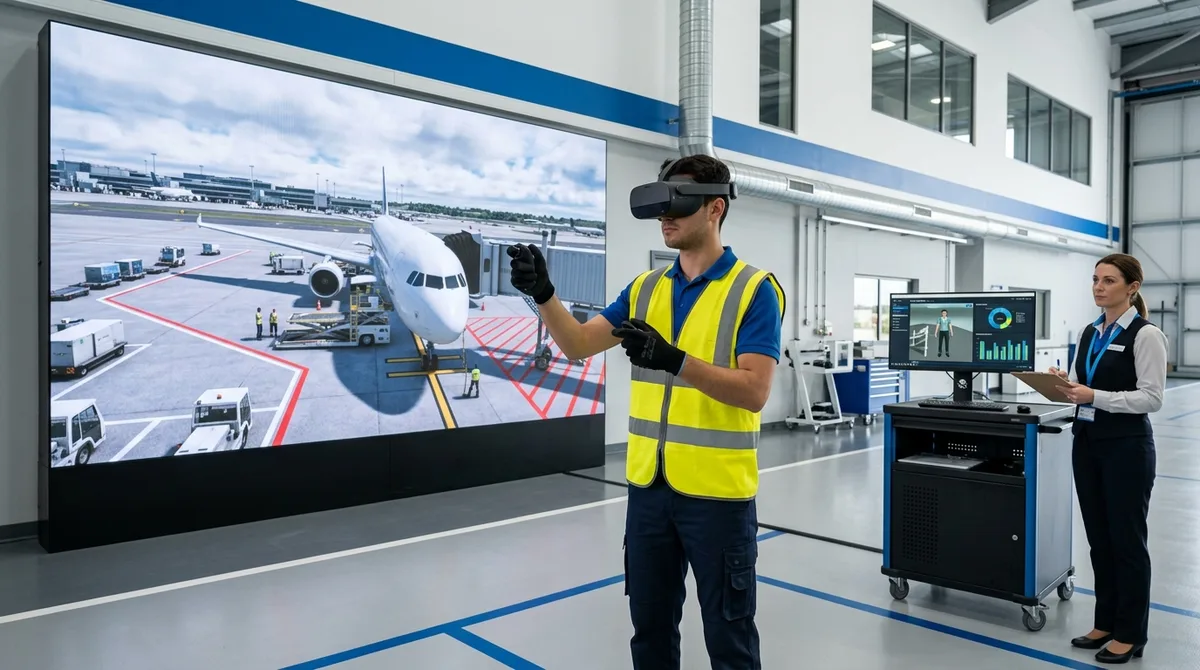
Aviation VR training uses immersive simulation to build skills for ground handling, aircraft maintenance, ramp safety, and emergency procedures. It lets teams practice on a virtual replica of aircraft and equipment without aircraft downtime, fuel cost, or ramp risk, and it allows rehearsal of rare emergency scenarios safely and repeatedly. It complements regulated flight and maintenance training rather than replacing certification.
Where VR Fits in Aviation Training
Aviation already uses high-fidelity flight simulators for pilots. VR extends that simulation logic to the many other roles where practice on real aircraft is expensive or disruptive: ground handling, maintenance, ramp operations, cabin safety, and emergency response. These roles are procedure-heavy, error-sensitive, and currently trained through a mix of classroom and limited hands-on time on aircraft that need to be flying.
No aircraft downtime
Every hour an aircraft sits for training is lost revenue. VR lets ground, maintenance, and safety crews practice on a virtual replica as often as needed, with no aircraft downtime and no ramp risk.
Aviation VR Training Applications
- Ground handling and ramp safety. Aircraft turnaround, marshalling, and the struck-by and jet-blast hazards of the ramp, practiced safely.
- Maintenance procedures. Inspection and maintenance tasks rehearsed on a virtual aircraft before working on the real one.
- Emergency and evacuation. Rare but critical scenarios, cabin evacuation, fire response, rehearsed repeatedly without staging a live drill.
- Safety and compliance. Procedure discipline and hazard recognition with documented per-worker competence.
Why Aviation Operations Adopt VR
The drivers are the same ones that make flight simulators standard: safety, cost, and repeatability. VR brings those advantages to the ground and maintenance workforce. Teams build competence on procedures before touching real aircraft, rare emergencies become rehearsable, and operations capture a documented record of who can do what. VR aviation training supplements, and does not replace, the regulated certification that governs the industry. It fits within broader safety and operations programs.
What We See in VR Training Projects
From simulation-based training in operationally demanding industries, the lessons translate to aviation:
- Procedure-heavy roles transfer best. The more a job is defined by a correct sequence, the better VR practice transfers.
- Rare emergencies are the strongest case. The scenarios you cannot afford to stage live are the ones simulation handles best.
- Documentation supports a regulated environment. Per-worker competence records strengthen the compliance posture aviation requires.
Frequently Asked Questions
What is aviation VR training? +
It is the use of immersive VR simulation to build skills for aviation roles like ground handling, maintenance, ramp safety, and emergency procedures, letting teams practice on a virtual replica of aircraft and equipment without aircraft downtime or ramp risk.
Does VR replace flight simulators or certification? +
No. High-fidelity flight simulators and regulated certification remain in place. VR extends simulation to the ground, maintenance, and safety workforce, and supplements regulated training rather than replacing it.
What aviation roles benefit from VR training? +
Ground handlers, ramp crews, maintenance technicians, cabin crew, and safety teams. These procedure-heavy, error-sensitive roles are currently hard to train on aircraft that need to be in service, which is exactly the gap VR fills.
How does aviation VR training improve safety? +
It lets crews rehearse high-consequence and rare scenarios, ramp hazards, emergencies, evacuations, safely and repeatedly, and it builds procedure discipline before workers are near real aircraft, with documented per-worker competence.
What is the cost benefit of aviation VR training? +
The largest benefit is eliminating aircraft downtime for training. Every hour an aircraft sits for hands-on training is lost revenue; VR lets crews practice on a virtual replica as often as needed without taking aircraft out of service.
Training aviation ground, maintenance, or safety teams?
Tell us the roles and procedures. We will show you how VR can build competence without aircraft downtime.